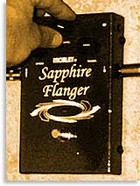
Morley’s Sapphire Flanger is a cute little box driven by wallwart or 9-volt battery. The box itself is a bit clunky and odd, but klunky and odd are “in” right now.
Our model did indeed deliver a “warm, fuzzy” kinda tone. The finish was a glittery blue, quite attractive. The speed setting was best left at slow settings, as rapid cycling made all listeners tipsy, and the depth varied the intensity from a suggestion of a Leslie effect to a lush, almost distorted sound. Very musical, very pleasing to the ear.
The classic flange tones were, well, classic, but perhaps overshadowed by the even sweeter sound yielded by the almost at-a-standstill Hammond organ effect. Not too pricey (highly discounted at your Morley dealer into the low $100-plus range), and well-made. And good things certainly come in bigger-than-Boss sized packages, yes?
This article originally appeared in VG‘s Dec. ’96 issue. All copyrights are by the author and Vintage Guitar magazine. Unauthorized replication or use is strictly prohibited.
Veteran guitarist Jon Butcher is changin’ with the times. Interviewed in Vintage Guitar‘s October ’95 issue, he was at the time recording, performing, and hoping for a sophomore effort from a band called Barefoot Servants, which he helped organize; the quartet recorded a self-titled album, and had toured as part of the Southern Spirit promotion. His solo career was quite active, as well; and when he went on the record with VG, he was anticipating the release of a solo album, Positively the Blues.
Since then, Butcher has released other albums, but his focus these days is on a burgeoning career as a producer and soundtrack composer. His recording efforts are currently done at his own Electric Factory Studios, where he incorporates classic guitar tones (many evoked from classic guitars) into his digital recording realm.
In follow-up dialogue, Butcher enthusiastically brought us up to date on his past efforts and the new facets of his career.
Vintage Guitar: Previously, you called your participation in the Barefoot Servants band one of the best moves you ever made, but I saw (bassist) Leland Sklar in the house band for the Zappa brothers’ cable TV show, and your current musical efforts seem to indicate there probably won’t be a Barefoot Servants II album. Jon Butcher: I recently spoke to Leland; he’s the kind of guy who’s always working, and you never know where he’ll pop up. He put that house band together, and if they get another season out it, then God bless all four of those musicians. I haven’t spoken to (guitarist) Ben Schultz in a while, but I know (drummer) Ray Brinker is playing in Pat Benatar’s band; I saw him at the last NAMM show. We’re at all four corners of the globe, so there’s a slim-to-none chance we’ll all be in the same place at the same time. But I’ve learned to never say never.
There was a review of a club performance of yours in a West Coast music periodical – it was a positive article and stated the occasion was an acoustic performance.
Those are sporadic at best. Doing things like that helps keep my songwriting skills as sharp as possible. I can’t think of a more immediate way to try out material I’m gonna record as solo stuff, or use on a soundtrack. I’m lucky I have the ability to do that, even if it’s on an infrequent basis, but it’s something I really enjoy. I’ve been playing the same old acoustic Yamaha flat-top and the same Guild guitar for years at things like that. I think one of the last gigs I did like that was at B.B. King’s (Universal City).
Are they solo performances?
Pretty much, but there’s also a singer I’ve been working with named Chris Pierce. His band, Best of Simple, just got signed and I’m producing them. He and I really sing well together, so a lot of the so-called “solo acoustic” performances will include him on percussion and a little guitar and harmonica. He’ll help me sing some of the new songs I’m trying, as well as some I wrote for their new album.
Another facet of a musical career that’s pretty much de riguer these days is a website, and you’ve got one of those, as well (www.jonbutcher.com).
Yeah. For somebody like me, who’s doing several different things – literally at once – there’s no other way to coalesce those things than having a central place for people to contact me, and for me to disseminate information. Let’s face it – there are very few companies that aren’t doing that. For composers and guys making a commercial effort in a studio, I can’t think of a better way to get the word out. The days of putting an ad in a local paper are pretty outta here (chuckles). A lot of younger musicians, as well, are so computer-set that it’s a medium that will not be ignored. I’ve had to revamp a lot of my knowledge and approach to making music due to computers, but I’m not complaining. The state of recording has changed so much in such a short time. Hard-disk recording is more prevalent than ever, and I’m gonna predict that there will be less and less analog machines in the future. If you’re gonna stay in the game, you’ve really got to be familiar with the tools.
Before we get into the details about your studio, let’s talk about some of the recent releases. First, there was Dreamers Would Ride, a greatest hit anthology.
(chuckles) Yeah, Capitol had a hand in that. Sometimes I look back on my career as a checkered past – I’m really proud of some of the stuff I’ve done, and some of the other stuff, less so. I can see now how important it is for young artists to keep their vision intact, and by that I mean if a band gets attention by playing in clubs or touring up and down the coast, or making demos, it’s good for producers and other people to stay out of the way at that point if there’s a response. A lot of times, when bands are novices, they believe a lot of the bull**** they hear from people who don’t know what they’re talking about. So they do their record, it doesn’t come out right, and it gets released and goes directly to the cutout bin. That story repeats itself over and over.
So how much input did you have with the selection of songs on Dreamers Would Ride?
You reached right to the nut (laughs)! I had some input. There were some songs I wanted to include, and some I didn’t want on there. Rather than say which are which – because I don’t want to alienate anybody in the company trying to sell it – I’ll just say that I think it would have been a better package with my choice of songs, but that’s just my opinion. There is a lot of stuff on there that fans of the bands I’ve been in will enjoy hearing, and there are some unreleased songs.
You’ve also had a live recording of a “King Biscuit” show released. What did you think about how that album turned out?
It was alright; it wasn’t the best show we’d ever done. When shows are being taped, and you know something’s going to be done with those tapes later, you’d be surprised at how much you can’t use, for any number of reasons. Unless you have the luxury of taping every show in a very high-end way, you take what you can get. But having said that, we had several shows to pick from, as I recall, and this one had the most usable versions of songs on it.
I presume your rig for that show would have included the “parts” Strat-type guitar noted in your first interview.
(pauses, then chuckles) Aw, man…I was just talking to another guitar player about the days when most guitarists had huge racks that were four feet tall – all kinds of processing, harmonizers, blah, blah (laughs). I’m sure my rig had a bunch of Roland processors and Rocktron stuff, but it’s gone the other way for me; I junked all of that years ago.
The biggest new facet of your career has been the recording studio and your soundtrack recordings. What kind of film work have you done so far? What about those Music for Film CDs you’ve recorded?
I did the original compositions for a film called Trash, by a hot young director named Mark Galluzzo, and I’m in the running for one called The Whole Nine Yards, starring Bruce Willis and Patricia Arquette. It’s extremely competitive; not unlike trying to get a record deal. There’s not a lot of musicians who have made the transition from being “rock guy” to composer for films people take seriously – the only example that springs to mind is Danny Elfman. His credits are extremely varied, from Batman on. He’s made that transition, and I think getting that kind of credibility is really difficult. That’s kind of where I am right now; you really have to work at your composing skills, and maybe less on chops, believe it or not.
The Music for Film CDs are actually “samplers” of my material that producers and directors would receive if I’m being considered for a soundtrack. Each CD can be “custom-made,” with different selections, depending on what kind of music might be needed.
The first one I heard had all kinds of styles and instruments, including a banjo and a clarinet, but the second had an overall “jazzbo” vibe; one could imagine hearing that kind of music in a smoke-filled club.
The second contains the sort of music needed for a film like The Whole Nine Yards, and some world-class musicians helped me out. There was Todd Sikafoose on upright bass, Dan Morris on drums – Dan’s been working with me on some of my solo material as well – and Jim Carney and Kevin McCourt on piano. All of these guys have heavy-duty careers and track records regarding recording and touring, and I’m lucky they like working with me. I’ve been coordinating this with Deluxe Entertainment’s Alan Kauffman, one of the film’s producers.
The whole idea of my production company is to not only play a lot of American music myself, but to also have the availability to put out a great session in terms of authenticity.
Details about how your work on Trash came about?
I’m not sure how the director managed to get in touch with me, but he really liked some of my dobro stuff – and I need to thank Ben Shultz for rekindling my interest in that instrument – but the relationship with Mark worked out great for everyone concerned, and I hope to do another film with him.
Have you acquired any additional instruments lately?
Not really; I’ve been using the same standbys since we talked last time. To me, the Fender Strat has transcended being a kind of guitar; the model means “guitar,” as far as I’m concerned. Even some of the jazzy stuff that sounds like a big, fatbodied guitar on the second sampler is a Stratocaster! Instead of using an amplifier, I recorded it with the neck pickup only, going direct into the microphone preamp, and I ran that into a compressor, then into the board. It’s pretty convincing, isn’t it (laughs)?
But I do have that old fatbody Guild I’ve used for other stuff. It gets the sort of resonance heard in old recordings when guitars like L-5s were used. There are some guitars that fall out of circulation, and I discovered that guitar a few years ago, and I’ve hardly been able to put it down. I know there are a lot of people who might have different opinions about those early Guild pickups, but my guitar sounds real warm. I think it’s a ’59.
Tell me about the basic layout of your studio.
Well, the details can be found on the website, but basically, it’s a 64-track, digital hard-disk recording facility. I use a lot of tube processing on the front end, between the mic and the recorder, to get warmth and that analog vibe. But what I like, and enjoy about digital recording, is that it’s dead-on easy to edit, and it’s dead-on easy to make your music available to other people fast, because it’s computer-based. Say there’s a young director who wants to check out something for a film. Rather than send it to him on a CD, I can put a piece of music on my website and let him download it. You can’t beat that.
Did you design and build your studio?
Yeah, with the help of a couple of other guys. And to be honest, we’re still growing, and are going to do more and more major projects.
We opened about a year ago, and are already getting more film-friendly.
You’ve already had other bands at your facility – The Best of Simple, for example, whose singer you cited earlier.
They’re the hottest band I’ve seen in a long time. I first became acquainted with Chris several years ago. Nalle Colt, from Sweden, is a remarkable guitar player; he has so much earthiness in his playing, it’s amazing he wasn’t born in this country. Mitch Turner is on bass, and Rick Wheeler is on drums. We’ve been recording for about a year, and we just got our first major offer. We’ve made a really nice record, and I think when everyone hears this band, they’ll think they’re something special, like I do.
I’ve also worked with a band called Medicine Man; they were what I’d call “hard alternative.” In fact, I’m hard-pressed to think of an analogy! A guy named C’Vey is the guitar player and primary writer. I’m now shopping their demo. I’m also working with an artist named Caroline Stratton; she’s from Massachusetts, my old stomping ground, and she and I have known each other for a long time. Caroline’s a tremendous jazz singer, and we’re doing her CD right now.
And that’s just a sample of the range of artists I’ve been working with at my studio, and I’ll have to say that the types of music I’ve been involved in has really evolved to include a lot of different stuff. And I think that’s the way it ought to be for any musicians who take their careers seriously. If you’re not growing and evolving, you’re dying on the vine. As a guitarist, there’s no way I could continue to look at my career like I did in the Jon Butcher Axis. A lot of bands have re-formed to give it “one last shot” or put one more album out. God bless them, but that’s not for me. I can’t see the benefit of re-forming one of my old lineups to play some gigs up in the Northeast, for instance. I don’t know if I’d be taken seriously. I think I’ve got a lot more to offer as a viable artist if I continue to look in a forward direction, not back.
Jon Butcher’s entry into the decidedly different world of film scoring and running his own studio represents a transition not every rock guitarist would be capable of making. However, Butcher’s always been a consummate professional regarding his craft, and he has not only the requisite musical experience to validate such a move, he also has the desire and maturity of a professional player seeking to take his life’s, work to a different, laudable level.
One of Butcher’s favorite instruments is this ’50s Guild electric archtop. Photo courtesy: Jon Butcher.
This article originally appeared in VG‘s April ’00 issue. All copyrights are by the author and Vintage Guitar magazine. Unauthorized replication or use is strictly prohibited.
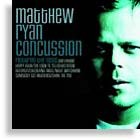
I’m a big fan of un-slick, direct acoustic music. Mathew Ryan’s Concussion is just that – country music in the mold of Steve Earle, not Garth Brooks. Ryan’s music has the grit of rural red dirt, not the glint of Nashville rhinestones.
Ryan is aided by Richard McLaurin on pedal steel, acoustic guitar, and percussion, Clay Steakley on bass, Craig Krampf on drums, David Henry on cello, Park Ellis on harmonica, and Ray Kennedy on Harmonium. Lucinda Williams, the queen of alt-country, adds duet vocals to “Devastation” while Mack Starks contributes to “Somebody Got Murdered.”
As you might surmise by the album and song titles mentioned, there’s not much in the way of demulcent ditties in the Cowsills vein here. Most of the subject matter is grimmer than a rusty hypodermic needle. “Somebody got Murdered” sounds like Tom Petty in a narcoleptic haze. Good, though.
Concussion has about as much chance of getting airplay on hot country and hip rock stations as Tiny Tim singing Mahler. But just because it ain’t mainstream doesn’t mean it’s worthless. Concussion has a honesty and forthright musicality that is appealing despite its bleak world view and demeanor. Give it a listen, but not right after your divorce comes through, okay?
This article originally appeared in VG‘s Nov. ’01 issue. All copyrights are by the author and Vintage Guitar magazine. Unauthorized replication or use is strictly prohibited.
“We didn’t quite get it,” explains company cofounder Jol Dantzig, discussing the birth of Hamer Guitars. “It was kind of a mistake. When we created Hamer, we created the high-end boutique guitar category, but we didn’t intend it that way. We were seeing vintage ’50s Les Pauls selling for $3,000. We thought we could make guitars just as good and sell them for a third of that price. The irony was that to everyone else, we were this upstart company selling guitars for twice the amount of the most expensive Gibsons at the time! So our perspective has always been a little skewed.”
High-end or budget, there’s no doubt Hamer Guitars have been successful and earned the allegiance of players and collectors alike.
The beginnings of Hamer Guitars (pronounced Hay’-mer, not hammer) go back to those heady days of the early ’70s, when Chicago was the breeding ground of soon-to-be-famous rock bands such as REO Speedwagon, Styx, and Cheap Trick. Circa 1970, Dantzig was playing bass in a club band called Heartbreaker. Through a friend, guitarist Gary Gant, Dantzig met another guitar player named Paul Hamer, and the two struck up a friendship. One thing led to another and in ’73 Dantzig and Hamer opened a music store called Northern Prairie Music in the northwestern suburb of Wilmette, Illinois. Among their activities was buying bashed up old guitars and banjos and restoring them for resale. They were, in fact, one of the early vintage guitar stores, before there was such a thing as the vintage scene we know today.
“Vintage guitars were called ‘used guitars’ in those days,” laughs Dantzig. “After all, a late-’50s Les Paul was just a little more than 10 years old.”
Dantzig and Hamer did well with their business.
“We would buy old Strats for $150, Jazzmasters for $80,” he adds. Soon they were selling vintage guitars to some of the biggest bands of the time, including Bad Company, Wishbone Ash, and many other big-name outfits. And these contacts would prove useful.
Curiously enough, even back then their best customers were not Americans.
“We used to literally sell crates of old guitars – maybe 75 instruments at a time – to Australia and Japan, where buyers would pay twice what Americans would pay,” recalls Dantzig, who quickly amassed a huge collection that included some of the earliest Broadcasters, P-Basses, Strats, and Les Paul Standards – a stash many would kill for today. These, too, would come in handy before long.
Once you have a music store that specializes in repairing and restoring old instruments, it’s not a big step to think about making your own, and in ’73 that notion put Hamer Guitars in motion. Dantzig and Hamer were well-matched in those early days.
“Paul was the salesman. He liked to shake hands,” Dantzig explains. “I was the hands-on guy who liked to make guitars and do marketing. I’ve always been a gearhead.”
Already deep into vintage lore, Dantzig and Hamer believed the golden age of guitars ended in ’63, and the last good guitars had been made. Fender instruments made after the CBS takeover in ’65 had gotten a bad rap from guitarists by the end of the ’60s, based in part on some quality control problems and the infamous three-bolt neck controversy (Fender engineers felt four bolts were overkill and they could save money without sacrificing stability; players didn’t see it that way).
Basically, Dantzig and Hamer considered most ’60s guitars a joke. Likewise contemporary Gibsons and Fenders. And they considered the copies emerging from Japan beneath their attention. Instead, they decided to create their dream guitars, new guitars worthy of the respect they gave to the vintage ones.
The first Hamer guitar made (in ’73) was a short-scale Flying V bass built for Dantzig. It had no serial number, and when it was done, Dantzig began to take it to gigs. Other musicians would ask what it was and would be incredulous when told he made it himself.
This first Hamer pretty much replicated a Gibson Flying V. It had a variety of pickups, though the bridge pickup was always a Gibson EB-3. The neck pickup changed, finally landing on a Höfner “staple” pickup. Dantzig still has that first bass.
When asked why Hamer was chosen as the brand name, Dantzig replies, “Well, we just thought Hamer sounded more like a guitar name than Dantzig. Besides, I thought guitarmaking was going to be a short run and I’d end up a famous musician or race car driver or something.” Then he quickly quips, “But Dantzig is still available.”
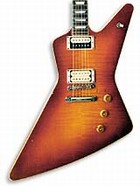
The second Hamer was an Explorer copy made for Paul in ’74. Dantzig isn’t sure, but he thinks they may have gotten the plans from another Chicago luthier named Jim Beach. Apparently, a number of people around town were beginning to make copies of Gibson designs. In any case, Dantzig and Hamer decided to build a hybrid of their favorite guitars. They copied the Explorer shape but added the flamed maple top and binding of a Les Paul Standard. The guitar was finished in a cherry sunburst lacquer. Pickups were original Gibson PAFs. Soon, this guitar would become known as the Standard. They gave this guitar the serial number 0000.
Part of the early Hamer philosophy was making guitars the way Gibson did when Ted McCarty was running the company. McCarty, by this time, was running Bigsby, in Kalamazoo, Michigan. In ’74, Dantzig packed his guitar and bass and visited McCarty, hoping to get some advice, and perhaps a blessing. To his dismay, McCarty couldn’t care less about guitars.
“He showed me a few of the new Bigsby products they were working on,” recalls Dantzig with some amusement. “But his real passion was for this new product he had, called the Flex Light. This was a little flashlight with a flexible lens you could turn in different directions and put in your pocket.”
McCarty was not impressed with the new Hamers and reminded Dantzig that the Explorer had been a failure when it was first introduced. Crushed, Dantzig returned to Chicago.
Nevertheless, Dantzig and Hamer continued to play with their new creations and got the attention of more and more curious musicians.
In ’75, the first order came in and “garage” production began. The first order was from Ted Turner (VG, June ’92), bassist for Wishbone Ash, who ordered an Explorer Bass with serial number #0001. Martin Barre of Jethro Tull (VG, October ’97) also ordered an early Hamer. So did their friend (and occasional jam partner) Rick Nielsen, of Cheap Trick (VG, January ’92, September ’97). “That’s how he ended up with #0000, which he still has,” recalls Dantzig. “We took so long to make his guitar that we just gave him Paul’s to satisfy him.”
In ’76, a meeting was called with everyone who worked at Northern Prairie Music – Dantzig, Hamer and two repair guys. It was held in Dantzig’s Volkswagen Minibus. They reasoned their shop was selling guitars to players who would put down $2,500 or $3,000 for a vintage Les Paul, but didn’t want to take them on the road for fear of breaking them or having them stolen. They felt they could make and sell a cheaper “modern vintage” guitar to these same people, and they wouldn’t be afraid to take them on the road. From these beginnings, Hamer USA Guitars was born, with all four as partners.
It was from this perspective that Dantzig and Hamer began to hawk their guitars. They’d take them to concerts passing through. It wasn’t long before word got around and other musicians began to order guitars and basses. Contemporary stars like Jan Akkermann and Rick Derringer (VG, August ’98) were clients.
Technically speaking, Dantzig’s ’73 Flying V bass was the first Hamer, the model never went into production. Paul Hamer’s bound flametop Explorer was given the name Standard and became the first of a long line that would be offered from ’74 until ’85 during its first run.
Keep in mind that while Hamer offered specific “catalog” models, the company was, especially in the early days, pretty much what we would now call a custom shop. In other words, while you may encounter mostly standard Standards as shown in brochures and ads, there are also many special features that occasionally show up. Indeed, as you read about special features that come online, these might appear on any instrument as a custom-order feature, so if you find an unusual Hamer, think twice before you conclude that it has been modified.
The Standard
Except for the bound flame top, the Standard was pretty close to a Gibson. It had a British Honduras mahogany body with a glued-in mahogany neck, the droopy banana or scimitar six-in-line headstock, an unbound fingerboard with dot inlays (243/4″ scale), fine-tune bridge, and stop tailpiece. By the time the Sunburst appeared in ’77, bound rosewood fingerboards with crown inlays were offered as an option, and these appointments begin appearing on some Standards. A few Standards are seen with the Sustain Block bridges used on Sunbursts (see below), so presumably they date from about this time. As mentioned, custom orders were accepted, so there were also a few Standards with bound ebony fingerboards and block inlays. Early Standards had Grover tuners, though these changed to Schallers in ’79 or ’80. In September of ’78 a Standard would set you back $1,199.95, list.
The earliest pickups on Hamer Standards were actual Gibson PAFs obtained from Gibson. However, PAFs were designed for jazz players in the ’50s. By the ’70s, guitar players were cranking up much larger amps in large arenas. In order to better balance the pickups in this environment, Hamer began to de-wind the neck pickup to decrease the output slightly. Very soon the supply of Gibson pickups was gone. Hamer gave its specifications to the young pickup maker Larry DiMarzio, who began making versions of his own DiMarzio PAFs to Hamer’s spec, with a de-wound neck pickup. This differed from the approach favored by most others at the time, which was to leave a PAF at the neck and add an even hotter DiMarzio Super Distortion to the bridge. Eventually, Hamer began to stamp its name into the baseplates of the pickups, and these would come to be known as Hamer Slammer pickups (they don’t rhyme!).
Early Hamers had black bobbins on the lead pickup and cream bobbins on the neck pickup. They quickly made a transition to zebra bobbins (one black, one cream) on the lead pickup. By around ’80, the Hamer Standard was also offered without the flamed maple top and in a variety of opaque colored finishes. A few 3/4-size Standards were also built from ’78 to ’82, identical except for their diminutive size.
While the Flying V-shaped bass didn’t go into production, there were a few guitar versions produced between ’77 and ’81. Except for the V-shaped bodies, these conform in all details to the original Standard including the Explorer-style headstock.
The Standard Bass
Hamer’s second model was the Standard Bass. Serial number 0001 went to Ted Turner in ’75. The Standard Bass was basically a bass version of the guitar with a bound flamed maple top over British Honduras mahogany body, a 34″ scale (found on most Hamer basses, unless otherwise noted), four-in-line scimitar headstock, rosewood fingerboard, dot inlays, a pair of twin-blade DiMarzio X2N bass pickups, often (by ’81) with an active preamp, and a Schaller Sustain Block bridge. The Standard Bass was offered until ’84.
Hamer guitars didn’t take off like a rocket. Dantzig and Hamer had to work hard, schlepping examples around the world and getting them into the hands of players. In an undated promotional piece that sports the Palatine address (making it before ’78), the Standard was being promoted as The Ultimate, a line that would be used for a few more years. Featured in the piece, wearing Hamer T-shirts or carrying Standards, were Nielsen, Ken Simmonds of Savoy Brown, Tommy Bolin, a very young Lita Ford, and Mick Ralphs. Several ads were reproduced, including one for Pastore Music of Union City, New Jersey, promoting Hamer and Travis Bean guitars, Risson and Orange amps, Anvil cases, and Tychobrahe effects pedals; a good snapshot of a real guitar shop of the times.
Hamer did get lots of good publicity, however. This was the source of the “mistake” mentioned earlier. Journalists from the guitar press flocked to cover Hamer, which had the cheek to offer a $1,200 guitar when a Gibson only set you back $600 or so. What they didn’t understand was that Hamer wasn’t competing with Gibson, it was competing with the growing vintage marketplace.
With limited orders coming in, existence was tough. How did they survive? That’s where Dantzig’s huge vintage collection came in handy. He had to sell it off piece by piece to keep the company afloat. By ’77, the other two original partners sold their shares, and the company was in the hands of Dantzig and Hamer.
Sunburst
Despite slow going, in ’77 Hamer introduced the second classic design of its early period – the Sunburst. Basically, it did with the Sunburst what it had done with the Explorer. The Sunburst was a double-cutaway Les Paul Junior copy, with a British Honduras mahogany body, glued-in mahogany neck, tapered three-and-three headstock, and a bound, flamed maple top with red-to-yellow sunburst finish. An unbound rosewood fingerboard with dots could be had for $699.95; $50 more got you a bound fingerboard with crown inlays. Pickups were the specially modified DiMarzio PAFs (de-wound zebra neck, cream bridge). Controls were one volume and two tone with a three-way select behind the bridge – unusual placement. For more tonal flexibility, in the middle position, the pickups were out-of-phase. Eschewing the fine-tune bridge and stop tailpiece of the Standard, Sunbursts featured a one-piece bridge/tailpiece assembly similar to that found on a stoptail Strat, with adjustable saddles and strings passing through the body. At first, this unit sat on a rosewood shim to give it the right height, but in ’78 these were replaced by the Sustain Block bridge, which featured a thicker chrome-plated milled brass base, giving them adequate height. The earliest Sunbursts had a noticeably longer headstock. Grover tuners were replaced by Schallers in ’80. The original run of Hamer Sunbursts lasted until ’83.
Adding Bass Strings… and More
In ’78, Tom Petersson, bassist with Cheap Trick, challenged Hamer to build him a 12-string bass, a request that was a harbinger. Petersson was playing a Hagstrom eight-string bass as the time. The result was the cleverly named 12-String Bass. This had a double-cutaway maple body basically the same as the Sunburst but without binding and with a glued-in mahogany neck, a large “split-V” headstock and a short 301/2″. There were six tuners on each side of the head, in two sizes, with smaller ones for the octave strings. The smaller octave strings were placed above the main string, as on a 12-string guitar. The main bass strings were tuned as on a normal bass guitar, with the two smaller strings tuned in unison at an octave above. For pick players, these could be reversed. Pickups were either one or two twin-blade DiMarzio X2N humbuckers. These were outfitted with a 12-saddle bridge and stop tailpiece.
By ’79, the 12-String Bass was offered with four “quadraphonic” outputs (plus one mono output – five in all) as the 12-String Quadbass. This version was in price lists at least through ’85, but was no longer listed in ’87.
Following delivery of the 12-String Bass, Hamer was challenged again in ’78 by an order for an 8-String Bass. This was essentially the same as the 12-String Bass except it had only one course of octave strings above the principal string and, of course, four fewer tuners. It otherwise shared the features and options available on the 12-String Bass.
Circa 1980, the 8-String Bass acquired a figured maple top and back, and by ’81 these featured an onboard active preamp with an LED indicator and three-way tone switch. At some point after ’84, the mahogany neck was changed to maple. Beginning in ’85, Alembic Activator pickups were offered as a $250 option. Also, by ’85, if not before, basses could be had in fretless versions for no extra charge. Similarly styled four-string basses were occasionally produced as custom orders. Recent versions of the 8-String Bass feature EMG pickups.
The 12-String Bass was offered until ’97. The 8-String Bass remains in the line to this day.
Dantzig recalls getting more and more requests for instruments they didn’t think they could make, but took the plunge and eventually built them. This included guitars like Nielsen’s five-necked monstrosity, which was built by ’82. Cheap Trick had also ordered at least one 10-string bass for Petersson (one octave string on the G and D, two octave strings on the A and E), and a custom 12-string guitar for Robin Zander.
Other “out there” models included various doublenecks, a Standard-shaped mandocello (mandocello scale with double strings tuned in fifths), a mandar (Standard-shaped with four pairs of strings tuned as a mandolin, but in a guitar scale), and at least one 20-string harp guitar (six-string neck with seven tunable sympathetic strings on either side). Another custom guitar was a seafoam green Teardrop made for Elliott Easton. It was shaped like a Vox Phantom with Hamer Phantom electronics(!), a triple-coil pickup, hand-delivered to Easton just before the Cars played on an episode of “Saturday Night Live.” Easton took the guitar from Dantzig and went onstage with it!
New Partner, New Digs
Still living off income from selling the collection, Hamer and Dantzig looked for help, and found it in ’78 in the person of Frank Untermeyer, a fellow getting a Master’s Degree in international business at the University of Wisconsin. Untermeyer was initially interested in joining the enterprise as its international sales manager, but he had some money and was convinced to become a partner. Dantzig controlled 60 percent of the stock, the rest was split between Hamer and Untermeyer.
With the influx of cash, the company relocated to Palatine, Illinois, to a larger space with some new equipment. It would stay at this site until early ’80, when it moved to a new 12,000-square-foot facility in Arlington Heights, where it remained until ’97. Most early Hamer catalogs do not have a copyright date, but you can get a clue by referring to the address.
The Special
With better facilities and the infusion of new enthusiasm, Hamer introduced its next model, a slightly downscale version of the Sunburst called the Special, in ’80. It differed from the Sunburst mainly in that it lacked binding. Most versions still came with a mahogany body capped in flamed maple, though opaque colors were an option. In ’81, finish options included sunburst, transparent cherry, natural, yellow, green, opaque red, blue, green, orange, and black. By ’81, a number of black-and-white graphic finishes were offered, primarily a series of stripes in various thicknesses. The glued-in neck featured a tapered three-and-three headstock and a 22-fret rosewood fingerboard with pearl dot inlays. The Special also carried the special-wound Hamer/DiMarzio PAF humbuckers. Controls were a three-way select, with two volume and one tone control. The bridge was the heavy-duty Sustain Block. At some point after ’83, vibratos were available, and in ’84 a few were made with Kahler flat-mount vibratos. This first version of the Special lasted until ’84.
In March of ’80 the Standard with dots listed at $1,199.95, Standard with crowns $1,299.95, the 8-String Bass was $1,499.95, 12-String Bass $1,700, 12-String Quadbass $2,000, Sunburst with dots $799.90, Sunburst with crowns $869.90, and the Special was $699.90. Hardshell cases for Standards and Basses were $129.90, $119.90 for the Sunbursts and Special.
As evidenced by Hamer’s artist list from around ’79 (see sidebar), the company was garnering a pretty high-visibility clientele and sales continued to climb.
The Prototype
Until this point, Hamer guitars were essentially derivative, inspired by Gibson designs. But in ’81, Hamer took its first tentative steps toward creating original designs and introduced the Prototype, not to be confused with the Les Paul-style guitar with that name offered by Aria Pro II at the time. In a way, the Prototype was a fusion of Gibson and Fender ideas. The mahogany body had slightly offset double cutaways, vaguely Strat-ish, though the waists remained equal. The neck remained typically Hamer and definitely Gibson-ish, with the tapered Hamer three-and-three head and heel at the body. The 243/4″ scale, 22-fret rosewood fingerboard was unbound with dots, joining the body at 21 for excellent access. The bridge was the Sustain Block with strings passing through the body. New was a laminated pickguard with Prototype engraved and carrying a three-coil bridge pickup very similar to Mighty Mite Motherbuckers of the time, though actually it was a single-coil pickup tucked next to a humbucker in the same ring. Controls were one volume and one midrange tone/contour control with a three-way toggle, again behind the bridge, which offered humbucking and single-coil sounds.
By ’83, a 12-string Prototype was offered, differing only in the larger headstock (tapered, not the V-head of the basses) and having a 12-saddle bridge and stop tail.
Joining the Prototype later in ’83 was the Prototype II, which added a slanted single-coil pickup in the neck position and a top-mounted Kahler double-locking vibrato system. In ’84, the Prototype listed for $799.90, the Prototype 12-string was $849.90, the Prototype II $999.90.
This initial Prototype series was offered through ’86.
The Phantom
By around ’82, Hamer had turned the corner on the road to success. In celebration, it got bolder and introduced three new guitars and three new basses, all more consonant with the “glam image” of the emerging heavy metal scene, though still not straying far from the Gibson model.
First was the Phantom A5 guitar. This was similar to the Prototype II except for a more dramatically extended upper-cutaway horn and a contoured body with offset waists. Otherwise, the mahogany neck and electronics were very similar, with the three-coil/single-coil combination. By ’84, Hamer pickups were called Slammers, still produced by DiMarzio. New were three-and-three Hamerlock tuners, which allowed the guitarist to lock down the strings at the tuner, similar to the Sperzel concept. The Phantom A5 was available with Sustain Block string-through bridge or a new Sustain Block Tremolo vibrato, which basically transformed the fixed bridge into a non-locking Fender-style vibrato. By ’84, the Phantom A5 was available with a Kahler top-mounted double-locking vibrato system. However, this first version did not survive through ’84.
In ’84, the Phantom A5 changed to a second version basically the same as the earlier one, except it featured a six-in-line headstock and Kahler Flat-Mount vibrato system was standard. Pickup control changed to a five-way select on the pickguard. In ’85, the neck was changed to maple.
This second version of the Phantom was now also offered as the Phantom A7 Synthesizer Controller. This was the same as the new ’84 Phantom A5, with the addition of a Roland hex MIDI pickup in front of the vibrato, with a three-way toggle (MIDI/regular/both) and two other parameter control knobs. Outputs included 1/4″ and synth DIN plugs.
A streamlined version, the Phantom GT, was also offered beginning in ’84. This was identical except for having a single Hamer Slammer humbucker at the bridge and one volume control, available in custom colors and graphic finishes.
The Phantom guitar series lasted through ’86.
The Vector
You’ll recall the very first Hamer was a Flying V-shaped bass made for Dantzig. This model did not go into production in the ’70s, but the shape, at least, found an incarnation in ’82 as the Vector, right in step with the tastes of those heavy metal times. The Vector was a Flying V copy with a glued-in neck, tapered Hamer three-and-three head, unbound 22-fret rosewood fingerboard, and dot inlays. The body was Honduras mahogany with an optional unbound flamed-maple top. Pickups were initially the same Hamer-spec DiMarzio PAFs, which by ’83 had become re-dubbed Hamer Slammers. Controls were two volumes and one common midrange tone, with the three-way again behind the bridge. Most Vectors have the Sustain Block fixed bridge with strings through the body, but some are found with the Sustain Block vibrato, or Kahler or Floyd Rose double-locking units. Finish options included sunburst, cherry, yellow transparent, blue transparent, green transparent, opaque red, and a black-and-white graphic. Later Vectors switched to a triangular-shaped headstock similar to the Gibson style. The Vector was offered until ’87.
Blitzkrieg
The third new style introduced in ’82 was the Blitz Guitar and Bass. The Blitz was a more basic take on the Explorer/Standard idea, again catering to the contemporary taste for guitars with less traditional styling. Basically, the Blitz guitar was an Explorer with a glued-in Hamer neck with the tapered three-and-three headstock. Unlike the Standard, it did not feature flamed maple tops, but came in opaque finishes. The unbound 22-fret rosewood fingerboard had a 243/4″ scale and dot inlays. The Blitz was outfitted with the two Hamer-spec DiMarzio humbuckers, now called Hamer Slammers. Initially, the Blitz came with either the Sustain Block fixed bridge or Sustain Block vibrato. Beginning in late ’83, many featured top-mounted Kahler vibratos.
The Blitz Bass was essentially the same, with P and J-type pickups and a Sustain Block bridge/tailpiece. The Blitz guitar lasted only two years until ’84, while the Blitz Bass lasted to ’90.
Cruising
One final design that debuted in ’82 was the CruiseBass, basically a bass version of the double-cutaway Phantom with a glued-in neck, Hamer tapered headstock, and P and J-style pickups. The CruiseBass was available in four and five-string versions. The earliest examples have a pickguard, but by around ’84 this was eliminated. Like the Blitz Bass, the CruiseBass was offered until ’90.
Search VintageGuitar.com for part two of the History of Hamer.
Hamer artists, ca. ’79
A undated list with a Palatine address, which places it between late ’78 and early ’80, lists artists who purchased Hamer instruments. It provides a fascinating glimpse of the guitarists who helped put Hamer on the map.
Aerosmith – Brad Whitford – Standards (2)
Bad Company – Mick Ralphs – Standard
Bad Company – Boz Burrell – Standard
Blues Brothers – John Belushi – Sunburst
Blues Brothers – Matt Murphy – Sunburst
Roy Buchanan – Roy Buchanan – Standards (2)
Cheap Trick – Rick Nielsen – Standards (7), Sunburst
Cheap Trick – Tom Petersson – 10 & 12-String Basses
Cheap Trick – Robin Zander – Custom 12-String Guitar
Dick & Alex – Alex Parche – Standards (2), Sunburst
Dire Straits – Mark Knopfler – Sunburst
Eagles – Joe Walsh – Sunburst
Focus – Jan Akkermann – Standard
Hall & Oates – Daryl Hall – Mandocello, Mandar
Jethro Tull – Ian Anderson – Standard, Sunburst
Jethro Tull – Martin Barre Standard, Sunbursts (2)
Kiss – Paul Stanley – Standards (3)
Krann – Helmudt Hattler – Standard Bass
Nick Lowe – Nick Lowe – 9-String Basses (2)
Molly Hatchet – Dave Hlubek – Standards (2)
Off Broadway – John Ivan – Sunbursts (4)
Paradise – Derek St. Holmes – Standard
Kenny Passarelli – Kenny Passarelli – Mandocello
Pezband – Tommy Gawenda – Sunburst
Pezband – Mike Gorman – 8-String Bass
The Police – Andy Summers – Standard, Sunbursts (3)
The Ramones – Johnny Ramone – Sunbursts (2)
Rockpile – Dave Edmunds – Sunburst
Rockpile – Billy Bremner – Sunburst
The Rolling Stones – Keith Richards – Standard
The Rolling Stones – Ron Wood – Standard
The Rumour – Brinsley Schwarz – Sunburst
The Runaways – Lita Ford – Standard
The Sex Pistols – Steve Jones – Sunburst
Shoes – Gary Klebe – Standard, Sunbursts (2)
Shoes – John Murphy – 8-String Basses (2)
Shoes – Jeff Murphy – Standard, Sunburst
Stink Band – Peter Aykroyd – Sunburst
Sweet – Andy Scott – Standard
Ted Nugent – Charles Huhn – Sunburst
Teenage Radiation – Steve Dahl – Sunburst
The Who – Pete Townshend – Sunburst
The Who – John Entwhistle – 12-String Quad Bass
Tony Williams Band – Tony Williams – Sunburst
Wishbone Ash – Martin Turner – Standard Bass
This article originally appeared in VG‘s June ’00 issue. All copyrights are by the author and Vintage Guitar magazine. Unauthorized replication or use is strictly prohibited.
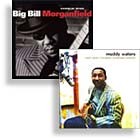
These two CDs mark two generations of bluesmen covering the roots and the future of the blues. McKinley Morganfield, better known by his grandmother’s nickname for him as Muddy Waters, is the father of Big Bill Morganfield, who has recently burst onto the blues scene with a debut album and this sophmore effort.
Muddy Waters and the 50 classic sides on this two-CD retrospective need no introduction. Presented in chronological order, these are Muddy’s famous first songs cut for the Aristocrat and Chess labels in Chicago in 1947 through ’52, complete with a handful of alternative takes. There’s nothing new here; this is just a solid collection of great vintage blues.
Big Bill Morganfield is all about Muddy Waters and the old blues, too. His sound is classic Windy City; heavy-duty bottom end, barbed-wire slide guitar, Little Walter harp, growling vocals, and crisp, short tunes. Big Bill’s blues are as comfortable as a pair of old slippers.
This article originally appeared in VG‘s April ’01 issue. All copyrights are by the author and Vintage Guitar magazine. Unauthorized replication or use is strictly prohibited.
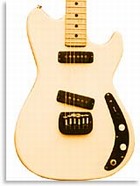
When is a Tele not a Tele? Well, when it’s a Leo Fender-made SC-2, among other things. This is a neat guitar my favorite repairman, Doug Lawrance, found here in Texas. This guitar is similar to an ASAT, but has a different body shape and feel. Best of all, these guitars don’t cost what an ASAT runs, new or used. That means it’s Gigmeister-worthy.
Leo Fender’s story is well-chronicled, but his G&L designs show a definite evolution, with some of the earlier ones less stylish than others.
Some of the early-’80s guitars, like the Interceptor, were simply ugly. Others, like the Cavalier, never caught on. Granted, after designing the Strat, the Precision Bass and the Jazz Bass, it could be argued that all of Leo’s cool shape ideas were on permanent loan to Fender. However, in 1983 Leo, along with George Fullerton, decided to create a new line of less-expensive instruments that were still completely professional.
Introduced at the winter NAMM show, the SC-2 was part of a series of guitars and basses. The guitars were available with one, two or three pickups in fixed-bridge or non-locking vibrato models. Two companion basses were similar in shape, with one or two pickups. According to the ads appearing that winter, the SC series are “…a new breed…G&L offers you tomorrow’s treasures at today’s affordable prices.”
The SC-2 has two G&L-designed single-coil pickups with adjustable polepieces. Sharp observers will notice it’s the exact same design as the ASAT, the coveted G&L remake of the venerable Telecaster. In fact, the bridge is also identical, with a black powder-coated finish designed to avoid rusting out. It’s a wonderful design that offers almost an inch of travel for all six saddles in addition to the Strat-influenced dual adjustment screws for height. Another clever arrangement is the oblong hole which the string ball ends thread through, just below the intonation adjustment screw for each saddle. Best of all, the entire affair is sturdy yet comfortable enough for easy palm muting. Unfortunately, Leo’s idea to paint on the serial number was a bad one. This guitar, serial number G014883, is hard to read, even with a magnifying glass.
Finishes on the SC series included red, white and blue. This particular piece began life as white and has yellowed nicely over the years to a sort of stock Fender blond – kinda like a ’60s Telecaster.
The remainder of the guitar shows similar attention to detail. The three-way switch, volume, tone knobs and input jack are all top-mounted on a black metal strip, also black powder-coated for durability. Oversized chrome strap buttons are felt-washered to avoid scratching the paint, and the tuning gears are slot-headed Schallers. The 22-fret neck has a 71/2 degree radius which feels typical of a standard Fender neck, albeit with bigger frets. By this time (1983), enough players had griped about small frets that G&L began installing somewhat larger wire. The neck joins the body just past the 16th fret with three bolts, and Leo’s pet feature, the neck tilt. This enables you to adjust the neck angle without shims, creating a more consistent action all across the fretboard. This also gave Leo the chance to move the truss rod adjustment to the headstock, a move he wanted to do after leaving Fender in 1965. The truss rod can be tightened or loosened without removing the neck or loosening the strings. The SC-2 also includes a common string tree for the three treble strings.
Now that we’ve covered the technical stuff, how does this axe sound? Very Tele-ish, to be sure. The front pickup sounds good, especially with the tone knob rolled back. It won’t be mistaken for a humbucker, but it sounds strong and clean. One big bonus is the individual polepiece adjustments – which lets you balance strings right on the guitar! The back pickup sounds wonderful, as bright and clean as any good Tele should. The middle position is great, with a terrific “clang” that cuts and sounds full-bodied at the same time.
In fact, I’m doing some recording now (8-track) with the SC-2, and it has forced its way onto most of the songs on my new project. I’ve tracked it through an amp with clean and dirty sounds with great results, as well as direct into a dbx 163 compressor into the board. An interesting discovery is that when doubling guitars, you need less bass on a track. I doubled the SC tracks with my Ibanez RG-570 in position four (middle and back pickups) and found myself subtracting bass in the mix. A thinner-sounding guitar like the SC-2 or a Tele panned one direction with a thicker guitar panned the other gets that dense sound heard on so many great recordings.
The SC-2 isn’t the sleekest guitar ever, and it seems clear G&L marketed it as an entry-level pro instrument (how’s that for a misnomer?). Nevertheless, there will be readers who can overlook the cosmetics and listen for themselves. I would also prefer some neater knobs – the stock ones look like they were bought at Radio Shack at 7:30 Saturday night, just before the gig. The body shape could have used some contouring – it’s not as comfortable to play and hold as a Strat. Also the body size on a full-scale neck looks a bit small.
These picayune quibbles in no way detract from the SC-2. It’s an excellent guitar for many types of music, including country, roots rock, blues, alternative and even pop. Those of you playing country, for example, who want a Tele sound without the Tele styling may find the SC-2 to be just the ticket. Happy hunting!
A tip of the Gigmeister hat to my buddy Doug Lawrance – e-mail him at elawco@vnet.ibm.com or phone him at (817) 496-TUBE, and he might sell this guitar to you.
The G&L SC-2. Photo: Angelica Wilson.
This article originally appeared in VG‘s Feb. ’97 issue. All copyrights are by the author and Vintage Guitar magazine. Unauthorized replication or use is strictly prohibited.
When is a Tele not a Tele? Well, when it’s a Leo Fender-made SC-2, among other things. This is a neat guitar my favorite repairman, Doug Lawrance, found here in Texas. This guitar is similar to an ASAT, but has a different body shape and feel. Best of all, these guitars don’t cost what an ASAT runs, new or used. That means it’s Gigmeister-worthy.
Leo Fender’s story is well-chronicled, but his G&L designs show a definite evolution, with some of the earlier ones less stylish than others.
Some of the early-’80s guitars, like the Interceptor, were simply ugly. Others, like the Cavalier, never caught on. Granted, after designing the Strat, the Precision Bass and the Jazz Bass, it could be argued that all of Leo’s cool shape ideas were on permanent loan to Fender. However, in 1983 Leo, along with George Fullerton, decided to create a new line of less-expensive instruments that were still completely professional.
Introduced at the winter NAMM show, the SC-2 was part of a series of guitars and basses. The guitars were available with one, two or three pickups in fixed-bridge or non-locking vibrato models. Two companion basses were similar in shape, with one or two pickups. According to the ads appearing that winter, the SC series are “…a new breed…G&L offers you tomorrow’s treasures at today’s affordable prices.”
The SC-2 has two G&L-designed single-coil pickups with adjustable polepieces. Sharp observers will notice it’s the exact same design as the ASAT, the coveted G&L remake of the venerable Telecaster. In fact, the bridge is also identical, with a black powder-coated finish designed to avoid rusting out. It’s a wonderful design that offers almost an inch of travel for all six saddles in addition to the Strat-influenced dual adjustment screws for height. Another clever arrangement is the oblong hole which the string ball ends thread through, just below the intonation adjustment screw for each saddle. Best of all, the entire affair is sturdy yet comfortable enough for easy palm muting. Unfortunately, Leo’s idea to paint on the serial number was a bad one. This guitar, serial number G014883, is hard to read, even with a magnifying glass.
Finishes on the SC series included red, white and blue. This particular piece began life as white and has yellowed nicely over the years to a sort of stock Fender blond – kinda like a ’60s Telecaster.
The remainder of the guitar shows similar attention to detail. The three-way switch, volume, tone knobs and input jack are all top-mounted on a black metal strip, also black powder-coated for durability. Oversized chrome strap buttons are felt-washered to avoid scratching the paint, and the tuning gears are slot-headed Schallers. The 22-fret neck has a 71/2 degree radius which feels typical of a standard Fender neck, albeit with bigger frets. By this time (1983), enough players had griped about small frets that G&L began installing somewhat larger wire. The neck joins the body just past the 16th fret with three bolts, and Leo’s pet feature, the neck tilt. This enables you to adjust the neck angle without shims, creating a more consistent action all across the fretboard. This also gave Leo the chance to move the truss rod adjustment to the headstock, a move he wanted to do after leaving Fender in 1965. The truss rod can be tightened or loosened without removing the neck or loosening the strings. The SC-2 also includes a common string tree for the three treble strings.
Now that we’ve covered the technical stuff, how does this axe sound? Very Tele-ish, to be sure. The front pickup sounds good, especially with the tone knob rolled back. It won’t be mistaken for a humbucker, but it sounds strong and clean. One big bonus is the individual polepiece adjustments – which lets you balance strings right on the guitar! The back pickup sounds wonderful, as bright and clean as any good Tele should. The middle position is great, with a terrific “clang” that cuts and sounds full-bodied at the same time.
In fact, I’m doing some recording now (8-track) with the SC-2, and it has forced its way onto most of the songs on my new project. I’ve tracked it through an amp with clean and dirty sounds with great results, as well as direct into a dbx 163 compressor into the board. An interesting discovery is that when doubling guitars, you need less bass on a track. I doubled the SC tracks with my Ibanez RG-570 in position four (middle and back pickups) and found myself subtracting bass in the mix. A thinner-sounding guitar like the SC-2 or a Tele panned one direction with a thicker guitar panned the other gets that dense sound heard on so many great recordings.
The SC-2 isn’t the sleekest guitar ever, and it seems clear G&L marketed it as an entry-level pro instrument (how’s that for a misnomer?). Nevertheless, there will be readers who can overlook the cosmetics and listen for themselves. I would also prefer some neater knobs – the stock ones look like they were bought at Radio Shack at 7:30 Saturday night, just before the gig. The body shape could have used some contouring – it’s not as comfortable to play and hold as a Strat. Also the body size on a full-scale neck looks a bit small.
These picayune quibbles in no way detract from the SC-2. It’s an excellent guitar for many types of music, including country, roots rock, blues, alternative and even pop. Those of you playing country, for example, who want a Tele sound without the Tele styling may find the SC-2 to be just the ticket. Happy hunting!
A tip of the Gigmeister hat to my buddy Doug Lawrance – e-mail him at elawco@vnet.ibm.com or phone him at (817) 496-TUBE, and he might sell this guitar to you.
The G&L SC-2. Photo: Angelica Wilson.
This article originally appeared in VG‘s Feb. ’97 issue. All copyrights are by the author and Vintage Guitar magazine. Unauthorized replication or use is strictly prohibited.
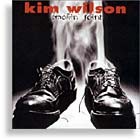
This CD, recorded over a two-year period, spotlights the world class work of the legendary T-Birds frontman, but of interest to the readers of this publication would be the four – count ’em, four – great guitarists lending support.
You kind of get the feeling that this level of musicianship is hiding around every corner in your local blues hood. That’s definitely the case in at least the Phoenix and Los Angeles areas.
Rusty Zinn should be familiar to the devotees of the current indigo renaissance. Well-established as a leader in his own right, his Al Casey/Bill Jennings-inspired lead work on this album is some of his strongest to date. Zinn’s articulation of the early-’50s styles rivals any player, new or established.
Space limitations preclude writing much about the other three but, suffice it to say, Wilson has no weak musical links. Messers Billy Flynn, with Zinn on the Phoenix set, and Kirk Fletcher, and Tray Gonyea on the California date cover the blues basses with style and aplomb. Whether the song is inspired by the work of a young Riley King or the late Luther Tucker, these guitarists are deeply versed in all the blues idioms, in these instances the majority of the influences would be post-war.
Wilson is doing what he should at this stage of his career. He has nothing left to prove and is as always at the top of his game, but is now surrounding himself with extraordinary young players who obviously inspire him. He is responding to their respectful challenges by giving them plenty of space to stretch, and that they do with stylistic respect to a leader who has been responsible for leaving the litter of many smoking joints along the blue highway. Contact M.C. Records at (631) 262-9274, mc@mc-records.com.
This article originally appeared in VG‘s Nov ’01 issue. All copyrights are by the author and Vintage Guitar magazine. Unauthorized replication or use is strictly prohibited.
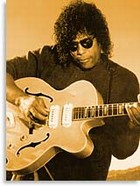
In our preliminary discussion with respected British guitarist Steve Howe prior to going “on the record,” the interviewer noted that the main focus of the questions he’d prepared were oriented at accomplishing the, …um, “concept” that’s the subtitle of this article, because guitar lovers and music fans around the globe are probably familiar with the musical stylings of the man whose amazing guitar technique made such memorable recordings with such bands as Yes and Asia.
So, in an interview somewhat along the lines of previous Vintage Guitar conversations with guitarists like B.B. King and Duane Eddy, we asked Steve Howe for information concerning his instruments and recordings that would be of the most interest to guitar lovers, which might not have been detailed earlier by the erudite and gifted Howe. When VG spoke with Howe, he was in the middle of a recording project utilizing guitars from the Scott Chinery Collection; the CD was slated for release in conjunction with the collection’s photo book. It was after midnight when our cassette recorder started work, and Howe was still in the studio (he’d already been there for over 12 hours).
The available information concerning Howe’s music and instruments includes the excellent photography book showcasing his amazing guitar collection; the photos were taken by Miki Slingsby, who also photographed Duane Eddy for a Vintage Guitar cover (an article showcasing Mr. Eddy’s historical instruments appears in the current issue of VG Classics; those guitars were also photographed by Mr. Slingsby). Our initial inquiry to Steve Howe concerned a comment he’d once made about modification of vintage guitars:
Vintage Guitar:You stated in the past that you didn’t have a problem modifying older instruments if it helped their sound. Do you still stand by that viewpoint? I’m asking this because of your current effort with the Chinery guitars. Steve Howe:I can give you a classic example that happened about a half hour ago. I was playing a 1934 Martin OM-45; it’s one of my favorite guitars from Scott’s collection. It’s in original condition, but the tuning pegs slip. That’s where I’m coming from; if a great vintage guitar is meant to be played and something about it doesn’t work, it could be frustrating. New machine heads would be vital to some guitars; after 40 or 50 years, some parts wear out.
I liken it to having an old car; would you want to drive one for years without changing the tires or the oil? I went a bit far with my Broadcaster; it’s my most modified collectible guitar, but it still works for me. And I’ve learned things; I don’t claim that everything I’ve done is right, and some guitars in my collection had already been modified when I got them. Practically all of the guitars in my collection have had their tuning pegs replaced; the replacements are much better than the “three-on-one” heads.
How much of your “pre-Yes” material is available on Compact Disc?
There’s a really good CD that I put out in England last year called Moth Balls; it’s available from a distributor called Feedback. There are 25 tracks from the ’60s on it, and a large amount has never been released until now. I was very happy with the consistency of these tracks; it’s a lot of fun. There are tracks from Bodast, Tomorrow, The In Crowd, and even the Syndicats; all seven tracks I recorded with them had never been available before. There are also two solo tracks that had never been released; I’d forgotten that I’d recorded one of the solo tracks called “You Never Can Stay In One Place;” I thought I remembered everything I’d ever recorded (laughs)!
Is it fair to say that the most complex recording you’ve ever done would have been Tales from Topographic Oceans with Yes?
Yeah, within Yes. I’m one of the few lucky people who has the 28-minute version of Side One, which was never released. Back then you had to think of a record in terms of about 20 minutes per side. It was a very good project, and was a bit like what I’m doing now and like I’ve done all the way through my career; I’ve looked into my collection and played lutes, Danelectros, Spanish guitars, Les Pauls, 175s, L-5s.
Topographic was a big deal, and I just played Side One live on stage recently with Yes; it’s a nice piece to play. In a way, we were getting complex with “Close to the Edge” and “Awaken” as well, and I think one track that “sums it up” for me is “To Be Over,” from Relayer. Not only does it have some writing that I did that I’m fond of, Jon also wrote around it and wrote for it. The complexity and arrangement is such that it’s multilayered; bells, guitars, drummers. To me, that’s a classic track that doesn’t get mentioned often. It doesn’t have the wonderful Rick Wakeman on it, but it certainly has a group that was tight.
What’s the story on your recent performance with Yes? That’s the first I’ve heard about it.
We did three shows in early March in San Luis Obispo, California; we recorded them and also did two studio tracks which total 30 minutes. There should be a double CD with live material and the new studio tracks out this summer; it’s called The Keys to Ascension.
Steve Howe with a Gretsch Custom. This guitar belonged to Chet Atkins c. 1960. It has added pieces at the end of the fingerboard, beneath the 5th and 6th strings, which was part of an octave divider effect.Who’s in the band?
Jon Anderson, Chris Squire, Rick Wakeman, Alan White, and myself.
Speaking of live performances, I’m aware that the “Asia in Asia” MTV concert was released on video, but why wasn’t it released as an album?
That’s a good question; I think it will be released sometime soon. Sometimes there was a very “dull” approach to managing groups in the ’70s and ’80s; it was kind of mundane. We did albums, we did tours; we were creating “bits of history” at times but nobody really thought of exposing such things through all of the formats that were available.
Another example is an album of mine due out soon on Caroline; it’s called Homebrew, and is a collection of my own studio tapes. There are five or six songs from the Anderson, Bruford, Wakeman, Howe period that should be quite surprising to listeners, and other tracks. I wanted to put this out to show how I write songs; “this is what I do at home.” It starts outs with six instrumentals that feature a lot of guitars; there are times when I’ll be playing two electric guitars in a duet, for example.
Your previous solo albums were released in ’75, ’79, ’91 and ’93. What were the similarities and differences in them, and was there one where you were more satisfied with the results?
Well, there was also the 1994 album, Not Necessarily Acoustic, which was a live album from my first solo tour of America. To be honest, I like all of the music I’ve recorded to different degrees, but the one that I still like a lot is Turbulence, because it was something that I “detailed;” I recorded the album then went back and “touched it up” by adding a bit here and there, and I did the same thing when I mixed it. It’s satisfying when you do things right; there have been some albums that I’ve done with bands like Asia and GTR that weren’t mixed in my style.
I’d waited a long time to do an album like Beginnings, and I kind of went mad and did a “variety” album (chuckles). The Steve Howe Album was a little more streamlined but still had the same breadth, and that’s why I enjoy Turbulence; it’s much more focused and is mainly about one style of music. The Grand Scheme of Things, the ’93 release, was a big project that didn’t get much exposure, but I think the instrumental work on it is enjoyable; it was kind of a synopsis of my work up to then. It had a lot of influences, and inspired me to release different kinds of albums after that.
There was the live solo tour album, and I did an album with Paul Sutin called Voyages on CNC Records; it features a lot of Danelectros and a Steinberger 12-string. It’s a bit more “New Age-y” and melodic.
New Age-wise, you were also on a benefit album called Polar Shift.
Paul Sutin was on that track, as well. I’ve also been working with Annie Haslam; she used to sing with Renaissance. We did a jazz gig in New York called Lilies in the Field; it was a benefit album to raise money for the children in Bosnia.
Steve in the studio lounge with a D’Aquisto Teardrop and a 40’s Selmer Jazz Model.Some years ago I interviewed Jeff Berlin, who was the bass player for an Anderson, Wakeman, Bruford & Howe broadcast concert; he said he was called in because Tony Levin couldn’t do the performance. Berlin said he had to learn the material very quickly; what’s your perspective on that episode?
Tony was the perfect bass player for us at that time, but he got a mild case of hepatitis. We didn’t know who to call; we may have even talked about calling Chris Squire, but that didn’t happen. I like Jeff, but in a way he didn’t have enough time to settle in and make as much of a contribution as he was capable of doing. He did a fine job and got all of his parts right.
Have you ever done any instructional videos?
I did one that I don’t care for too much, called “The Turbulent Plan;” I think it’s a bit “flaky” (chuckles). Some parts of it are fun, though, and I still do guitar clinics. I enjoy doing those, but sometimes I think I’m going to talk for a short time, then I go on for ages; it’s almost like someone is tempted to drag me off! I like being able to prepare thoughts on a certain angle of guitar playing, and being able to share those thoughts. Since I’m self-taught, I can’t really talk about learning how to play the guitar.
Any comment about how the 4-disc Yesyears anthology turned out?
Well, I think there were some mistakes made on it; I really pushed for the complete version of “America,” with the introduction and the guitar solo, but the version that was on the anthology was the one that had been released as a single to try to get some airplay.
One thing that I was happy about was the inclusion of “Montreaux’s Theme;” it’s the only existing copy of a very intricate piece of music that we wrote. I enjoyed that kind of playing; I think I played a Stratocaster on that piece. I didn’t play a Stratocaster much with Yes; I recall using one on “Parallels.”
Your book also noted your use of a Strat on the Drama album.
That’s right; I view the /I>Drama album as having been made by a special and unique band, almost like a “supergroup Yes,” since the Buggles were in with us. Having Geoff and Trevor was like injecting Yes with liquid mercury!
There was also a Yesyears video.
(chuckles) I could talk a lot more about the CD anthology. I think there’s a lot of “chat” on there that is unnecessary. I don’t think musicians look that good when they’re talking about themselves, particularly on television. Radio’s not a bad medium for talking, but sometimes even that gets overdone. What a musician plays is important.
How did the project with the Chinery guitars evolve?
I met Scott through some friends in New York; we did some guitar business, and then he asked about playing his collection on an album. I though it was a lovely idea, but I told him I had a bit of a problem with the repertoire. I don’t play tunes by other people all that much, but I know a few songs. So after some exchange of ideas, it was decided that I’d produce the album and make some appearances on it, and I approached Martin Taylor about being on the album as well; I’d produced his 1992 album Artistry. He’s an exceptional jazz guitarist, and it’s a good team. We’ve gotten 17 tracks done as of today. We do some duets, and there are a couple of tracks where I’m on my own, but the bulk of it features Martin. This is a showcase for Martin, and for Scott’s guitars as well.
The record is almost wrapped up, but we haven’t recorded the track with the “blue guitars” that Scott commissioned; we’ll do that when all of those guitars are ready.
Any plans to tour with Taylor to promote the album?
This has been fun; it could be interesting to see what develops. Obviously, Martin and I don’t need the Scott Chinery collection to play duets, but this collection has presented an opportunity for us to play together, and there are some amazing instruments that we’ve been able to use. The Chinery collection is quite astounding; it’s quite broad, and we had a lot of guitars to choose from when we recorded.
As for any other possibilities in the future, what about plans for Yes? The news that you recorded in San Luis Obispo was a complete surprise to me, and it will probably surprise a lot of our readership as well.
I think we’ll record again, although when and where and who will be involved isn’t settled. There were some rumors that Rick wouldn’t be able to go any further, but I think he was quite excited about doing the shows and the recording, so maybe there’s a future in it for everybody who was together in early March.
Steve Howe’s recording projects are as eclectic as his playing style, and he’s passionately dedicated to doing his professional best with whatever instrument he’s playing in whatever genre, yet Howe’s playing simply can’t be pigeonholed. That’s always been the case for the veteran guitarist, and considering his future prospects and projects, the breadth of Steve Howe’s stringed instrument abilities will also mean that it’s highly unlikely his playing will ever be pigeonholed. And thank goodness for that.
Steve Howe with a Gretsch Custom. This guitar belonged to Chet Atkins c.1960. It has added pieces at the end of the fingerboard, beneath the 5th and 6th strings, which was part of an octave divider effect. This article originally appeared in VG‘s Sep. ’96 issue. All copyrights are by the author and Vintage Guitar magazine. Unauthorized replication or use is strictly prohibited.
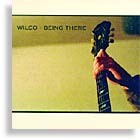
I really didn’t think this kind of band and album existed anymore. Or at least, they sure seem few and far apart. Jeff Tweedy and his cohorts make very catchy pop/rock mixed with country. It brings to mind people like John Lennon, the Replacements, the Kinks, and some really good country/rock bands. If you don’t believe me, just listen to wonderful cuts like “Far, Far Away.” Or the rockin’ “Outasite (outta mind).” There’s even a good-old-fashioned raucous rave-up called “I Got You (at the end of the century).”
Every cut is catchy in its own way. The vocals are excellent, easily conveying the feel of each song. The band does what it has to with everyone chipping in on various instruments. If I controlled radio, there’s at least four “hits” on here. But in today’s radio, it appears they just don’t fit in the Top 40. It’s a shame. We grew up thinking well-rounded groups with good songwriters were the norm. Now, that seems to have changed.
This is a double-CD, with both discs being short. But, it’s priced like a single CD. And it’s well worth the price. If you care about rock and roll played with feel and conviction, this is the kind of record to seek out. An ambitious piece that hits its mark.
This article originally appeared in VG‘s April ’97 issue. All copyrights are by the author and Vintage Guitar magazine. Unauthorized replication or use is strictly prohibited.

 In our preliminary discussion with respected British guitarist Steve Howe prior to going “on the record,” the interviewer noted that the main focus of the questions he’d prepared were oriented at accomplishing the, …um, “concept” that’s the subtitle of this article, because guitar lovers and music fans around the globe are probably familiar with the musical stylings of the man whose amazing guitar technique made such memorable recordings with such bands as Yes and Asia.