Month: October 2001

  • Robert Gordon with Danny Gatton – Live:The Humbler

    Live:The Humbler

    This terrific album comes from a cassette of a live show of Gordon’s in the early ’80s. The rockabilly/roots rock singer had just hired Gatton several shows earlier, and man does he cook. The tape apparently circulated for some time as a bootleg and picked up the title The Humbler because any guitarist listening would indeed be humbled.

    From cut one, “Ubangi Stomp,” all the way to an extra cut called “Finger On Fire,” it’s ridiculous how well Gatton plays. If you play in a band that does tunes from the ’50s and straight rockabilly, and you need to liven up your playing, just steal the solos and fills from this one.

    There’s plain, old-fashioned rock licks and monster runs. “Black Slacks” has a killer rockabilly solo that melts into a jazz run, and finally ends with the solo from “Rock Around the Clock.” “Cruisin’” has some very cool open-string hammer-ons and pull-offs, followed by a very cool chord solo. “There Stands the Glass” shows ya all you’ll ever need to know about pedal-steel bends, volume swells, and the use of delay. You get the idea. Get this CD.

    Although the quality isn’t always the best, it’s yet another example of why the late guitarist was one of the best, if most unheralded, players of the ’80s and early ’90s. Oh yeah, Gordon sounds good, too, as does the rest of the band, including the wonderful Tony Garnier on bass.


    This review originally appeared in VG‘s May ’97 issue.

  • Paul Revere & The Raiders – Mojo Workout!

    Mojo Workout!

    If it’s a given that rock revisionists (er, historians) haven’t given Paul Revere & The Raiders the respect they deserve, then where does that leave Drake Levin?

    “Drake who?” you ask?

    My point exactly.

    Well, this double-CD stomp (and shout and work it on out!) should be Exhibit A for inducting the quintet into the Rock and Roll Hall of Fame. And while Drake Levin will never gain membership into the annals of Guitar Heroism, he should be recognized for providing the driving rhythm and stiletto leads for this kick-ass-and-take-names troop.

    The Raiders have been all but written off as some sort of novelty act, despite ruling the roost in one of the hottest of rock hotbeds of the early ’60s – the Pacific Northwest – and having a string of 20 charted singles in 10 years (including “Steppin’ Out,” “Just Like Me,” “Kicks,” “Hungry” and “Good Thing”) that were anything but fluff. Maybe critics are blinded by the comical name or the Revolutionary War outfits, but you know what? In the pre-psychedelic days (come to think of it, during the psychedelic days, too), funny names and matching uniforms were the norm (in my stomping grounds, Northern California, two of the biggest local acts were Peter Wheat & The Breadmen, and William Penn & His Pals).

    Revere & Co. represented the 90-percent-perspiration days, when showmanship was paramount. You couldn’t just play well, but in order to pull off all the gags and dance steps, you had to play well. And the Raiders combined an almost tent-revival fervor with stop-on-a-dime precision, always with a sense of humor and an about-to-spin-loose edge.

    Mojo Workout! documents the period when the band became the first rock group signed to Columbia Records, before they developed a more polished sound and a string of originals, when they were still a holdover of pre-British Invasion influences like instrumentals, R&B, New Orleans party music (think about it – it was Paul Revere who rounded up the minutemen, warning, “The British are coming!”).

    Disc two collects early singles (including their pre-Kingsmen – and superior – version of “Louie, Louie”), outtakes, and a rehearsal for a September ’64 in-house live set recorded by Columbia. Some cool stuff, but Disc one – that live recording in its entirety – is the real deal. The repertoire is standard bar-band stuff (Mark Lindsay wailing “What’d I Say,” and maybe the rockin’est version of “Peter Gunn” ever), but it’s played with a battle-of-the-bands vengeance that’ll make you sweat.

    And when you listen to Drake Levin’s syncopated, treble-a-plenty solo on the live version of “Louie,” consider that he was probably standing atop the piano, swinging his guitar neck in time with the bass player all the while.


    This review originally appeared in VG‘s April ’01 issue.

  • Martin Taylor

    All That Jazz From the British Isles

    Scottish jazz guitarist Martin Taylor is a well-respected player in his own right, so much so that he’s collaborated with the likes of Stephane Grappelli, Chet Atkins, and David Grisman, as well as Steve Howe in the Scott Chinery Collection recording project. His perspective differs from a stereotypical guitarist from the British Isles, as does his playing.

    In a recent conversation with Vintage Guitar, Taylor detailed his love of jazz and the reasons he chose to play it. The interviewer had noted that Taylor was from Scotland, and opted to base his first inquiry on that country, only to be set straight by Taylor at the outset:

    Vintage Guitar: Did growing up in Scotland mean that your musical inspirations would have been different from someone growing up in England or Ireland?

    Martin Taylor: Well, actually I grew up in a small town about 30 miles out of London, but I’ve lived a greater part of my life in Scotland. My mother is English, and comes from a musical family; her grandfather was a violinist and her uncle a professional cellist. My father’s family was also musical; they were traveling folk from Ireland and Scotland and, like all the nomadic people of Europe, had a very strong musical tradition. My paternal grandmother and great-grandmother were very good singers, and my father, Buck Taylor, was quite a well-known jazz bass player in Britain.

    I was brought up listening to jazz, primarily the Gypsy guitarist Django Reinhardt, and also American jazz musicians like Art Tatum, Louis Armstrong, Fats Waller and Ben Webster. So I was obviously greatly influenced by the music my parents listened to, rather than the surroundings that I grew up in. The music of my childhood and youth was the Rolling Stones, the Beatles, and Jimi Hendrix; I enjoyed that music also, and had the great privilege of seeing Hendrix play in London when I was about 13. But the music that really moved me, and that had a musical language that I understood best, was jazz.

    What about your earliest instruments and experiences?

    My father gave me a ukulele when I was about three or four, and he showed me a few chords. He also played guitar, and I would strum away on his brand new 1959 Hofner President. My family was quite poor, but my dad wanted to encourage me to play, so he bought me a Russian classical guitar from a friend at a fairground. It was practically impossible to play; terrible action, but I fell in love with it and played it until my fingers started to bleed. If there was anything that should have put me off from playing, it was that awful guitar, but I loved playing from that moment on.

    A few years later I got a German guitar called a Framus, then when I started to do gigs at around 12, I bought myself a Guild Starfire. I was playing in my dad’s band by that time, at weddings and village dances; music for dancing. It was a great experience and I look back at those days with a great deal of fondness.

    By the time I was 15, I had decided that I wanted to pursue a career in music, and at that time it was possible to leave school at 15, so I took up an offer to go on the road with a band playing around England during the summer. Then, in the winter, we took up residency on the Q.E. 2, and sailed to New York. I’d always dreamed of going to America, and it was a very exciting time sailing into New York at sunrise; I had never seen anything like it. One of the first things I did was to head down to 48th Street and buy a guitar. I bought a 1964 Gibson ES-175, the same year model as Steve’s [Howe], although it wasn’t as good as Steve’s. His guitar is amazing.

    I played on the cruise ships out of New York for a couple of years; we played a lot of jazz in the group, and on one jazz cruise I got to play with the Count Basie Orchestra. I got to hear a lot of great jazz musicians at places like the Village Vanguard, and in my mind there was no question that I should play anything but jazz.

    Once there was “no question” that you’d be a jazz player, what other instruments did you acquire?

    After the ES-175, I bought a 1971 Gibson Johnny Smith, which I used for a long time, until British guitarist Ike Isaacs gave me a 1964 W.G. Barker for my 21st birthday. I used the Barker for many years; all of the tours and recordings I made with Stephane Grappelli were on the Barker.

    Earliest recordings?

    My first album, Taylor Made, was recorded in London in 1978 for Wave Records. In 1981, I recorded Skyeboat for Concord Records out in San Francisco, and I did many records with Grappelli on various labels. I played on several of Stephane’s collaborations with Yehudi Menuhin, and Stephane and I made a duo album in the early ’80s for EMI, called We’ve Got The World On A String.

    I also recorded several albums in the early ’80s with clarinetist Buddy de Franco, and I had some success in the U.S. with an album called Sarabanda, which had John Patitucci on bass, Paulinho da Costa on percussion, and was produced by David Hungate, from Toto. I didn’t really enjoy recording in those early days; it’s only in recent years that I have felt at ease in the studio. I like recording now, and am reasonably happy with my newer recordings.

    How and why did you first come to the U.S. to record and further your career here?

    My first trip to the States was in 1972, but I didn’t spend much time; it wasn’t until 1979 when I made my first tour with Stephane Grappelli that I got to stay here for an extended visit. I did about 11 or 12 tours with Stephane, I played a couple on my own, and I also came over on three occasions to play duos with the late Emily Remler. She and I played well together; I loved her playing and it was a great tragedy that her life was cut short.

    It was very important for me to come to the U.S.; it’s the home of jazz and blues, and most of the musicians that have inspired me over the years were American. My career back home began to take off in the late ’80s, so my trips to the States became fewer. I was doing a lot of solo concert tours around Europe, the Far East and Australia, so all my time and energy was taken up with that. At home I play theatres; in concert settings it’s to quite large audiences, so it has been very important for me to pursue that area of my career, as I was getting a larger following and selling a lot of albums in the U.K. Recording Tone Poems II with David Grisman and collaborating with Steve on the Scott Chinery project has really whetted my appetite to play in the States again; I plan to make regular visits again.

    You’ve also been associated with Chet Atkins; I saw you on a Nashville Network program with Mr. Atkins and Vince Gill, among others.

    I was playing at a guitar festival in Israel a few years ago, and met Marcel Dadi, the French guitarist. He invited me to play at the Chet Atkins Appreciation Society’s guitar festival at Issoudun, in France. I met a lot of great guitarists at Issoudun; Thom Bresch, Brad Jones, and the president of the Society in the U.S., Mark Pritcher, who invited me over to the Nashville Convention. I had already met Chet many years before in the States, and in fact we recorded a track together at Chet’s studio in 1987; the tune was “Here, There and Everywhere.” I put it on my latest solo album, Portraits, along with two new duets that Chet and I recorded last year in Nashville.

    I’ve been a Chet fan since I was a kid; it’s funny, because on that TV show, Chet and I were both interviewed, and there was one moment where I suddenly felt overwhelmed by being on TV with the great man himself. I’ve seen a video of it since, and you can’t see it but for a moment; I just couldn’t believe I was on American TV with Chet. He’s such a hero of mine!

    On that show you were playing a large, blond archtop. What was the make and model?

    The guitar I used was the prototype of a guitar I designed, along with Martyn Booth, for Yamaha. It’s called the AEX1500; in the U.K. it’s known as the Yamaha Martin Taylor. It’s now available in the States and I am very proud of it; it came out well.

    I’ve been a Yamaha endorsee for six or seven years. I have two AEX1500 production models; one blond, one sunburst. I also have two prototypes, the blond one you saw on TV and a black model. I have another Yamaha archtop guitar called an AES1200, an APX10 steel-string flat-top, a nylon string APX10, and an APX8C, which I use with my band, Spirit of Django. Yamaha has been very good to me!

    What other guitars are in your current “arsenal”?

    Besides my Yamahas, I still have my father’s 1959 Hofner President; although I don’t play it, I could never part with it. I have the 1964 W.G. Barker from my Stephane Grappelli days, a Benedetto Cremona Bob made for me in 1988, and my newest addition to the “family” is a 1929 Martin 000-45, which Scott Chinery gifted to me from the Chinery Collection; a very generous gift, which I treasure.

    My Gibson 175, the Johnny Smith, and a couple of other guitars were all sold at different moments of poverty! I regret parting with them, but I had a family to feed at the time. I was given a Selmer Maccaferri “D-hole” guitar once at a Stephane Grappelli concert; the owner told me he liked my playing so much he wanted me to have it. I played it for several years, then when I met up with its owner again I talked him into taking up the guitar again and gave it back to him.

    I find it difficult to think of guitars in monetary terms; I could sell a couple of my guitars and buy myself another house or another Mercedes, I guess, but money can’t replace the pleasure I get from these instruments.

    Which instruments do you take on the road?

    I only travel with my Yamahas. If something happened to my Barker I wouldn’t be able to replace it. The Yamahas are practical; they’re easy to play and they sound consistently good no matter where I’m playing. I know that sounds like an ad, but it’s true; that’s why I play them.

    How did the Tone Poems II collaboration with Grisman transpire?

    David Grisman and I first met in 1979 in California; Stephane had told me about David. Stephane just loved David’s playing, and a Grisman gig was always the highlight of a U.S. tour for us. David and I became friends and always kept in touch; I played on some of his albums like Dawg Jazz/Dawg Grass and Acoustic Christmas.

    David heard my solo album Artistry, which Steve produced, and wanted me to make a solo album for his Acoustic Disc label, but I was signed with Linn Records and I have a good relationship with them, so I didn’t want to rock the boat. I suggested that I record an archtop version of Tone Poems I; since it was to be so different from my recordings for Linn, they agreed to release me to make it.

    When we talked about material, it was very easy to come up with the tunes, particularly for guitars and mandolins from the ’20s, ’30s, and ’40s, as that was the Golden Age for American songwriting. I like to play a lot of that older material, which is probably why David thought it a good idea that I record the archtops. I loved Tone Poems I; I’m a big fan of Tony Rice.

    How far back does your acquaintance with Steve Howe go, and how did the Chinery Collection effort come about?

    Steve and I first met around 1988, in London. Yamaha invited us both to look at a prototype MIDI guitar they were developing, because we had both had experience using guitar synths, and they wanted our opinion. Steve came along to a gig I was playing that night, and we just became friends and kept in touch in the same way that my friendship with “Dawg” developed over the years, through a mutual obsession with music. When Linn Records asked me to make a solo album, which ended up being titled Artistry, I asked Steve to produce it.

    I was doing a lot of solo concerts at that time, and Steve was very interested in my thoughts and experiences on solo playing, as he was contemplating going out on the road solo himself. We exchanged a lot of ideas; I’m proud that I managed to convince Steve to “take the plunge,” and he now does a lot of solo gigs.

    Last year Steve introduced me to Scott Chinery. Scott had already approached Steve about recording the Chinery Collection, and apparently Steve suggested that I was the man for the job. I flew up from Nashville to meet Scott and Steve in New Jersey to discuss the recording project. Scott’s collection is staggering! When I walked into the guitar room, I couldn’t speak for about 30 minutes! I’ve never seen anything like it. D’Angelicos, D’Aquistos, Gibsons, Martins, Benedettos, you name it; the finest guitars in the world. Scott got me to play the D’Angelico Teardrop, and then, from what I remember, asked me about recording the guitars. I must admit I was in a bit of a daze being surrounded by those guitars!

    Howe said, in his interview, that he wanted you in on this project because you were more into “standards,” whereas Howe has his “own” repertoire. Comment?

    I guess that’s correct, in that I come from a jazz tradition which draws from the standard repertoire, so I am very much at home in that environment. But as it turned out, I wrote a few tunes for the project, and Steve and I wrote a couple of tunes together. Steve even got me to play a tune where I showcased all of my country licks…all three of them! He really stretched me out on that one!

    I’ve written a fair amount of music for TV over the past few years, and I enjoy being given a brief to write to. In this case, the “brief” was the guitar collection, writing music that suits each instrument. I found that to be interesting and challenging.

    How did the Chinery recording differ from Tone Poems II?

    With Tone Poems II, David and I decided that the “thread” linking the guitars together should be a piece of music written around the time that the instruments were made and were popular. The aim of the Chinery project was to play music that we felt was appropriate to each instrument, not necessarily because an instrument might be connected to a particular time period.

    Tone Poems II was more jazz-oriented, I guess, although there are a lot of jazz tracks on the Chinery project. They are quite different recordings. On Tone Poems II I played a total of 23 guitars, and on the Chinery recordings, a total of 67 instruments, including baby guitars, mandolins, banjos, basses, pedal steel, etc. My favorite guitar on Tone Poems II was the Gibson Lloyd Loar, and on the Chinery project, a 1931 D’Angelico, a D’Angelico Excel, and the Martin 000-45.

    As we’re doing this interview, the recording utilizing the “blue guitars” Chinery commissioned is still pending; what song or songs will you be doing?

    We’re still having thoughts about that. We need to find a way of recording the guitars so that they are all heard equally at their best; I have some ideas, and so do Steve and Scott.

    Future plans?

    I’ve just returned from Paris, where I was recording a new album with my band, Spirit of Django; the album will be called The Gypsy. Stephane Grappelli plays on three tracks, and we recreated the Hot Club of France version of “Undecided” from 1934; it was fun playing Django’s solo.

    I’m still playing a lot of solo concerts and my last solo album for Linn Records is selling well. I’ll be recording the Chinery “blue guitars” soon, and a U.S. tour with David Grisman is scheduled for November of this year. I’ll also be making my annual trip to Chet’s convention in Nashville in July.

    Next year, Linn will be releasing a compilation CD to mark my 25th year as a professional musician, and I’m searching my attic for any of my old recordings to go on the CD.

    In general, life is treating me well; I am very lucky to be involved with such great musicians as Steve, David, and Chet, and as I approach my 40th birthday, I feel as if my life has only just begun.

    It’s always gratifying when someone as eloquent on the fretboard as Martin Taylor is also eloquent when he/she does an interview. Taylor’s reputation is international, and his effort on the Chinery Collection guitars will simply add to his stature, around the globe, as a gifted guitarist.


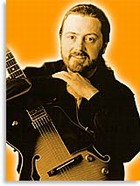
    Photo Courtesy of Linn Records

    This interview originally appeared in VG‘s Sep. ’96 issue.

  • The Hadden Sayers Band – Swingin’ From The Fabulous Satellite

    Swingin' From The Fabulous Satellite

    If tasteful, solid, rock is your thing, this band is for you. Storming out of Texas and led by guitarist Hadden Sayers, they blend blues, classic rock, country, and good old-fashioned pop music into a satisfying stew. The rhythm section, Steve Will (bass), and Eric “Magic Baby” Hansen (drums), propels Sayers on cuts like “Trippin’ Down to Mexico,” and “Kristi Don’t Care.” And Sayers’ solos take things to another level.

    There’s something for everyone, really. From the rhumba/blues that turns into a shuffle on “Woke Up This Morning,” to the “Surf Medley” finale, you’ll find plenty to enjoy. There’s a part in the liner notes that apologizes for the music getting a little loose at some points. But you know what? That’s part of the beauty. This is the kind of band that helps keep the sorry ship of rock and roll upright every night in the bars.


    This review originally appeared in VG‘s Dec. ’98 issue.

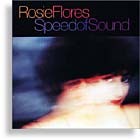
  • Rosie Flores – Speed Of Sound

    Speed Of Sound

    With her seventh solo release – having tried Bakersfield country, rockabilly bop, L.A. troubador, and even cowpunk – Rosie Flores has finally found an identity that was always there; the extraneous trappings just had to be peeled away. And at this point in her career, Flores shows a degree of confidence and maturity to match her formidable vocal and guitar gifts.

    Rosie co-produced the CD with guitarist Rick Vito (formerly with Bob Seger, Jackson Browne, Bonnie Raitt, and Fleetwood Mac, to name a few), and the marriage is perfect. Also onboard are such session luminaries as drummers Ian Wallace and Jeff Donovan, lapsteeler Greg Leisz, and pianist Justin Reinhardt, who complement – rather than bury – their leader.

    Some of the tunes are pure fun – Johnny Cash’s “Country Boy” give artist and producer a chance to trade leads, with Rosie on acoustic and Rick on electric, and Buck Owens’ “Hot Dog” is a veritable tour de force of Flores’ rockabilly licks – while others show a melodic, jazzier side of Flores, to good advantage. “Somebody’s Someone” is a coy, swingy original, with Vito playing Django to violinist Tammy Rogers’ Grappelli, and on “Devil Love” his dancing metallic acoustic ornamentation adds more Gypsy flavor. Rick’s fat, “Like a Rock” slide tone shows up on the Bo Diddleyesque “Don’t Take It Away,” while Leisz’s lap steel adds a lonesome, spooky atmosphere to the title tune. Rosie adds some twangy guitar to this, the album’s most ambitious composition and successful performance, co-written by Flores and Rachel Gladstone.

    Hopefully Flores and Vito will continue to work together (and hopefully with this aggregation backing), because there’s obviously tons of potential here. This is Rosie’s best to date, but the next might prove even better. And the one after that.


    This review originally appeared in VG‘s Sep. ’01 issue.

  • Marshall Triple Super Lead

    Marshall's  Triple Super Lead

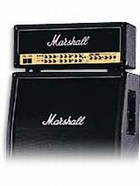
    Marshall’s new JCM2000 Series was introduced last year and has been well-received by Marshall fans and amp aficionados in general. The 2000 Series started with the two-channel Dual Super Lead then evolved into the new three-channel Triple Super Lead.

    The Triple Super Lead is available as a head (TSL100) or as a 2 X 12 combo (TSL122) that uses the same amplifier and chassis, and includes two different 12″ Marshall Celestion speakers: a Marshall Celestion Vintage and a Marshall Celestion Heritage. Each offers its own particular tonal characteristics and by combining them the amp delivers a more interesting sound with a wider dynamic range. An optional TSLC212 (2 X 12) cabinet with the identical speaker configuration can be added to the combo for further expansion. One or two 2 X 12s can be also be used with the TSL100 head instead of 4 X 12s.

    As for the basics, the TSL has three channels – clean, crunch, and lead – which are each voiced with distinct tonal characteristics. Furthermore, each channel has independent controls for EQ, volume and gain, and master controls for reverb, presence and FX mix, and a deep switch. The deep switch can be used to fatten up the bottom-end by adding more low frequencies, making the overall sound bigger. Additionally, the TSL includes two built-in effects loops. Loop A is the master loop that functions for all three channels when it’s used alone. Loop B is effective on the crunch and lead channels only. When both loops are used together, Loop A works with the clean channel so you can separate effects chains between the clean channel and crunch/lead channels. The FX mix control adjusts the dry/wet effects mix as a parallel loop for levels 1-9, then becomes a full series loop when set on 10.

    The TSL uses four Marshall Svetlana EL34 power tubes and four 12AX7 preamp tubes. Channel switching can be done manually or with the included TSL Foot Controller, which also can be used to activate the reverb and effects loops. Red LEDs indicate the functions in use.

    Marshall amps have never been known for their clean tones, but the TSL’s clean channel has surprisingly clean – dare we say – “Fender-like” tonal qualities. It can get dirty if you set it that way and gets great tones for playing blues and styles where you would want clean sustain or smoother dirt. Along with the standard treble, middle, and bass EQ controls, the clean channel also has a separate switch for mid boost. Activating the mid boost disconnects the middle control and reconfigures the way the treble and bass controls work together.

    The lead and crunch channels follow the footsteps of Marshall’s more modern high-gain amps. These two channels share master controls, but have separate controls for EQ, volume, and gain. Both also have tone shift buttons that create that mid-scooped (V) EQ – a favorite sound of metal players, heavy rockers, and those who want that type of a deep, fat sound. The lead channel offers a bit more gain and slightly more edge than the crunch channel. Otherwise, the tonal characteristics of the two channels are nearly identical. When going from a rhythm tone to a lead tone you want to have a bit more gain and sustain, and you typically need a stompbox to get the overdrive for that extra push. Not here – the lead channel on the TSL offers that extra push.

    Another area where the TSL shows dramatic improvement is in the reverb. It enhances the depth of the amp’s tone without sounding fake or overpowering. The reverb effect ranges from a subtle shimmer to a deep, rich sound with more intensity.

    Additional front panel features include the power and standby switches and a Virtual Power Reduction switch which modifies the power amp circuit to emulate a lower-powered amp (approximately 25 watts, according to Marshall). For techheads, the circuit modification takes place between the phase inverter and output tubes so all four power tubes remain active and operating in pentode mode so the four power tubes wear evenly. There’s also an output mute switch which can be used to instantly mute the output from the speakers without having to put the amp on standby. This is great for quick, silent guitar changes or turning off the speaker while recording.

    The amp’s back panel is where you’ll find the main’s input and fuses, three loudspeaker outputs (one for a 16-ohm cabinet and two wired in parallel for four or eight ohms), an impedance switch (four or eight ohms), an emulated line out (uses the same circuitry as Marshall’s JMP-1 preamp, accessed via an XLR connector, and suitable for running direct to a board, DI box or recording console for full Marshall tone with emulated “cabinet” tone), send and return jacks, and loop level switches for each of the two effects loops. The loop level lets you adjust the send and return levels to the optimum setting for the effects you are using. For most rack effects, loop level is set for a high signal level (switch out) and at a lower level for stompboxes and certain rack effects. The manual reminds users that distortion boxes do not belong in an effects loop and should be used in front of the amp.

    For our test, we plugged the TSL100 head into two old Marshall 4 X 12 “basketweave” cabinets loaded with original 25-watt Celestions, and used a ’59 Les Paul Historic Reissue and a ’70 Tele. We compared the TSL100 to a 100-watt early-’70s Super Lead and a 100-watt 800 Series model JCM2203. The TSL sounds excellent through the old 4 X 12s and basically does everything the old Marshalls do – and more. The TSL brings the best elements of the older and newer Marshalls together, retaining all the classic Marshall tone and feel. The TSL’s tonal spectrum is far more versatile than any other Marshall out there, offering the widest range of clean-and-sweet to loud-and-nasty sounds. With more features and options for controlling the sound, this new design provides the ultimate in flexibility for the player. The new TSL is truly a winner.

    And don’t forget the warranty! Marshall now offers a five-year warranty on parts, three years on speakers and labor, and 90 days on tubes and fuses. The warranty is transferable, so if you sell the amp or buy one used, it may still be covered (provided the warranty is transferred).

    Contact: Marshall, 316 South Service Road, Melville, NY 11747, (516) 333-9100, fax (516) 333-9108.


    Marshall TSL 100 head Specs
    Type of Amp: Tube
    Power: 100 watts
    Tubes: Four EL34 power tubes, four 12AX7 preamp tubes
    Features: Three independent channels with separate EQ, volume and gain, and master controls for reverb, presence, FX mix, and deep switch. Two effects loops with level control, speaker outputs, Emulated Line Out, Virtual Power Reduction and Output Mute switches, five-button footswitch with LEDs for channel selecting, reverb, and FX loop.
    Price: TSL100 head $1,999, TSL122 combo $2,399.


    This review originally appeared in VG‘s Dec. ’98 issue.

  • Wayne Kramer – LLMF

    LLMF

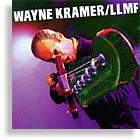
    The Wayne Kramer story has been documented pretty well. A member of the MC5, time in prison due to drug charges, several very good albums on Epitaph the past few years, and now a live album (use your imagination to figure out what the initials in the title stand for).

    Not surprisingly, Kramer and bandmates Doug Lunn (bass), and Ric Parnell (drums) tear the house down (or should that be up?). From loud, abrasive power-chord rock, to wah-driven funk, to spoken-word, avant-garde jazz/rock, and everything in-between, this CD covers the bases.

    Kramer’s guitar playing is almost always right on the money. Whether he’s using his wah to great effect on cuts like “Bad Seed,” highlighting his nasty lyric in “Crack In the Universe” with loud single-line imaginative soloing, playing a Springsteen-esque solo in the very anti-Bruce “Something Broken in the Promised Land,” or just flailing away (meant only in the best way) on the likes of “Kick Out the Jams,” Kramer shows why he should be considered in the upper echelon of rock players.

    Lyrically, this isn’t for the squeamish. Kramer’s not enchanted with things in America and he lets you know it on cuts like “It’s Never Enough,” and “Something’s Broken…” He also shows his love for beat poets and poetry in “So Long, Hank,” a seven-minute guitar-driven tribute to Charles Bukowski. Other strong and interesting cuts include “Junkie Romance,” and the guaranteed-to-be-controversial “Bomb Day In Paris.”

    Vocally, Kramer presents a pretty cool alternative. Rather than sing, he almost speaks (a la the beat poets) or chants lyrics. It’s a unique sound that works quite well. Band members really feed off each other, too! The live setting shows off the band’s strong points. Even when they’re loose, it works.

    Suffice it to say, there’s nobody out there right now like Wayne Kramer. Experienced, a killer player, and more attitude than any young, angsty band. Check out this CD, or, for that matter, any of the past three on Epitaph.


    This review originally appeared in VG‘s Dec. ’98 issue.

  • Buck Dharma

    Regarding the Reaper and Other Recollections

    During the hard rock decade of the ’70s, Long Island’s Blue Oyster Cult proffered a decidedly different approach to loud, guitar-based music. The combo’s dark ruminations garnered it a controversial reputation for its lyrics and logos, and its signature song, the 1976 mega-hit “(Don’t Fear) The Reaper,” is exemplary; some listeners interpreted the tune as advocating suicide.

    Donald “Buck Dharma” Roeser’s lightning-fast fretboard histrionics were an integral part of BOC’s sound. Controversies or not, the riffs and licks Buck and his bandmates played were permanently implanted into the minds of many fans and aspiring guitarists. As his band was preparing for a Summer ’98 tour, he discussed the history of what has been called “the world’s brainiest heavy metal band,” and the guitars he’s used along the way.

    Vintage Guitar: According to the Vanilla Fudge’s Tim Bogert, there was a Long Island scene in the mid ’60s that included bands like the Vagrants, the Young Rascals and the Hassles, among others. Do you remember those bands, and what was going on there?

    Sure. They were club bands, but we got started on campus, so we were more of a college band instead of a bar band. We played bars, but that came along later. I used to see all the bands you mentioned.

    Tell me about some of your earlier instruments and experiences, “pre-BOC.”

    Buck Dharma: I got involved with rock and roll in the surf era, and I was a drummer in my first band, which was in high school. I was playing street basketball, and I broke my wrist, and while I had the cast on I started fooling around with a Stella acoustic my brother had gotten for Christmas. By the time my wrist healed, I’d decided to become a guitar player.

    I knew another drummer, so I got a guitar, which was a Premier jazz box with two pickups. It looked sort of silly on me, because I’m kind of short (chuckles), and this guitar had no cutaway. I started off as a lead guitar player right off the bat, playing on the high E string. I’m totally self-taught on guitar; everything I’ve learned, I figured out off of records.

    I also had one of the first Hagstrom guitars imported to America. It was some kind of prototype; it didn’t have the same hardware or binding on the neck that the subsequent ones did. It was a very good, cheap Fender copy.

    The band that became Blue Oyster Cult didn’t form until you were in college. What type of sound were you going for?

    Where we were coming from when we were in college was the incredibly rich English pop of that period. We were doing a lot of Animals songs, but we got into blues, big-time; we were blown away by the Blues Project. We were in college in upstate New York; almost in Canada, and we used to make an eight-hour drive to New York City at least once a month to see bands like Paul Butterfield, and the Blues Project, who were basically New York white guys playing the blues. We said, “Hey, we can do that!”

    Did Danny Kalb influence your playing?

    Big-time; his speed was blazing. After seeing Kalb, I went into an intense woodshed period – I would play all day long, learning his licks. Once I learned his stuff, I could play very fast in general, so he was a very big influence on my playing and in the evolution of my technique.

    You’re one player whose stage name and real name have been public knowledge for some time. What’s the significance of “Buck Dharma?” Or is it a corporate secret?

    Not really; we all considered pseudonyms when we were starting out, and in those days it was probably more important to have a flashy name. I liked mine, so I hung on to it, but in retrospect it’s turned out to be a pain in the ass. I like Buck, but my wife still calls me Don (chuckles).

    Once the band had a record deal, some of the imagery its music created might have been considered controversial, but I had a feeling back then it was part marketing hype, as well. The details about the band’s logo are noted on a web page I checked out, but I’ll let you tell your version of how that symbol became the logo.

    That logo was created by the graphic artist who did our first two album covers; it really doesn’t exist anywhere else, but there are some similar historical antecedents behind it. Supposedly, it looks like the Greek symbol for chaos, and an alchemical symbol for lead. Whether these things are true, I can’t tell you. But the real poop on it is that it was created by a graphic artist, and when we saw it, we said, “That’s our logo.”

    I read at one point that some groups were trying to apply some kind of Nazi symbolism to the logo, and the Jewish Defense League was planning on protesting at some of your concerts.

    Yeah, and it was totally ridiculous; like looking for devils behind trees. BOC has always had a historical and intellectual bent as far as what we’ve been doing, but we’ve never pandered to devil worship or any of that stuff. We deal with themes of good and evil in our tunes, but we don’t take a position. The idea that we have an agenda, political or otherwise, was always silly. If we talked about the dark side of humanity, we just laid it out there and said, “Here it is.”

    The cover art for your third album, Secret Treaties, wouldn’t have dissuaded the aforementioned Nazi hunters, because it was a sketch of the band standing in front of an ME-262 (the world’s first operational jetfighter, built and deployed by the Germans during World War II).

    A lot of people were really upset about that, and I don’t know why. What Secret Treaties deals with is the fact that while World War II was going on, there were actually a lot of back-door deals between the Axis countries and the Allies; commerce did not stop. The album was an allusion to that: the war was not what it seemed.

    To give you a little more background, we had been signed by Clive Davis to Columbia, and if you remember, Columbia came out of the ’50s and into the ’60s as a pretty stodgy label; Mitch Miller was the A&R guy.

    I think we were signed by Davis fairly early in his tenure, but I never felt the company knew how to sell us; they didn’t know what to do with us. I always thought we were sort of an embarrassment to them. I think Aerosmith was probably the same type of band for Columbia; the company was probably more comfortable with artists like Springsteen, who had more of a straight-ahead image.

    In the ’70s, you often dressed in white onstage and played white guitars, as well.

    I had a Gibson SG which started out as a cherry-finish Standard; they never made a white two-pickup SG, but they’d made the three-pickup models in white with gold hardware. I had this one refinished. I also played a white Strat at one time; I still have it.

    Later on, you were seen playing a single-cutaway Les Paul in a Tobacco Sunburst finish.

    That was a Deluxe; I bought that new around ’73. It was just one of things where you go into a music store, pick something up, and really like it. I just used it on the band’s latest record.

    When the band used to play “ME-262” in concert, there was one part where the drummer would step out front with the rest of the players, and he’d play guitar as well, so there were four guitarists and a bass player. Is that still the case?

    We don’t do the five guitars like we did in the classic era. Albert [Bouchard], the original drummer, was the only drummer we’ve had who could play guitar.

    And the live album that “ME-262” is found on, On Your Feet or On Your Knees, sounded a bit murky, production-wise, but Some Enchanted Evening and Extraterrestrial Live made up for it in spades.

    I’ll tell you what’s good on On Your Feet, and that’s “Then Came the Last Days of May.” One of the reasons I like that is because it was mixed by Jack Douglas, who had done the Aerosmith records of that era. He was always a favorite of mine.

    It’s funny; I have very little objective perspective on our records, because usually by the time you get finished making them, you don’t want to hear them for a long time. Then you’ll hear them on the radio or at somebody’s house, and you’ll remember how good they were. I don’t know how other artists are, but I rarely sit and listen to my records once they’re done. You already know every nuance and microsecond of it.

    Are there any particular cover songs BOC has done that you like? There’s “Born to Be Wild,” “We Gotta Get Out of This Place,” “Kick Out the Jams.” I’ll ask about “Roadhouse Blues” in a minute.

    I like most of them. The weirdest one we probably ever tried was a studio version of “Born to Be Wild.” My philosophy about covers, in general, is that if you can’t bring something new to the party, you really shouldn’t try to cover a song, but that didn’t stop us from being foolhardy enough to try to cover “Kick Out the Jams” (laughs).

    “Roadhouse Blues” was recorded in concert with Robby Krieger sitting in.

    Yeah; we’ve done “Roadhouse” with both Robby and Ray Manzarek at different times. The Doors were a big influence on us. They weren’t like the San Francisco bands, who were big influences as well – The Dead, Jefferson Airplane, Steve Miller; the Doors were out of L.A., and were doing music that was very “dark” in a conceptual manner, and they were very song-oriented as well. So it was a big thrill to do “Roadhouse” with those guys.

    One might assume the inspiration for “Godzilla” was that you were a fan of the old Japanese monster movies.

    Yeah, definitely. I wrote the riff for that song in a Hyatt Hotel in Dallas; the riff made me think of Godzilla, and I wrote the first verse right off the top of my head, then I labored for several more weeks to come up with more lyrics. I thought the music and the groove were reminiscent of that first Godzilla movie that Raymond Burr was in.

    That song has always gone over well in concert, and I presume it’s still a staple.

    Right; it’s one of three tunes we have to play every night. The others are “Burnin’ For You” and “(Don’t Fear) The Reaper.” They wouldn’t let us out of the hall if we didn’t play those (chuckles).

    In the mid to late ’70s, wasn’t BOC one of the pioneers of laser light shows in concerts? As I recall, Eric Bloom had some kind of glove-like device he would point at a mirror ball to disperse the laser beams.

    He had a fiberoptic cable that went to a lens strapped to his wrist, so when he pointed it at the mirror ball, the laser would appear right from his hand. It was a stunning effect.

    But at one time, wasn’t there some controversy about whether or not such effects might cause eye damage?

    Yeah, let me set the record straight: we never hurt anybody with that laser show. However, the government flipped out when they realized what was going on; they didn’t like the idea that rock and rollers had all of this “power,” so they made us invent a lot of failsafes and interlocks for the equipment. OSHA actually followed us around on tour for three months! After that, they even clamped down on our “scan” effect, which was a laser cone that was also stunning, but there’s no danger as long as the laser is scanning. You see that effect in movies now, but you can’t see it at live concerts anymore. Anyone who saw one of our laser shows back then saw something that isn’t done at concerts now.

    Speaking of Bloom, what exactly is the stun guitar he was credited with playing?

    (chuckles) We made up stun guitar to describe some of the fuzz parts Eric did. In fact, there’s a stun guitar part on the new record!

    “Reaper” might have made some folks think of BOC as a proverbial one-hit wonder, but there were other songs that got a nominal amount of airplay, at least on the AOR format. There was the aforementioned “Godzilla,” “Burnin’ For You,” and later fare like “Dancin’ in the Ruins”

    Well, we really weren’t a pop band, and we still aren’t. I don’t know what kind of band we might be called, but when I think of Blue Oyster Cult, I don’t think of mass market.

    “In Thee” was a bit of a departure in that it had acoustic guitars, a lot of vocal harmony, and a romantic theme.

    That song was written by Allen Lanier, and it’s probably his finest tune. It’s got a resonance and beauty to it. We just put a new version that was a live and “unplugged” recording on the new album, which is how we’ve doing that song live lately. We thought the song deserved a little more exposure, so we put it on an album again.

    On the original version, I used a Martin D-35, and the electric was a custom-made guitar called a Vulcan.

    I haven’t asked about amps.

    We’ve probably used what everybody else has used over the years. When we started buying equipment, we got Acoustic 260s, which the Doors used, and they were terrible amps for the kind of music we were doing (laughs). They had no distortion or overdrive at all. From there, we got Marshalls, which you can’t go wrong with, of course. The problem was, if we were opening a three-act show, we’d be right on the “lip” of the stage, and the Marshalls could deafen you. After that, we used Music Man amps for a while, then some Boogie Mark II heads, which were also great.

    In the studio, I’ve been using smaller combo amps lately; a Vox AC-30, Fender Supers. The studio where we recorded Heaven Forbid has a great collection of vintage amplifiers. I also used a Boogie Mark II head through a 4 X 12.

    Having had your biggest hit before the advent of MTV – and I know BOC has done videos – how do you feel about their relevance?

    We’ve done six or seven over the years, and I don’t know if they have any effect at all. It’s nice to see yourself on television, but obviously, they weren’t a factor in our popularity to begin with, because those were pre-video times. I think they help certain new bands get exposed, but it seems like you see so little of the spectrum of music on television. The bad thing about videos is they’re very expensive; you can make a record for what a video costs, and is it worth the money as a promotional tool? I’d probably say no.

    When the video age came along, I think several bad things happened: I think it killed southern rock almost entirely. It ruined the careers of a lot of people who weren’t that great-looking, but it made the careers of some very pretty people who didn’t have a lot of talent. It also allowed certain acts that were cognizant of the visual medium to get noticed, but whether that’s a good thing, I’m not sure.

    How was your solo album, Flat Out, supposed to differ from a Blue Oyster Cult album?

    The material on Flat Out was, in general, more pop-oriented and more romantically-themed; more personal. I had quite a few songs that just weren’t suitable for BOC.

    Heaven Forbid‘s release is pending as we’re recording this.

    It’s our first record of new stuff since ’88; it’s got 11 tunes and is a great album, if I do say so myself (chuckles).

    You’ve got an offshoot venture called the Buck Dharma Band, and that group recently did a benefit in Atlanta. Details?

    I like the trio format; the musicians in the band are Danny Miranda, who’s also the bass player for BOC, and John Mocelli, who drums for Meat Loaf; he was also in BOC at one time. And my wife sings.
    We got a call from a fan who picked up on a newspaper article about a kid in an Atlanta suburb who had an inoperable brain tumor, and he was using “Godzilla” to visualize fighting his illness. He underwent an experimental drug protocol, came out of it, and kind of vanquished the disease. We went down there and did a benefit concert to help with his expenses. He’s a great kid, and we had a great time. The concert was videotaped, and copies of it are also available as part of the benefit.

    You’re using a Steinberger in concert for the most part these days.

    It’s my all-purpose axe. I got turned on to Steinbergers when they made the bolt-on, wood-body model; the all-plastic one was too sterile for me, tone-wise. The neck profile suits me perfectly, and of course, they don’t warp. They’re very consistent from instrument to instrument.

    You noted earlier that you used the Tobacco Sunburst Les Paul Deluxe on Heaven Forbid. Are any other instruments that you might have part of a collection, or do you use most of them in the studio?

    I’ve had very few valuable instruments. I had a ’57 Strat, but my philosophy is that if I don’t really use certain guitars, it hardly seems worth owning them. There are a couple of guitars I’d like to have; I’d like to get a Gretsch Tennessean or some other Chet Atkins-type guitars, because I don’t have one of those now. I wouldn’t mind having a Rickenbacker, but I’ve got a couple of Strats, and a custom SG-style guitar that was made by a fan in Pittsburgh. I played “The Reaper” live with that one for many years.

    Do you anticipate having to do extensive touring to promote the new album?

    We’re committed to a six to eight-week tour this summer; we’ll be in sheds with other bands from our era, like Motorhead and Iron Maiden. So we’ll probably be working more than we did last year, but we don’t feel like touring as hard as we did when we were coming up.

    Other future plans?

    I want to do a Buck Dharma Band record, and there will undoubtedly be a follow-up to Heaven Forbid.

    While Buck Dharma has a rep as a rapid-fire riffmeister, his insights into Blue Oyster Cult’s history, its songs, and the guitars he’s used aver that he’s paid attention to his experiences over the decades. Of course, his guitar prowess is also quite eloquent…but it’s also a lot faster.


    Donald “Buck Dharma” Roeser. Photo courtesy of Buck Dharma.

    This interview originally appeared in VG‘s Aug. ’98 issue.

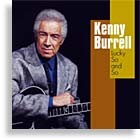
  • Kenny Burrell – Lucky So and So

    Lucky So and So

    Here’s the latest from a true legend. Kenny’s been doing it for so long, and doing it as well as or better than everyone else, that it’s foolish to even think there’d be something bad to say about this release. And there really isn’t. there is something a little different about it, though. Kenny sings on four cuts. Yes, one of the world’s greatest jazz guitarists sings. And to no one’s surprise, he sings wonderfully.

    First, let’s hit his playing. Like many of his albums, this one has somewhat of a thematic feel. It’s a quiet album, bluesy in many respects. As always, Kenny’s playing is…well, pick a word; brilliant…fabulous…magnificent. It’s almost a definition of jazz playing. It’s bluesy, it swings soft, it swings hard. His chordal work will leave you smiling. It’s, in a word, perfect.

    What’s really nice is that although you’ve heard some of these songs before, they all sound new. He never has a problem infusing a recognizable song with something new. And his chordal/single-line 1:20 intro to “Tenderly” is worth the price of admission by itself.

    Now for the singing. He’s done a little before, but not like this. “My Ship” gives him a shot at ballad singing, and he does it well. He has lots of fun with the title cut, singing it great and playing a wonderful bluesy solo. And his fun scat in “Squeeze Me” might bring to mind the late, great Joe Williams, but the vocal style is all his own.

    I feel kind of silly even recommending this one. If you’re a fan, you’ll pick it up. And, if you’re not, start here and continue to some of the greatest jazz guitar albums in history. It’s a journey you won’t regret.


    This review originally appeared in VG‘s Sep. ’01 issue.

  • Chris Thomas King

    Bluesman For The New Millennium

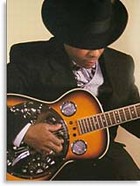
    Me, My Guitar And The Blues is the uncompromising new release from acclaimed guitarist, bluesman Chris Thomas King. The album echoes inspired, atmospheric, authentic Delta/Bayou blues journeys from King as he glides with ease on authoritative slide and acoustic voicings on Dobro, Martin steel string, and classical nylon string guitars while throwing in a scratch of electric Strat every now and then. King also performs all vocals, all instruments including bass, drums, keyboards and produced and mixed the album.

    Amazingly versed and accomplished as a guitarist, vocalist, and multi-instrumentalist, King, born in 1964 in Baton Rouge, Louisiana, is the beneficiary of a remarkable musical heritage. His father, Tabby Thomas, a Louisiana blues legend in his own right, encouraged Chris from childhood to play the guitar and a multitude of instruments. Tabby’s musical kinship and travels with the likes of Buddy Guy, Joe Tex, Guitar Kelly, Moses Whispering Smith, and Henry Grey, embedded the seeds that took root in King, who by his early teens, was playing guitar with these greats live, on their albums, and wound up on the infamous Louisiana All Star Blues Tour in Europe in 1983.

    The benchmark revelation in King’s musical education occurred during his 1983 tour, witnessing the reverence that European audiences held for the blues as a greatly esteemed, indigenous music style and for the American blues artists who performed and interpreted it. Deciding to take up the blues mantle himself, in 1986 King recorded and released his debut album, The Beginning, playing guitar and all the instruments on the album.

    To further inform his musical palette he moved to Austin, (King was a regular in house player at Antones), performing among the blues/rock circles of the late 1980s, early 1990s. He continued to hone his musical chops during the mid 1990s, living and recording in Copenhagen, Denmark, known for its creatively stimulating free forward attitudes, but by 1996 he returned home to New Orleans.

    Chris then added “King” to his name to honor B.B., Albert, and Freddie and took reflective regard for his hometown Delta roots, settling in and building his own recording studio. In the tradition of most blues artists, King has been a traveler of sorts whose music and life have taken many roads and come full circle. Over the last decade, King has released a succession of albums, each daring to push the creative envelope further and further as an ever evolving personal expression of the blues.

    Now he is enjoying his well deserved due with the release of Me, My Guitar And The Blues, his first acting role, (in which he also plays guitar), as real life bluesman Tommy Johnson in the Coen Brothers major feature film, O Brother, Where Art Thou?, and the impending release of yet his newest, upcoming album, O Brother, The Legend Of Tommy Johnson, a record inspired by and including music from the film.

    The soft spoken guitarist, multi-talented musician, equally stellar evoking traditionalist voicings on his treasured Regal Dobro and blazing scorching riffs on his Fender Stratocaster, discusses his current projects and the strides he has taken as a blues artist in the new millennium to both preserve yet evolve the great tradition of the blues.

    Vintage Guitar: On Me, My Guitar And The Blues you produced the album, you wrote all but two songs, you perform vocals, and you play all of the instruments.

    How much of a creative challenge was this for you?

    Chris Thomas King: When I first came home from the 1983 Louisiana All Star Blues Tour in 1983, I had some earnings from that tour and that’s when I decided to cut my first album, The Beginning. But I didn’t feel comfortable having all of the great older blues musicians around town perform on my record because I didn’t feel comfortable telling artists of such stature how to play music. I wasn’t comfortable to be a leader among such great musicians, plus I wanted to record music which I wrote that was a little bit different, with a new sound; something closer to what a young musician would say. So then I tried to get other young musicians that I went to school and played music with to perform with me, but not a lot of them wanted to because they didn’t want to do the blues. They wanted to play music like Parliament Funkadelic. So I ended up going into the studio alone to try to make my music and put it on tape and I wound up playing the lead guitar, the drums, the bass. Out of necessity, I had to do it all myself, whereas out of that necessity, I’ve become very comfortable with that creative process. Over the years, I also built a studio here in New Orleans and also technology has come to a point where it’s easier to do. It’s a lot easier to be the engineer, the producer. I’m glad that I learned the old fashioned way, where I’m not relying on technology, but it is easier to be a one man band, songwriter, producer, etc.

    What personal artistic statement did you aspire to create as a blues guitarist, as a singer, and as a songwriter on the album?

    My music had gotten so advanced with my albums 21st Century Blues From Da Hood and Chris Thomas King, that I felt I was getting too far ahead of my American audience and that they really didn’t know the Chris Thomas that grew up at my Dad’s club Tabby’s Blues Box playing with these statured older musicians. I grew up on the Delta blues style, not the big electric modern sound I had created. People in New Orleans knew this about me because they had been watching me since I was seven or eight years old playing music. But people in other parts of the country only knew me from my records. So I wrote and recorded Red Mud, which came about because I wanted to show and say to people, “This is where my music and I really came from.” I went back to my Delta blues roots and Red Mud was an all acoustic album. Me, My Guitar And The Blues is a continuation of Red Mud and shows where my music came from and where my music is progressing forward. I used the Delta blues style and then added some modern things like a hip hop beat so people can hear how my music has evolved. I wanted to bring the audience with me and say, “This is how I came from Red Mud to here.”

    How long did it take to record, mix and complete the album?

    Well actually I never stop recording. I continuously record and then I’ll group some songs together for a particular album. But I would say about four to five months. I began recording it early 1999 and released it on my own label, 21st Century Blues.

    Can you elaborate on your unique approach to playing slide guitar and which slides you use?

    I’m really bad at keeping up with slides and picks and so forth. So when I get to gigs, sometimes I have to borrow slides from someone in the audience! But normally I can play with just about any slide.

    Do you prefer glass or metal?

    I don’t have a preference, just anything that works. One thing that I don’t like to play with is a plastic slide. But if it’s glass it gives you a different tone, if it’s brass it gives you a different tone, and steel or platinum slides will each have a different tone and each one will give you a different sound. It just depends on what sound you’re looking to achieve. If I had to make a choice, the one slide I’ve played with the most is a brass slide because my strings are really heavy and having a heavier slide on my finger makes it easier to get the tone. It bends the strings a little bit easier.

    What gauge strings do you use?

    On my acoustic guitar I use the E in 13.

    What about your Dobro?

    I have a Regal Dobro. I’m not sure what year it is. The other guitars that I use on Me, My Guitar And The Blues are a Martin steel string guitar. I also use a Fender Classical nylon string acoustic guitar, and that style of guitar is something most blues artists don’t use. To me, that has such a full, rich, beautiful sound for acoustic blues and it’s reminiscent of that beautiful sound of classical guitarists like John Williams.

    When you’re playing slide, which guitars do you prefer for achieving the richest tone?

    My Dobro because for recording I love the sound. But when I play live, it doesn’t have any electric pickup so I have to mike it. So it’s not the guitar I prefer for live performances. But in the studio, when I want that full, rich sound, that’s my guitar of choice.

    What guitars, gear, and equipment do you use when playing live?

    I use a Fender Stratocaster. It’s a 40th Anniversary reissue that’s pearl white and it’s my main guitar. I also use a Fender Bassman Tweed Amplifier to get my tone. I know a lot of people know me lately as an acoustic player, but my years playing a Stratocaster go way back to when my father bought me my first guitar.

    Do you remember what your first guitar was?

    It was a Kent electric. It was like a like a little cheap copy of a Fender Strat.

    When did you first learn to play guitar?

    I started messing around with the guitar when I was very young. My Dad would be at work and I’d go around and mess with his guitar when he wasn’t there. He would come home and a few strings would be broken and he had a little bit of a problem with that.

    (King laughs) So one Christmas Eve he got me a little guitar of my own which was the Kent. For a long time I wouldn’t put it down.

    Can you discuss your picking pattern.

    There’s a new album that I’m working on right now that’s going to be released in the next two or three months and it’s called O Brother, The Legend Of Tommy Johnson. It includes music from the Coen Brothers movie that I have my first acting role in, O Brother, Where Art Thou? as well as music that was inspired by the movie. After I got the acting role, Ethan Coen called me up one morning asking if I could go to Nashville to spend some time with a Canadian guitarist by the name of Colin Linden. He’s someone the film’s music director, T-Bone Burnett is familiar with and so they wanted me to spend some time with Colin because he’s a guitarist who has really studied the stylings of the great 1920s blues players like Skip James and Blind Willie Johnson. I was curious, because I thought I got the role because I could do this style of music but I think I got the role more on my acting ability. The 1920s is not an era I had spent a whole lot of time playing and the players of that era… .their playing style is very complex. I learned it’s a five fingered approach. Whereas when I was playing acoustic guitar before, I was using three fingers. I really couldn’t play this style of music the way that I was playing. Sitting down with Colin… .I spent a day or two with him singing and playing some songs… .and I realized that it’s a five fingered approach to picking that style of blues. He showed me his technique for playing and helped me to form a technique of my own to do it. So it opened up a whole new door to me. It also helped me to make more of the character in the movie. In the film you see me perform a song called “Hard Time Killin’ Floor Blues” which is on the film’s soundtrack as well as the album I’m doing that’s inspired by the movie. During the shoot of the movie, I was in character and clothes from the period, listening to music from that period. Waiting for the technical people to set up the shots, I would be in my dressing room, in between scenes, and I would spend a lot of time with my guitar from the movie and I began to write songs and spend time playing music. Out of that experience came several songs that I wrote in character, based on what the time frame might have been like and they are included on my upcoming album. It came about because the actual soundtrack for the film is mostly bluegrass music, actually about 16 bluegrass songs. There’s only about two blues songs on the soundtrack, even though I play a real life, semi-mythical blues character in the film. People are going to see this film and romanticize about the Delta and they’re going to want to listen to some Delta blues music and I feel that my blues album that’s inspired by the movie can fill that void.

    Since you play a blues artist in the film, how much of a resemblance to your own life and experiences did the role take on for you?

    None really. For one thing the movie is set in the 1930s and it didn’t resemble my lifestyle. My only similar references to the character are that I’m from the South and the dialect of the language… .but none as far as his experiences, the historical context with it taking place in the Depression era. The biggest challenge for me though was playing the music of that period. They didn’t hire me to portray this role to play music like Chris Thomas King, but to play the music of the period. My thing that most people know me from is that I’m the cutting edge blues guy who tries to bring something new to the table, mixing and sampling and so forth. I’m the guitarist in a little band in the film called The Soggy Bottom Boys.

    I’m the sidekick in the film to George Clooney, John Turturro, and Tim Nelson and it’s probably one of the biggest roles a blues artist has ever had in a major film. The movie was shot in Mississippi at the crossroads in the Delta. I play Tommy Johnson. A lot of people haven’t even heard his story. He lived and recorded in the ’20s. Tommy only recorded less than 12 songs but his most famous song was about canned heat, and you know what canned heat is! Legend is that Tommy really had a problem with canned heat. The Coen Brothers, Joel and Ethan, pulled from a lot of sources for their film. It’s based on Homer’s The Odyssey.

    What tuning do you play and compose in?

    Several different tunings. Most people use the key of G and the key of D, which of course I use. But I also use some minor tunings. One of my favorite tunings is D minor and most musicians don’t use that tuning.

    When I use G and D, I usually put my capo way up on the neck and play in keys like A or B. I get a lot of e-mails and letters about the tunings of my guitar.

    When you are singing, do you find that that influences the direction of your guitar playing, or is it the other way around?

    Mostly I find the keys that I can sing in and then I have the guitar follow that. If the guitar is really dominant, then I would use my singing to compliment what I’m playing on guitar. But mostly, the guitar follows my vocal performance.

    When you’re composing, do you compose on guitar and what inspires your songwriting process?

    Almost anything can inspire me. I can literally be driving along in my car and get an idea for a song. Very rarely do I pick up my guitar and practice. Usually when I pick up my guitar it is to write a song and work out some melody that I’m hearing. I write most of my music on piano. I enjoy sitting at the piano and composing. When I write on the piano, my music takes on a different melodic tone. A lot of people don’t realize that I play piano. Obviously, some of the songs that are pure Delta blues songs are written on my Dobro, the open tunings, something of that nature.

    Even though you implement vast amounts of overdubbing, your album has a very spontaneous feel.

    Playing so many different instruments, if I can make that feel like a band, that’s a great compliment to the production of the record.

    But, when I’m playing live, I know the chord progression, the rhythm of the song and the lyrics, and my band has a great understanding of the natural groove to the music. I do perform live with a band. My bass player is Anthony Hardesty and my drummer is Darryl White.

    What production techniques do you use and how did having this particular creative control chart the course and goals that you set for Me, My Guitar And The Blues?

    Ever since my first album, I’ve been pretty comfortable producing my records. For a period I began producing for Warner Brothers and the major labels. I ended up in Los Angeles spending a lot of money in L.A. studios recording albums. I always left their studios not quite satisfied with what I had done and totally not satisfied with the amount of money I spent out there. I felt there was a lot of waste and a lot of unnecessary things going on. So I decided after I made the record in the garage in Copenhagen (21st Century Blues From Da Hood), then and there that I felt the music that I had done in that garage was far more powerful and true to my creative vision than anything that I had done before. It gave me the confidence to know that I didn’t need to spend six figures on a recording session, recording the blues. Most people recorded the blues on one microphone in a hotel room somewhere. All the classic Delta blues recordings were made that way. It’s almost 75 years later and we’re still listening to these records and marveling at them. So it’s not necessarily what microphone or what equipment you use. It’s mostly getting a great performance. To get a great performance, you have to be comfortable, so since that time, I moved back to the States and I’ve constantly been building my studio here in New Orleans, adding to it. I’m not saying I won’t ever go back to L.A. to record. In fact, I did some of the movie soundtrack work there. I just feel very comfortable working in my own studio. Also, I don’t like to use tape. I use ProTools. My whole recording and mixing process is tapeless and done in ProTools, so it’s all digital, no analog. Ten years ago, you had to go to L.A. for that kind of quality and efficiency, but now you don’t have to, so it’s a great thing.

    As a blues player, how do you select which notes and scales will best inflect blues style, how selective are you in getting down the right sound and groove, and what moods inspire you to the right sound and groove?

    It mostly depends on the lyrics. If you’re telling a story that’s uplifting, you just have the music compliment that. If it’s a sad story, you might use some minor keys that will give you a sad tone, and if it’s something that you want people to dance to, then obviously you’re going to give them a good rhythm and a good beat. I think it depends on what emotion you want people to feel from the music. I’m hoping to get to do more soundtrack work because that relies heavily on emotion. I feel I have a real sense for that kind of thing. My vision of the blues is I feel there’s a lot more to the blues than what America has been discovering with the older music. I think now that we’ve uncovered just about everything about the blues’ past, people are ready for the blues of the present and the artists who are exploring that. And now, people are also looking forward to where the blues is going now that we’re in the 21st century.

    You lived and recorded in the mid-1990s in Denmark, finding great success that eventually crossed back over here to the States, bringing you back home. Why do you think that Europe has always and continues to be more accepting and supportive to American blues artists than our own audiences here at home in the States?

    They understand that music is a rich art form and that the blues are something that they don’t have in their culture, so they don’t take it for granted. One thing about Europe… .America is more interested in the past, the history of the blues, but in Europe, they’re more interested in where the blues is going. They get more excited regarding this. I did go to England at first, I lived in London for about nine months, but I found it to be very flavor of the month and consequently a very different England than I had heard or read about in the past. It’s not really about music as much as style. So it was further into Europe that I found people with open minds and open attitudes about music. It was in Copenhagen, Denmark where I met musicians who didn’t have any preconceived notions of what blues music should be, so I met some friends and ended up staying there almost three years. And so I felt free to create my music. When the album that I recorded there was released, it became very popular, especially in France.

    Then I got a call to come back to the States, to L.A., because they liked the album and I then moved back home to New Orleans in 1996.

    Have hardcore blues enthusiasts been resistant or have they finally opened up to your modern evolving expression of the blues?

    I get invited to perform at all of the national blues festivals and so the purists have come to accept what I do as just another evolution of the music. You have to remember that the music of the 1920s sounds totally different from say, the blues rock of the 1980s and the music of today, but it’s still the blues. Certain time periods just reflect certain sounds, but it’s all the blues. The challenge to me is to create music and albums, where when people listen to them thirty years from now, it will tell them something about the time period I lived in. So Me, My Guitar And The Blues should sound like an album from the year 2000, not an album that was made in 1955 or 1970.

    Perhaps more than any other style of music the blues are born of a very deep expression of emotion and also of life experience. Can you elaborate on how this has informed you on Me, My Guitar And The Blues and overall as a blues artist?

    My life experience is all that I have to recall from that I can truly express convincingly. When I was a young kid, 13 or 14 playing music, I couldn’t perform songs about my kids, a lost love and so forth. I feel that I’ve done what I set out to do in a sense in how people are looking to the blues of the ’90s and today. My music sounds like I’ve captured the era that I live in… ..the hopes, the dreams, the pain, the tragedies, the aspirations that people experience during their lifetime. If I can capture these emotions, then I feel I’ve been true to my creative voice. I’ve grown as a writer where I don’t have to write about my own personal experiences. I can write about anyone’s. I don’t personalize every song but a lot of my experiences are there. What I don’t like about a lot of blues music are artists who try to completely recreate note for note, sound for sound, for example Little Walter or some other past great blues artist’s music. It’s like a copy or a counterfeit album. It doesn’t have anything to do with the artists’ own personal expression and it doesn’t have anything to do with the past or the present context. I’m comfortable trying to create music of this moment, of this time. If it reflects that in a truthful way to people or in a way that they can relate to, I think I’ve done what I should be doing as a blues artist.


    Chris Thomas King
    www.christhomasking.com
    Since the release of his acting debut O Brother Where Art Thou? Chris Thomas King finds himself trying to get 48 hours out of each day. King’s new acting career has him up for a role in legendary director Steven Spielberg’s latest movie The Minority Report starring Tom Cruise. King also has offers on the small screen including an ABC sitcom pilot.

    The O Brother soundtrack is currently number one on the Billboard country music chart and number 19 on the pop chart. It has been certified gold by selling over 500,000. The movie was number nine at the box office last week.

    King is also excited about “21CB” a new Hip-Hop/R&B group. The first CD from the group is near completion and King says, “It may be the best record I have done so far.” King produced all tracks at his New Orleans recording studio. The group’s live shows are built around a DJ. Darryl White (DJ Scorpio) serves as DJ and percussionist. DJ Scorpio will provide all grooves from samples to live drumming. “The sound of the record takes New Orleans Hip-Hop to a new level by adding live guitars and blues sampling to the mix” says King.All the recent success has inspired an increase in sales of the Chris Thomas King discography. Arhoolie Records is set to re-release King’s very first recording “The Beginning” for the first time on CD. There has also been so much interest in King’s guitar playing style that publishers are preparing music books featuring tabs to Kings’ songs, and playing style. If all of this wasn’t enough Chris Thomas King begins the first part of a world tour in Spain February 19 through March 4.There is still no release date for the new O Brother, The Legend of Tommy Johnson CD. Several Labels are currently interested in releasing the record. Among the interested labels are Tone-Cool, Island Def Jam, Fantasy and Rykodisc.

    Email us at: ctk@christhomasking.com
    And Visit at: www.christhomasking.com