Month: July 2001

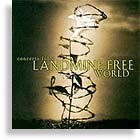
  • Various Artists – Concerts for a Landmine-Free World

    Concerts for a Landmine-Free World

    Ever since the first Farm Aid concert, musical extravaganzas for worthy causes have become standard fare. Concerts for a Landmine-Free World is different from the usual star-studded gangbang because it features roots-oriented artists. The biggest “celebrity” you’ll find is Emmylou Harris, who leads off the CD with “The Pearl.” Other artists include John Prine, Guy Clark, Mary Chapin Carpenter, Bruce Cockburn, Nanci Griffith, Gillian Welch with David Rowlings, Patty Griffith, Kris Kristofferson, Terry Allen, and Steve Earle.

    Recorded during five nights in December ’99, this CD is several steps above your average live concert anthology. The music, while not all topical or political, has a commonality in honesty and intent that makes it all fit together. Executive producers Emmylou Harris, Steve Buckingham, and Gail Griffith must be commended for the overall quality of the project. Concert recorders Doug Dawson and Dean Norman (who are also listed as crew, so they obviously aren’t afraid to get down and dirty) did a fine job capturing the live concert sound.

    Sick of live concert recordings that are all hype and no meat? This disc will shake you from your torpor. Not only is the music masterful, but all royalties go to the campaign for a landmine-free world. Worthy cause, great music; great combination.


    This review originally appeared in VG‘s May ’01 issue.

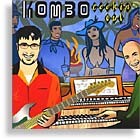
  • Kombo – Cookin’ out

    Cookin' out

    Kombo is Ron Pedley on keyboards, and Jon Pondel on guitars. They’ve got lots of great help too, with guys like Steve Ferrone, Matt Bissonette, and Sharon Hendrix. The music is the same kind you might hear on smooth jazz radio, but a little funkier. Like “Dirty Martini.” It’s some nice mid-tempo funk with a nice solo. And the cover of “Low Rider” is sure to make you smile with its double-stops and killer chordal work that highlights the familiar licks and melody. “Tight” is “happy soul,” reminiscent of songs like “Soul Serenade” from the ’60s. Pondel’s guitar cooks all over this one. Nice rhythm and killer leads. His sound is compressed/pinched just enough that it sounds great on this kind of music.

    There’s also a nice cover of the old Fifth Dimension hit “Stoned Soul Picnic” with killer vocals by Hendrix. It’s a nice arrangement, just different enough, and features a nice bluesy solo by Pondel. There’s something for everyone here – horn-driven funk with nice guitar and organ work dominates the title cut. And the soulful, bluesy funk of “Getting’ It Done” is sure to capture fans of folks like Eddie Harris. Recommended for fans of soul-influenced funk.


    This review originally appeared in VG‘s May ’01 issue.

  • Jim Weider

    A Big Step with Big Foot

    If you know of Jim Weider, it’s likely from his work with The Band. He took over the post held by Robbie Robertson when Levon Helm, Rick Danko, Garth Hudson, and Richard Manuel reformed in the 1980s. He performed well under the considerable pressure, and he recently released an excellent album of tunes showcasing both his writing and playing abilities. Big Foot highlights killer solos and tones on great covers and originals, and features some nice guest appearances from the likes of Harvey Brooks, Tony Levin, David Sancious, Ernie Cate, and others.

    Vintage Guitar: Many of our readers may only know you from your work with The Band, so the fact you have released a solo album may be a bit of a surprise. For their sake, talk about what you set out to do on the record.

    Jim Weider: Well, I’ve always liked playing instrumentals. Even before I joined The Band, I used to play and write a lot of instrumentals in Atlanta. If you want to go back into some history here in Woodstock (New York) there was Buzzy Feiten, Dave Sanborn, and Neil Larsen, who, when they weren’t playing for Paul Butterfield, had a band called Full Moon. They were all developing their styles and playing lots of instrumentals, really stretching out, way ahead of their time. That was very influential for me.

    There was other stuff for me, too, and you can hear it on my record; stuff by Lonnie Mack, and the Ventures. When instrumentals were big in the ’60s, we always played them. I’ve always written instrumentals, and always wanted to bring that back. Stuff you can dance to and groove to, yet it’s just not a jam. The songs have parts. Because back when there were great instrumentals, the songs had great parts. The songs will start you somewhere, take you somewhere, and bring you back.

    How about the tones on the album? I mean on the first cut, that sound you’re getting…!

    A lot of people like that. You know what it was? The sound I got on “Big Foot” was cut live in a studio with a Princeton Reverb in a bathroom with a Shure SM57 and a tube Echoplex. Basically, that’s it. That’s the tone. I mixed it so I was right up front. To get that edge, I’ll put the mic right on the speaker. The way the Princeton broke up and the tube Echoplex boosted the signal, it sounded great. I think I played the ’54 Esquire on that one.

    A very nasty – but nice – sound, if you know what I mean…

    Yeah, I think I doubled the licks with my Deluxe reverb when I messed with the track. Other than that, it’s pretty much live.

    Is this your first – for lack of a better word – “solo” album?

    Yeah, it definitely is. It’s actually a process that took years.

    How did it come about?

    To make a long story short, me and Randy Ciarlante – my drummer and writing partner – had a band together back in the ’80s. When there was time off from The Band, I was writing some of these instrumentals and we were playing them out. Of course, they were developing. I cut ’em on an eight-track, then go back and re-write. “New Orleans Boogie” developed like that. Then when we started making a Band record, I cut “Many Rivers to Cross” for a Japanese release. That came out and I saved it. I was slowly cutting stuff, and I had a session on eight-track at Levon’s studio.

    I was just accumulating tunes before we started recording The Band’s Jericho album. I cut three or four songs, then went back and cut “Texas Shuffle” with Harvey Brooks and Rand, along with three or four other tunes. I’d do it in between working on tracks for The Band record. So, I just never quite finished it. We had cut “After the Rain” for the Band’s High On the Hog album, but they didn’t use it. So I kept it and overdubbed Jonell Mosser on vocals. “Sliding Home” was cut in one day. We went in, and I said, “We’ve got some down time, so let’s do this track.”

    So I had all these tracks in ’96 or ’97, The Band was finishing its last record, and I really wanted to finish this record. I went in and cut “Little Miss Lover,” not knowing who would sing it. Then I cut “I’m In Love,” because I’ve always loved that tune. Ernie Cate did an incredible job on the vocals. I kind of built those tracks after recording them at David Sancious’ studio.

    “I’m In Love” has an incredibly warm feel.

    Yeah, I got lucky with that one…and it really felt good!

    You alluded to getting help from some great friends on the record.

    I did. The main thing is Richard Bell and Randy, they’re on the main portion of it, but then we had folks like Harvey Brooks, Tony Levin, David Sancious…a lot of people just came to town, so it worked just great.

    You’re talking about the Woodstock area. Are you from there?

    Yeah, I grew up here, first heard The Band here, and met Levon here way back when.

    Let’s talk some of your history. Where else would people know you from, besides The Band?

    Well, I started out backing various songwriters in the Woodstock area. That helped me to learn how to play melodically around the tune. Then I went to Nashville and ended up working on the road with Johnny Paycheck. We jumped in a van late one night and went to Texas. Me and Jimmy Day, the great pedal-steel player, were living together.

    I also did some work with Ben Keith, another great pedal-steel player who brought me to Nashville. After that, I went to Atlanta and worked for seven years with Harvey Brooks and Richard Bell as a rhythm section, recording people at Axis Studios. That time was cool, because I met a lot of players, and used to do a lot of shows with my band, Full Tilt. Then, Robbie Dupree called me up. He had a hit in the ’80s…

    “Steal Away”…?

    Yeah, and he asked me to come up and tour with him. Long story short, I did that, and then Levon was starting the Allstars. So I worked with him, and that turned into The Band in ’85. First it was Levon, then Levon and Rick, and Richard found his way back, then Garth, and then I came in.

    We’ve got to ask; any fears about following Robbie Robertson, a guy many consider one of rock’s best guitarists and songwriters?

    You know, a lot of people have asked me that, and it was a big thing for me to do. I had been playing with Levon and Rick for a while, and I had always dug their music, and Robbie was always a big influence. His playing was so melodic, with great riffs, and he usually used a Tele…

    To all of a sudden be filling those shoes, and the first concert was the Crosby, Stills, and Nash reunion tour in front of about 10,000 people… They flew me out, and here I was playing with them. That was pretty wild. I was very nervous. They really made me feel at home, they let me solo exactly how I wanted, so I felt pretty much at home.

    I grew up in Woodstock, so all that stuff was pretty well-ingrained. When I was in Atlanta, I really got into the country/rock stuff when that was big in the ’70s. Plus, I used to figure out all the Roy Nichols licks, and then when I heard Roy Buchanan… I used to try to do those pedal steel licks on the guitar. I try to incorporate all that stuff with blues bends, and call it electric country blues. I did a video on that for Homespun. I don’t know if people got the title or not. It wasn’t a country video.

    For me, it’s guys like Jesse Ed Davis, who was one of my ultimate favorite players. His touch and tone and vibrato were so unique on the Tele. It was a very big influence for me.

    Would it be safe to assume you’ve always been a Tele guy?

    Oh yeah, from the beginning. From Steve Cropper to James Burton in the early days, those guys were huge influences. And then the guy who finally took me away was Buchanan. I learned to use the fingers on my right hand from listening to those guys, and from a guy here named John Hall.

    The leader of Orleans?

    Yeah, he was using those fingers, and I’d noticed it. From there I’d listen to Jesse Ed on the Taj Mahal records, and to Burton. I didn’t know at the time he was using fingers. Once I learned that, it opened up a lot for me in developing a sound. Then listening to Roy Buchanan cranking up those amps and really getting a unique sound from the Tele was something. I saw Roy in the early ’70s, and that did it. I had been playing ’60s Teles, so I went out and searched. I did my own going to California trip, and found my ’52 Tele, and that’s the one I’ve played for almost 30 years.

    I’m guessing there’s a story behind your finding it?

    Oh yeah, it’s a good one, because you’ll know the guy!

    I traveled to California and found a ’57, but it wasn’t quite right. So I sold it to Jimmy Messina at the back of a concert hall. I had a chance to get Conway Twitty’s old Tele, but it had his name on the neck, so I passed.

    Anyway, I saw an ad in the paper for two guitars. It said, “Old Telecaster and old Precision Bass.” I went to his apartment, and it happened to be Norman Harris from Norman’s Rare Guitars. $350 for the Tele and $300 for the bass. That was all he had – just those two guitars. He was just starting out, working for a music store. I only had $340, but he sold it to me – gave me a deal.

    About 15 years later, I was working with Levon, and Norm was there. He saw me pull the guitar out and said, “Are you still playing that?” I said, “I never stopped, Norm.” And then I just said, “Three hundred and forty dollars, Norm…!”

    That back pickup on those ’52s is so good. This one has a sound like no other I’ve ever heard. My guitar tech, Dominic Ramos, thinks it’s because at one time I’d cleaned everything with steel wool and he thinks it may have gotten in the pickup and screwed it up. He thinks there’s some kind of mojo goin’ on.

    So, you take that one out on the road with you?

    Yeah, I always have. You’ve gotta enjoy ’em.

    What else do you have?

    It’s mostly Teles. On the record you might hear my Scotty Moore ’53 ES-295, or a Strat. But mostly for the tones, it’s Teles. For me, the hardest part is getting the tones. I mic’d it up myself in the basement. I like to put a SM57 on the amp, and put another amp with a distant mic. I’d take my time trying to get the right sound to fit the song.

    Well, I think that was certainly successful.

    That’s good to hear. I think when you’re doing instrumentals, that’s really important. The song and the tone have to move you.

    When you go out on the road, what do you use for amps?

    I always use my blackface Deluxe Reverb with a Naylor speaker. I use a Vibrolux or Princeton, too, depending on the size of the club.

    Safe to say, with amps too, you’re pretty much a Fender guy?

    All the way through. Diehard!

    As far as The Band goes, is there any future?

    I think that’s pretty much it. We lost Rick. Levon’s got his own band, so pretty much I’m pursuing The Honky Tonk Gurus, full-time.

    What about touring? Any plans for heading out further than the East Coast?

    Yeah, this is a really great band. And we’re going to go out and try to work it.

    I know you’ve done lots of instructional video work. Anything else in the works?

    Yeah, in fact I’ve got another one coming out. The first one was Get That Classic Fender Sound, and then there was Rockabilly One and Two. There was Electric Country Blues One and Two. That one actually shows a couple of tunes off of Big Foot. The one that just came out on Homespun is Basic Licks and Classic Solos for Electric Blues Guitar.

    Any new music in the works?

    Yeah, the Gurus have been doing some demos.

    So maybe in the next year or so?

    Maybe. I tend to write and rewrite instrumentals until they’re right.

    Here’s my stock final question. What do you sit around and listen to?

    You know, I like to listen to stuff like that new Macy Gray album.

    That’s a great record.

    Yeah, it’s really cool what she’s doing. It’s kind of like Sly Stone meets 2000. I’m really into production, too, and that record is produced very well. Great songs and great guitar parts. I love Van Morrison…

    Guitar-wise, we’ve lost some of my favorites. The great Danny Gatton and Roy Buchanan are gone. I like to listen to Sonny Landreth, and Ry Cooder. There’s not a lot of Tele players left! I just like good singers and players. I guess I go back and listen to a lot of old stuff, as far as players go. I always like to hear what Jeff Beck’s doing, but I love to hear him do something more organic because he’s such a great feel-and-touch player. I’d love to hear him just go in with a great rhythm section and just play the guitar. I love that organic sound of the guitar and amp. I did use some effects on “Little Miss Lover,” but that’s about it.

    Since you brought that one up, were you, or are you, I guess, a Hendrix fan?

    Oh yeah, big Hendrix fan. I’ll go back and listen to a lot of Jimi. And Clapton from Fresh Cream. The tones were so cool, not processed. Maybe just a fuzz-face or a wah.


    With Big Foot, Weider finds himself at the forefront of Tele players. Any Tele tone you want is on the album. Rarely do you find a player who plays great tunes with this much soul and finesse. Check out this album, especially if you’re a Tele fan, and add a new favorite player to your list.


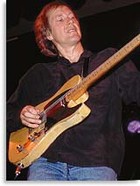
    Jim Weider in action with his ’52 Telecaster. Photo: Amy Elliott.

    This interview originally appeared in VG‘s Feb. ’01 issue.

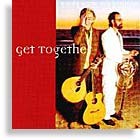
  • Woody Mann and Bob Brozman – Get Together

    Get Together

    From the opening notes of Mann’s fretted guitar and Brozman’s slide work, you can’t help but be captivated.

    Mann is known for his roots and blues fingerpicking on a variety of albums, method videos, and transcription books. Brozman is a musical polyglot most famous for being a prophet of the National guitar. Their pairing has created a stunning album.

    The first thing that strikes you is the astonishing recording quality, with a deep sound that is warm and clear and fills the room, allowing both instruments to speak without being interrupted. The duo plays a range of new and vintage guitars from Bear Creek, Michael Dunn, National Resophonic, Santa Cruz, Wiessenborn, Stella, Gibson, and a guitarra portuguesa.

    The second thing sneaks up on you in the simple beauty of the original compositions. The songs are mostly blues along with some Hawaiian-tinged traditional tunes and, for want of a better term, folk songs. Most of all, they allow the two musicians to stretch out and relax and play long solos that delve deep into the themes.

    If you ever feel jaded by the current crop of blues or acoustic guitar albums, give this disc a spin. The depth of feeling and quality of musicianship within these simple songs will make you a believer.


    This review originally appeared in VG‘s May ’00 issue.

  • Ritchie Blackmore

    Return to the Rainbow

    Wanna read all about personality clashes within the legendary rock band Deep Purple, or about the temperament of guitarist Ritchie Blackmore???

    Well, try to find those stories in the backissues of various and sundry sanctimonious, pusillanimous “rock journals,” because you won’t find such sordid gossip herein. Legendary Stratslinger Ritchie Blackmore is now back on the scene with a new incarnation of Ritchie Blackmore’s Rainbow, the hard rock outfit he founded when he departed from Deep Purple in the mid 1970s. A reunited Deep Purple recorded several albums in the late ’80s and early ’90s, and then Blackmore departed once again, for pretty much the same reasons he left the first time two decades earlier.

    But let’s not get into the details, okay? When Vintage Guitar interviewed Ritchie Blackmore, he was between phases of Rainbow’s world tour, promoting their recent release, Stranger In Us All (Fuel Records), and his polite and eloquent conversational abilities belied the stereotype that seems to have dogged the guitarist since Deep Purple burst onto the rock scene in the late ’60s with a “heavy” cover of Billy Joe Royal’s “Hush.”

    Vintage Guitar: The liner notes for Stranger In Us All include a note of thanks from you to “…My Dad, for buying me the guitar that started it all.” What were the circumstances, and what was the make and model?

    Ritchie Blackmore:When I was 11 years old, I pestered my dad to get me a guitar; I’d been listening to performers like Elvis Presley on the radio, so that would have been Scotty Moore I heard playing guitar. He bought me a Framus acoustic at the local guitar shop; I thought it cost about seven guineas, which would have been the equivalent of 20 dollars, and that was a lot of money in those days. I remember him telling me “If you don’t learn how to play this thing, I’m going to put it across your head.”

    I had also been listening to Tommy Steele, who was big in England. I wanted to play like him; I’d watched him on a show called “Six-Five Special,” which was a rock and roll show much like “Shindig” was in America. I used to watch “Six-Five Special” and strum along with my guitar; although I couldn’t play any chords, it looked good (chuckles).

    I was lucky, because I went to lessons at the very beginning, so I got off on the right footing. I had to ride my bicycle to lessons; I had to hold my guitar and try to steer the bicycle, and such trips were interesting, because I had to travel six miles.

    Did you listen to Radio Luxembourg as well?

    Yeah, it was a big highlight of my life back then. I’d listen to it from eight to 10 at night, but after 10 o’clock I had to listen to it very quietly, because my dad thought I was sleeping! Radio Luxembourg was a big thrill to listen to at the time; they played Buddy Holly and Duane Eddy, who were my heroes. The bands I played in as a teenager did a lot of Buddy Holly and Duane Eddy songs.

    What kind of guitar were you playing once you began playing in bands?

    I got a pickup for my birthday, and I wired it up to the Framus, along with volume and tone controls. I eventually put a total of three pickups on it, and then I got a Höfner Club 50 when I was about 15 or 16, and I also got a Watkins Dominator amplifier. We worked maybe once a week if we were lucky, and the amplifier looked really good, but every time I plugged it in, it would blow up during the first or second number! I’d have to carry on playing through someone else’s amplifier.

    I had to trudge all the way back into London whenever the amp blew up. I carried it three miles to get on the tube, and it weighed about 30 pounds. The shop would give me another amplifier, but the same thing would happen again the next time we played. As soon as I began playing, I’d blow the amplifier up again.

    How many times did that happen?

    Six. I went to the shop once a week for six weeks. They finally asked me to bring in my guitar as well, and when I did, they asked me to play something for them right there, and I blew the amplifier up in front of them!

    They finally gave me an amplifier that lasted for a couple of months before it blew up. But I think that model of amplifier had been designed to be played at half-volume, and I was playing at full volume.

    And the Club 50, which I recall other players using in their earlier days, didn’t really have potent pickups, did it?

    No, not at all. They were great-looking guitars; they had some fantastic wood. But when I was about 17, I bought a used Gibson ES-335 with dot inlays; I believe it was a ’59, and I know that they’re collectors’ items now.

    Is it fair to say you first received some public notice, at least in the U.K., with Nero & the Gladiators?

    I never played with Nero & the Gladiators, but I often see that in print. I did play with an early rock band called Screaming Lord Sutch and the Savages. I liked the way Nero & the Gladiators performed unique versions of songs; they were among my heroes at the time.

    About half of Shades of Deep Purple has some unique cover songs as well, including “Hush” and a couple of Beatles tunes. Was there any connection to Nero & the Gladiators, influence-wise?

    Well, it was similar, but we hadn’t written enough tunes of our own. I heard “Hush,” by Billy Joe Royal, when I was living in Germany, and I thought it was a great song, and I also thought it would be a good song to add to our act, if we could come up with a different arrangement.

    What about the Vanilla Fudge? They would have been doing unique cover songs around the same time.

    We’d heard about them, and they ended up being one of my all-time favorite bands. We couldn’t believe they were doing eight-minute versions of songs, which was exactly what we were doing. That would have been in ’68.

    What kind of equipment did you use on Shades of Deep Purple?

    My 335, and a Marshall 200-watt amplifier. I used an English-made fuzzbox, and a Vox wah-wah now and again.

    I thought “Hush” had some great guitar tones on it. Was that more than one track and/or more than one guitar?

    We did the whole song in two takes, and we did the whole album in 48 hours. We had a total of two tries at everything. Sometimes I like working under pressure like that, because I can really “flow,” whereas a lot of times I get into a studio situation where I have to go over something too many times, and I get bored stiff, and I lose the spontaneity. There’s actually one part on “Hush” where the guitar is feeding back; sustaining. I have a tendency to switch pickups as I’m playing, almost like a nervous habit. If I’m playing something that’s syncopated, sometimes I’ll throw the switch across in syncopation, too. I never realized I was doing it that much, until someone told me. But I like to play certain phrases with different sounds, so I switch back and forth from the bass pickup to the treble pickup a lot.

    Tell me about your equipment through the first incarnation of Deep Purple.

    I’d started with my 335 and a Vox AC-30, which I took to Marshall and asked them to copy; I wasn’t 100 percent happy with their combo amps. I probably drove all of the people at the Marshall factory crazy, because whenever I stopped by to test something, I’d play very loud. In fact, Jim Marshall’s office was down the road from the factory, and on the other side of the road as well, but he said he always knew when I was there, because he could hear me (laughs).

    They finally came up with an amplifier that was suitable for me; they added an extra output stage that added more “beef.”

    When did you switch to a Stratocaster?

    Probably around ’71. After playing a Gibson for so long, it took me quite some time to get used to the neck on a Fender; I had a hard time at first. And a Fender sounded very “clean;” with a Gibson pickup you got a certain amount of sustain, but a Fender is very right-to-the-point and very unforgiving. It’s brilliant if you get the note right, but if you don’t, it’ll let you know.

    The first Stratocaster I played had actually been owned by Eric Clapton. He gave it to a friend of mine, who was a roadie at the time. That guitar was the one that got me interested in Fenders. I think the first album where I played Fenders was Deep Purple In Rock.

    How was the first incarnation of Rainbow supposed to differ from Deep Purple?

    There weren’t as many egos (chuckles)! Obviously, the setup was very similar, with an organ and guitar.

    Why was the cover of “Still I’m Sad” on the first Rainbow album an instrumental version?

    I really don’t know; I think someone suggested that we put an instrumental on the album. I always thought that Yardbirds song was great, and it had what was almost a Gregorian chant on it. I thought it would work as an instrumental, and there’s a new version of it on the new Rainbow album, with vocals. I heard the rest of the band playing it, and they wanted to do a new recording of it. The key was a bit too high for the singer, so we now do it in a different key.

    Is it fair to say that the first incarnation of Rainbow was a proverbial “One-Hit-Wonder” with “Street of Dreams?”

    We had quite a few hits in Europe; “Stone Cold” and “I Surrender,” among others. “Stone Cold” became a hit in the States, too.

    When Deep Purple reunited, were you still using Stratocasters and Marshalls?

    Exactly, although I was trying to use a Roland guitar synthesizer a bit around ’85. I was fascinated by the sounds you could get out of one, particularly the string effects.

    Guitar enthusiasts have heard terms like “Renaissance” or “Baroque” applied to your style, and my perception is that you seem to be more at home playing those types of runs rather than blues licks.

    Sometimes that’s true; it depends on what mood I’m in. Renaissance music from the 1500s is my favorite music; I love classical as well, but I don’t play classical music very much. I like to play blues licks, too, but I find that sometimes the blues can be a bit limiting and repetitive. I can jam with someone and play blues then, and I’ve heard some great blues players, but in some respects I’ve heard it before, and Renaissance music is what really gets me going.

    One would presume it’s more challenging as well.

    Yeah, I think it is, but a lot of blues players would think not. You can’t just fly off and extemporize with Renaissance music, however. It’s very disciplined and rigid, but at the same time, it doesn’t come across as “planned;” it can be very exciting.

    Was the music supposed to be any different when Deep Purple reunited?

    Not particularly. We really didn’t have anything planned; we just played. I think Perfect Strangers was a pretty good album, possibly because we hadn’t played together in a long time, but I wasn’t so keen on what came after.

    You participated in a benefit recording of “Smoke On The Water” for Armenian earthquake relief. Chris Squire of the Yes also took part, but when I interviewed him, he didn’t know many of the details concerning the project. Can you enlighten us?

    (chuckles) I probably know less than he does. I was asked if I would like to play on it, and I thought it was a great idea to do a charity project; one of the things that stirred me up was that Paul Rodgers was singing on it, and I’ve always been a fan of his.

    Which means I need to ask if you’ve heard either of the last two Bad Company albums, since Robert Hart has been their lead singer?

    I like what they’re doing. I thought the singer was very close to Paul Rodgers, but I still thought what I heard was very good.

    Here’s the point: Doogie White, the lead singer on Stranger In Us All, seems to have a style somewhat like Ronnie Dio, who was the first lead singer for the band the first time around. Is that a “bonus,” for lack of a better term?

    I’m not sure. He can sing various types of music, but there wasn’t a conscious effort to have a singer who sounded like Ronnie Dio. Otherwise, I would have gotten together with Ronnie Dio! But Doogie is very influenced by Ronnie Dio.

    Another recent project for you was recording with Pat Boone for his In A Metal Mood album, which ended up being considered somewhat controversial with some religious groups.

    Well, I’ve always looked up to Pat Boone; I listened to him in the ’50s, when I was going to school, and when I was asked to play on one of his modern recordings, I considered it an honor. It’s great to be able to play on an album by someone who inspired you when you were growing up.

    But it’s amazing how some people are so narrow-minded in their thinking. If someone has long hair or has a leather jacket, they’re automatically a villain. That kind of bigotry has been around for years, and it’s sad.

    Still Stratocasters and Marshalls in the new incarnation of Rainbow?

    No, I’ve made a considerable change on the amplifier side. I now use Engl amplifiers; they’re German amps, and are amazing. They’ve got a lot different settings and overdrive sounds. I find they work very well at low volume and high volume. My Marshalls only seemed to work best when they were flat-out; when I turned them down they sounded thin. But the Engls sound great at any volume.

    As for your ongoing use of Stratocasters, your association with that brand and model dates from around the time that Fender began making their Strats with the three-bolt neck configuration.

    I tend to search for good necks more than anything else; the electronics are always very similar. A friend of mine used to go down to the Fender factory and get the thinnest neck he could find for me. I’d always put together guitars myself; I’d change out necks and sometimes the electronics as well, until I was satisfied with the feel and the sound.

    So I really don’t have any “old” Stratocasters; I have old parts, but sometimes I can’t remember what I did to which guitar. I used to glue a neck in place after I’d changed it out, because they had a tendency to shift.

    Have you used any Stratocasters since Fender returned to a four-bolt neck attachment system?

    Yes, and there’s also my signature model, which is quite unique. The neck is built-in as part of the guitar; it’s not a bolt-on. It’s really interesting to feel the back of a Fender guitar that doesn’t have bolts in it. I also wanted thick fret wire, and it has two pickups instead of three, because I never use the middle pickup. Like I said, I like to switch from one pickup to the other, and sometimes if I caught the middle pickup, it would throw me.

    So you never would have had any interest in trying out a Strat with the newer, five-position toggle switch.

    Not at all; I found that it could be too confusing and too subtle. When you’re playing that loud onstage, it’s basically a case of “black and white” and “loud and quiet.”

    So it’s “neck pickup or treble pickup?”

    That’s right.

    Are there any specifications to your signature model’s pickups?

    No, they just have to be loud!

    Considering what you said about assembling various Stratocasters to your personal taste, I take it that you’re not much of a collector.

    No. It’s strange; sometimes I’ve had heated arguments with people who will sing the praises of a ’58 Strat, but for me, they’re almost all the same; I think that the person playing the instrument is where the difference lies.

    I’ve seen some Gretsch guitars that I thought looked fantastic, and a guitar’s looks is what will get your attention first, but I’ve never been one who would pay thousands of dollars more for a nice-looking Strat that was made before ’65. I think they’ve been making some good ones all along.

    Another current project for you that I’ve heard about is something called Blackmore’s Night; I understand it’s primarily acoustic.

    Right; I’ve always wanted to play Renaissance music, and this is my effort. Candice Night, who’s my fiance, sang background vocals on Stranger In Us All, and co-wrote some of the songs on it as well. She loves Renaissance music as much as I do, and we were always playing it around the house, and people were telling us we ought to do an album of that kind of music. I play acoustic guitar and mandolin on it; Candice sings, and there are some other musicians augmenting us. We’re quite pleased with the way it turned out; it’s out in Japan this week. It’s kind of an eclectic, “majestic”/”regal” rock album. It’s probably my favorite album of all the ones I’ve ever played on.

    Where has the tour supporting Stranger In Us All taken you so far, and where else will be you be going?

    We’ve gone all across America so far; we’ve gone to South America and Japan, too. Next month we go to Denmark and Poland.

    We’re also planning on touring to support the Blackmore’s Night project; there should be about five musicians in that band, and we’ll be playing in some selected places like some castles in Germany, trying to get the “atmosphere.” That should happen in about two or three months, and should be quite interesting.


    It’s obvious Ritchie Blackmore is very intense about his music, but the dialogue we had with the veteran guitarist was cordial and enlightening. Even though he’s had decades of experience playing loud music (and he’ll keep on purveying such), his offshoot effort with Renaissance music indicates that he’s dedicated to broadening his musical horizons by recording a musical genre that’s been a personal favorite of his for years. Considering his accomplishments as a rock guitarist, Blackmore has more than earned the right to pursue his personal musical dreams, which should make for interesting listening, as well.


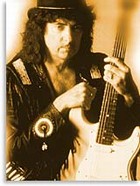
    Ritchie Blackmore with his signature model Fender Stratocaster. Photo courtesy of Fender Musical Instruments Corp.

    This interview originally appeared in VG‘s Oct. ’97 issue.

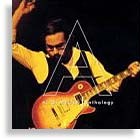
  • Al Di Meola – Anthology

    Anthology

    Al Di Meola needs no introduction, and most of the music on this fine two-CD collection will be familiar to most guitarists as well. The only question is What’s new?

    The 20 tracks here cover Di Meola’s recording career on Columbia, from Casino to Elegant Gypsy, Splendido Hotel to Tour de Force. There’s a sampling from each album and the different styles and phases of his musical development.

    The new material here includes four tracks, “Medley: Short Tales Of The Black Forest/Fantasia Suite For Two Guitars,” “The Wizard,” “Al Di’s Dream Theme,” and “Theme To The Mothership.” All are live cuts and to true fans, worth the price of admission alone.


    This review originally appeared in VG‘s May ’01 issue.

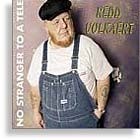
  • Redd Volkaert – No Stranger to a Tele

    No Stranger to a Tele

    Anybody who’s paid any attention to guitarists in the past decade or so won’t be too surprised when I say what a nice album this is. Redd, as many of you probably already know, is a genial-looking fellow who resembles a lepraucaun and plays the living hell out of a Telecaster. He’s spent the last couple of years on the road with Merle Haggard, and here he’s just oozing country.

    The title cut kicks things off with some killer bends, nice jazzy/country chordal work, and some booming twang. You get the picture. Like the title says, Redd is right at home on the Tele. There are plenty of cuts like that one. He’s flashy, but never a show-off – at times he’s downright subtle. And he shows he’s comfortable in a number of genres. The slow-rumbling boogie of “31/2 Minutes Left” features incredible bluesy rock playing with licks that’ll leave your jaw hanging open. “Chee-Z” could be the theme from a lost spy movie, and Redd’s all over it.

    Another nice aspect of the album I wasn’t ready for was Redd’s singing. He’s got a rumbly baritone that fits the traditional country songs perfectly. It’s a voice not unlike Haggard’s, but without as much “lived in-ness” as Merle’s.

    If you’re a Tele freak, Redd’s one of those guys who makes albums you must own. And if you’re just a fan of traditional country music, you should check it out.


    This review originally appeared in VG‘s June ’01 issue.

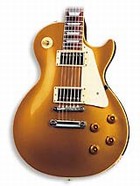
  • Gibson Les Paul Goldtop Reissue

    Nice reissue, aging optional

    The Gibson Les Paul. Four words. Sixteen letters. Major guitar history.

    No, it wasn’t the first electric guitar. Nor was it the first solidbody electric. But when the model was introduced in 1952, it was the first solidbody guitar to carry the prestigious name, “Gibson,” on its headstock.

    And although its greatness may not have been fully realized, in retrospect, the original Les Paul today is coming into its own as an underrated collectible, having been the platform chosen for introducing the humbucking pickup, and later used to sport flamed maple tops and sunburst finishes of Golithian importance.

    But we digress.

    The original Les Paul was available in any color you wanted – as long as it was gold! Thus, it was dubbed “the goldtop.” And recently, Gibson’s Custom Shop undertook the task of re-creating this sublime piece of guitar history.

    Available in reborn versions of all its classic incarnations (’52 with P-90s and trapeze tail, ’54 with P-90s and wraparound, ’56 with P-90s and stop tailpiece, ’57 with humbuckers and stoptail), the Goldtop Reissue is a nice mix of features old and new; “Les Paul model” is silkscreened on the face of the headstock, and Gibson still uses nitrocellulose lacquer to finish its instruments. And all of them sport a new color Gibson calls Antique Gold.

    In terms of electronics, the guitar has the standard two volumes and two tone controls and the three-way pickup selector. Nickel hardware is used throughout with vintage-style reissue tuning keys, and the guitars arrive from the CS strung with .010-.046 Gibson Vintage Series strings. There’s also a Gibson hardshell case, with blanket – except for the ’56 and ’57 “aged” versions, which feature a vintage reissue case.

    Technical details include a neck and back made of mahogany, a fingerboard of Madagascar rosewood based on a 12″ radius with a 243/4″ scale length, and a nut width of 111/16″. Neck inlays copy the original trapezoid design, and binding on the neck is narrow – as it was in the ’50s.

    “The original purpose of neck binding was to make the guitar cosmetically attractive, but it also has a practical purpose,” said Edwin Wilson, Custom Shop Historic Program Manager. “It creates a classic transition between the maple top and the mahogany body.

    Because the ’52 Goldtop is a special guitar (the original was, after all, the first solidbody guitar to carry the Gibson name), Wilson said that artisans roll and shape the necks on these reissues, leaving them a little fatter. He likens them to the neck on a ’59 Les Paul – chunkier and more rounded.

    The ’52’s great-sounding P-90 pickups, wound to old specs, give the guitar a clean, open tone that maintains its edge when pushed hard. The ’54 has the new wraparound tailpiece and also comes with P-90s. This bridge works great for those who palm-mute strings.

    The evolution of the instrument becomes more apparent with the P-90-equipped ’56. This marked a first for Gibson when it incorporated the separate bridge/tailpiece ABR-1 and the stop tailpiece, which yields better sustain.

    The 1957 Les Paul is one of the most significant electric guitars because it was the platform chosen to launch the humbucking pickup. In that spirit, the ’57 reissue does likewise.

    If you’re a fan of “aged” guitars, the line’s ’56 and ’57 models are available with the renowned touch of Tom Murphy – hand-aged to simulate a few decades worth of gigging, travel, weather, and heartbreak. Murphy’s handywork is done by…um… hand…so each guitar has its own unique cosmetic qualities.


    Gibson Les Paul Goldtop Reissue
    Type of Guitar: Solidbody electric
    Features: Carved maple top; solid mahogany back and neck; binding on body and neck; nickel hardware; various bridge/tailpiece/pickup configurations depending on model; two tone, two volume controls; three-way pickup selector; 22-fret bound rosewood fingerboard with pearl trapezoid inlays; 24 3/4″ scale length; Antique Gold finish.
    Price: $4,279 to $7,700 (retail)
    Contact: Gibson USA, local Gibson Custom/Art/Historic dealers, www.gibsoncustom.com.


    This review originally appeared in VG‘s May ’01 issue.

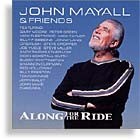
  • John Mayall and Friends – Along For the Ride

    Along For the Ride

    John Mayall (VG, July ’98) has been doing it for so long it seems he has always been there. And he has.

    In a career that has lasted nearly 40 years and produced almost 50 albums (not including compilations, of which his name graces another 40!), Mayall has very much earned the title of “Elder Statesman of the British Blues.” One of the first recollections of my teen music years was being highly enamored of his Back to the Roots double album a long, long time ago.

    Well, here he is with a CD full of great tunes with guest performances from folks who have played in his various bands, and folks who are just friends.

    One of Mayall’s alum, Mick Taylor, shines on “She Don’t Play By the Rules,” a nice blues-rocker that chugs along under some wonderful playing. And here’s one for ya’; when’s the last time you heard Billy Gibbons play without the other two fellas in Z.Z. Top? Can’t recall, eh? Check out his big, fat, blistering solo work on the shuffle “Put It Right Back.” Great stuff.

    Other highlights include phenom Shannon Curfman on vocals and guitar on “Testify” and indeed she does on this bluesy funk/rock tune. Other folks who shine include Jeff Healey on “A World of Hurt,” Gary Moore on the slow blues of “If I Don’t Get Home,” and a somewhat reformed early Fleetwood Mac on “Yo Yo Man,” where Peter Green joins McVie and Fleetwood, along with Steve Miller on guitar. Billy Preston adds keyboards and vocals to a couple of cuts, and as always, sounds very fine. Jonny Lang sparks the blues-rock of “That’s Why I Love You So,” and plays some nice guitar, but I would’ve loved to hear him tackle it vocally, too.

    Through it all, Mayall is in fine voice. You’d think he’d start to sound old and bored at some point, but it doesn’t happen. He just keeps going. By the way, his band adds some fine work thoughout, too. In fact, one of best guitar solos on the album is Buddy Whittington’s on “So Many Roads.”


    This review originally appeared in VG‘s June ’01 issue.