Month: June 2001

  • Fresher Guitars

    Fresher Guitars

    Epic poetry is great, but all these long treatises on the massive guitar pedigrees of Kay and Aria have made me feel a bit like a Milton scholar, a fate not to be wished anyone. The Fall was bad enough. So, how about a little lyric poetry, something fresh for a change, some lighter fare at the bountiful buffet of guitar history. Let’s take a peek at Fresher Guitars from Japan.

    I don’t remember when I first heard of Fresher guitars, but somehow I knew they’d made guitars with built-in effects. Anything goofball like that is, as you know, right down The Different Strummer alley. So, when I saw a VG classified placed by Nils Freiberger from the Boston area offering one for a reasonable price, I figured it was time to hook up with one. As it turns out, Nils traveled for work and was coming down my way, so we hooked up on a chilly windy Winter day and over cheesesteaks in an old 19th Century cast-iron corner restaurant in South Philly, talked guitars and did the deal.

    Now that I had one, what was it? The knowledge quest had begun. There’s a chapter on Fresher in “History of Electric Guitars” (Player Corporation, Japan, ca. 1985), a book which is highly recommended if you can find a copy, but unless you read Japanese, this is not terribly enlightening. Fortunately, Hiroyuki Noguchi, editor of Rittor Music’s Guitar Magazine in Japan, was able to supply some outline information to help us fill in a few of the blanks.

    Fresher is hardly a household name in most American guitar collecting families, with good reason. Basically, these were primarily made for domestic use in Japan, although at least some were briefly exported at least to the United Kingdom. Despite the fact that examples occasionally show up, as of now there is no evidence that Fresher guitars were ever officially imported into the United States.

    The Fresher story begins back in 1973 when Fresher guitars were introduced by the Kyowa Company, Ltd., of Nagoya. Nagoya, you’ll recall, is one of the principal guitar-making regions in Japan. Kyowa was primarily a trading company, importing products and developing some musical instruments. The company is still in operation, importing Charvel/Jackson, Takamine and Dean Markley products, among others.

    Fresher guitars were built by the Matsumoto Musical Instrument Manufacturers’ Association, a consortium of suppliers in the Matsumoto region. This organization, by the way, did not include either Fujigen Gakki or Matsumoku, the area’s more famous manufacturers.

    Little is known of these early Fresher guitars, but Mr. Noguchi recalls them as being pretty much low end instruments when compared to other brands available at the time, including Greco, Tokai, Guyatone, Fernandes and Ibanez. Based on the evidence of slightly later designs and the vogue for copying at the time, it’s probably safe to assume these were mainly inspired by popular American designs.

    Illustrated in the “History of Electric Guitars” are three guitars which probably reflect this early line. The FL-331 was a white Les Paul Custom copy, with gold hardware, bound ebony ‘board, block inlays and a pair of gold-covered humbuckers. This appears to be a glued-neck guitar. About the only difference seems to be a slightly exaggerated center dip on the open-book headstock. The FN-281 was a copy of the Fender Competition Mustang done up in a blue finish with white stripes, maple fingerboard and black dots. The FN-384 was a black copy of a Rickenbacker 4001 bass, complete with triangle inlays.

    As the Seventies progressed, quality began to improve and designs to get more original. In 1977, Fresher introduced the onboard electronics for which it will, most likely, be best known in guitar history. Initially three “Built-In 5 Effects” models were a Strat copy, like the one I got from Nils, a Les Paul and a Firebird.

    At least two numbering schemes have been encountered for the same models of guitars, and there’s no way to tell if the number is a clue to sequence, or whether the numbering relates to different markets. Since these model numbers don’t appear on the guitars themselves, such a distinction is probably academic. We’ll leave that to the Milton scholars!

    The Strat was both the FS-1007 and the FSC-100. This was a copy of a late-’70s Fender Stratocaster with a white ash body, solid bolt-on maple neck, big Fender-style headstock, brass nut, maple fingerboard, black dot inlays, three single-coil pickups, an adjustable bridge/tailpiece assembly, a pickguard that looks like a Strat except for a sort of genie tail on the lower bout where the electronics controls were mounted. In lieu of a traditional fiveway select, the FS-1007 had two threeway minitoggles which controlled either the front and middle or back and middle pickups, both sharing the middle pickup, in a most curious arrangement! Each of these was then hooked up to separate volume and tone control, yielding four knobs rather than the usual three. Finish was natural oak.

    Of course, what’s more of interest here are the onboard effects. Because it is so curious, let me quote at length from the catalog which Mr. Noguchi kindly faxed to me. This is written in that wonderful English which I’ve come to recognize as typical Japanese translation. You may be amused by the errors in grammar and syntax if you’re not familiar with this style, but it reflects what happens to the intrinsic differences in two languages with quite disparate etiologies when they collide in the form of advertising hype!

    “‘FRESHER’ JUST CREATED NEW FANTASTIC ELECTRIC GUITAR. ‘FRESHER’ have developed just new fantastic electric guitar in which body 5 Effectors are enclosed compactly, so that players can freely creat [sic] their own fantastic effect sounds just by momentary arrangement of the switches and controllers without any troublesome setting like as pedal system effectors.

    “No only individual effect sound but alternative sound by mixing effect sounds can be made. Of course, the normal sounds can be enjoyed. Also, players can change the order of connector between AutoWah and Phase Shifter.

    “Now, players need not to carry effectors separately and to connect them with cords. So. Free from noise. Free from setting trouble. Economical costs rather than the total costs of electric guitar plus five effectors. Only ‘FRESHER’ satisfy the demand of Jazz Rock guitarists who are enthusiastic to have new sounds.”

    The five onboard effects included phase shifter, auto wah, sustainer, distortion and power booster. These were controlled, overall, by a bypass minitoggle allowing you to kick them in or out at will. Three additional minitoggles then controlled the five individual onboard effects. Each of these then hooked up to a separate potentiometer which basically served as a volume or speed control, depending on the effect. Simplest to operate was the sustain, which had its own toggle for off or on. The other two operated with a threeway toggle, both off in the middle. One controlled either auto wah or power boost, the other either phase shifter or distortion. In essence, you could have up to three of the five effects in combination at any one time. Finally, there was a little red battery power light.

    The Les Paul was called both the FL-1005 and the FLP-100. This was a pretty good reproduction of a Gibson Les Paul Custom, with a solid carved maple top over a mahogany body, a glued-in mahogany neck, Rotomatic tuners with tension controller, bound headstock and fingerboard (no split diamond on the head, by the way), block inlays, brass nut, twin humbuckers, threeway select, twin volume and tone controls, elevated pickguard, finetune bridge and stop tail. The FL-1005 came outfitted with Gibson strings! This was available in a natural oak or tobacco brown sunburst. Unlike a Les Paul, however, this had the Fresher Built-In 5 Effects.

    The Firebird was called the FF-1003 and the FFD-100. This handsome devil was a neck-through-body guitar made of all-mahogany. The headstock was carved bi-level and two-tone, just like a real Gibson. The rosewood fingerboard was bound with dots. It had a brass nut, combination bridge/stop-tail, two mini-humbuckers and a black pickguard which began like a Firebird but stretched all the way down the guitar to hold the electronics. On the lower horn were two toggles, a threeway select and the effects bypass switch. Otherwise, the effects were the same.

    OK, so how do they work? Well, based on the one I have, not bad, all things considered. As usual with onboard systems, the effects tend to be a bit “thin,” and switching is noisy, something that often happens as these guitars age. If you are an effects purist, you want a good pedal. But if you like those cheezy effects that can only be gotten with an onboard circuit board, these are pretty cool. And like the copy says, you don’t have to schlepp around a bunch of pedals and cords.

    Actually, the guitar I have differs slightly from the guitars shown in the Fresher catalogs I’ve seen. Mine is called a Fresher Straighter (which the others may be too). Unlike the previous guitars, which have the logo written in an angular script, mine has the logo in a Fender-style spaghetti script. The Straighter is wrapped along the lower edge of the headstock much like the word Stratocaster on a Fender. Stand back and squint your eyes and you’d swear it said “Fender Stratocaster” instead of “Fresher Straighter!” Mine also has a more traditional fiveway select and one volume and two tone controls, like a normal Strat. Mine also has a rosewood ‘board with pearl dot inlays. Otherwise, it’s the same. The strings on mine pass through the body and are secured with ferrules.

    Another version of the Fresher Straighter was made with a traditional Fender-style vibrato.

    It’s not clear how long these effects guitars were made, but probably not long. I’d be surprised if they made it to 1980.

    Textual evidence from the catalog copy suggests that Fresher may have still been making these guitars as non-effector reproductions at this time.

    Perhaps even more interesting than the Built-in 5 Effects guitars were the Fresher Preamp guitars introduced in around 1978. These were equal double cutaway solidbodies with neck-through-body construction clearly in the same mode as other guitars popular at the time, including the Ibanez Musician and Aria Pro II Rev-Sound, all inspired by the success and aesthetics of Alembic.

    Two Fresher Preamp guitars were offered, the FX-309G and the FX-509. Both had wide shallow cutaways, almost perpendicular to the two-octave neck, with sharp little points on the horns. The neck was a five-ply maple-walnut laminate ending in a dramatically tapered three-and-three headstock, almost like a Paul Reed Smith, with a large concave scoop out of the top, the upper edge extending beyond the lower. The nut was brass. The fingerboard was bound and possibly made of an ebonized maple, if the copy is to be believed (or understood), inlaid with large oval position markers. Two twelve-pole humbuckers were mounted on metal surrounds. The stud-mounted bridge/tailpiece assembly was finetunable and had those little set-screws in the back to let you adjust them further. A brass sustain block was mounted in the body under the bridge. Hardware was gold. The FX-309G had one rotary pickup selector on the upper horn, while the FX-509 added a second rotary selector on the lower horn, yielding “18 settings.” These had white ash bodies which could be finished in natural oak or a two-tone light and dark color combination.

    Here’s what the copy said about the electronics. “The ultimate for Tone Variation. Fresher Preamp guitars offer the greatest variety of tone variations available today.

    “Using an On-Board Equalizer Preamp system, the player can control a wide range of Treble, Middle, and Bass sensitivities independently. And there rich tone variations can be controlled with out high frequency loss.”

    Basically the controls were four knobs set along a metal Tele-like strip on the lower bout and included a master volume, treble, middle and bass tone controls. The preamp was operated by two 9-volt batteries.

    Both the Built-in 5 Effects and Preamp guitars were offered in the United Kingdom in 1978 carrying the Kimbara brand name. The Effect line included the Kimbara 181/V Les Paul copy and the Kimbara 183/Y Strat with vibrato. This latter had the maple ‘board and the headstock simply read “Kimbara” with no faux-Stratocaster “Straighter” to confuse the issue. The Kimbara 183/B was basically a dark natural finished version of the FX-509.

    At least seven other guitars were offered in the Fresher line in around 1978 or so, several of which are quite curious, as well. These were essentially “copies,” but some took liberties with their inspirations.

    The EX-670 was a pretty faithful copy of a Gibson Explorer, with a glued-in neck and appointments essentially the same as the original. The SL-380 was a copy of a Gibson Thunderbird bass. The FS-556N was basically a Strat copy with a natural ash body, with Fender-style head, maple ‘board, traditional vibrato and pickguard with three single-coil pickups. What was different was the neck, which stretched all the way through the body with a heelless neck joint.

    Also offered was the BM-270 which was a copy of Brian May’s famous potato-shaped guitar. This had three pickups and was a dead ringer for the original. There was no date on this catalog, so I’ve assumed a late Seventies date. Even if it’s slightly later, this copy of May’s guitar appears to predate May’s arrangement with Guild.

    Also curious was the FX-840, which was a pretty good copy of the Ibanez Artist model. This had the twin small double cutaway horns, twin humbuckers, and a glued-in neck with a bound fingerboard with trapezoid inlays. The only difference was a three-and-three headstock with a flared crown.

    Two other strange hybrid guitars were offered. The FW-810 was an offset double cutaway with a body very similar to the Ibanez Studio series, which also dated from 1978. This had a pair of humbuckers attached to a six-position rotary select on the upper horn. This had a tapered headstock with an asymmetrical concave scoop out of the top, basically the same as on the Pre-Amp guitar, and not unlike the Ibanez Artist headstock. The FY-820 was an odd bass which had an exaggerated ash Fender P-Bass shape with a single split-coil pickup, a goofy batwing pickguard under the strings, maple fingerboard, and a neck that ended in a Firebird/Thunderbird headstock!

    In the early Eighties Fresher introduced another wonderful guitars which it advertised as being designed for the year 2001, the FX-700. This was a very angular Explorer with sharp points at each angle. It was done up in black with natty red binding, including on the fingerboard, which also had red dots. This had a locking vibrato system that looked like a Kahler and a pair of humbuckers with exposed staple pole pieces, threeway, volume and tone.

    At least two other Strat variations were available in the early Eighties as well, the FS-380S and FS-380H, the former with single-coils, the latter with a pair of humbuckers. This had a pickguard, and the humbuckers were covered in black plastic, with no poles visible. Hardware was black, with a traditional vibrato.

    At least one bass from this later era was offered, the FSP-850. This looked remarkably like a Riverhead Jupiter, with a rounded crown on the two-and-two head, a slim, offset double cutaway body with an extended round upper horn and an outwardly flared thinner lower horn. This had two single-coil pickups, threeway and two volumes and two tones.

    Clearly, these were not the only guitars offered by Fresher toward the end, but these are the only ones I’ve seen, and those were in photographs only.

    The Kyowa Company stopped producing Fresher guitars in 1985, and thus ends our brief saga. If you know more about this obscure Japanese brand, I’d welcome the information. But, at least now you know something the next time you encounter a Fresher Straighter with Built-In 5 Effects! Thanks to Nils Freiberger and Michael Lee Allen for giving us the opportunity to explore as much as we have.


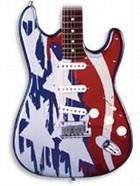
    Ca. 1978 Fresher Straighter Strat copy with the Built-In 5 Effects.

    This article originally appeared in VG‘s Sep. ’95 issue.
  • Fender Prototypes

    Gone... And Forgotten

    Philip Kubicki has been active in the music industry for over 30 years. He began building acoustic guitars at age 15. At 19, he was one of the first employees to be hired by Roger Rossmeisl, of Fender Musical Instrument’s research and development department for acoustic guitars. Nine years later, he moved to Santa Barbara, California, and established his own company, Philip Kubicki Technology, which builds acoustic guitars, custom electric guitars, bodies and necks, and mini-guitars. Phil currently manufactures the Factor Bass, designed in 1985, and recently introduced the Key Factor 4 and 5-string basses.

    This is the first of many stories Kubicki will share with VG readers in the coming months. Look for other Kubicki articles in the May, September and November issues in 1997.

    Reflecting back through my years in the guitar industry, much of my time has been spent in product development, prototyping, and the making of specialty guitars. In recent years, quite a bit has been written about the prototypes of instruments that made it to the marketplace. But what about the ones that didn’t, and the people who made them?

    Because of the developmental nature of invention, a series of prototypes is usually built. Beginning with the first model, refinements are made, then it is abandoned to build a new model incorporating the changes. Each of these prototypes becomes a betterment of the one before, until everything that was learned, solved and designed is integrated into the final prototype. The better the engineering and marketing synergy, the fewer the prototypes and the shorter the developmental time. If a patent is to be pursued, the patent process must be initiated before the product can be shown publicly. Then, it is test marketed for salability.

    Prototypes are rare indeed. Very few escape the possession of the parent company. Many are retained by the owner, founder, inventor, company or the immediate family for historical or personal reasons. A few are given to people who have been loyal and valuable to a company, as a memento of a time that was. Many have been destroyed, their true value not realized at the time they were built. The next time you see a real prototype, think of the moment in time when its creator was optimistic for its success, and when it was the only one of its kind in existence.

    A famous prototype is the very first Telecaster, which has been written about extensively and seen at guitar shows around the country. This guitar’s importance lies in the fact that there was a time when it was unique, the one and only Tele on the planet. From a guitarmaking standpoint, I view it as the most valuable of all Teles in existence. Others have been made famous by musicians and events, but this one represents the hands-on product of Leo Fender and George Fullerton’s work. It is also important that a prototype can be authenticated, as George Fullerton has done.

    The rarest prototypes are those abandoned after failing test marketing. Their value at the time seemed nil because they never made it into production. They have been put away and forgotten. Fender’s Marauder, Mod and Rocker, Songwriter, and Headless bass are just some examples of their abandoned prototypes.

    Since I am in the business of making headless basses, I’ll start with the story of the Fender headless bass, which was developed by Gene Fields in 1975. I got to know Gene during my years in the R&D department.

    Gene was with Fender research and development for 23 years! Some of his designs include the P.S. 210K keyless pedal guitar, the Starcaster thinline hollowbody guitar, and the second generation Marauder guitar. He also worked with Leo Fender on the Mustang bass, the Musicmaster bass, the Bronco and others. His last six years with Fender were in the string division. There, he was responsible for the introduction of automatic string winding machinery into the production line, the development of several sets of guitar and bass strings, and was involved with machining and testing of strings.

    In 1984, he joined Sierra in Portland, Oregon, designing guitars and basses before moving to M.C.I. Intertech as general manager of the pedal steel guitar division. Two years later, the company was purchased by the Fred Gretsch company, and rather than relocate again, Gene formed GFI Musical Products in Arlington, Texas, building high-quality pedal steel guitars.

    A few years ago, I went to the Arlington Fall Nationals guitar show and bumped into Gene. We had not seen each other for 20 years, so we grabbed a cup of coffee and sat down for a talk. As I told Gene about my company and our “Headless” and Key Factor bass guitars, he said he had something interesting to show me. I was amazed when he produced a Fender headless bass prototype. I was surprised because I never knew a project like that was ever developed at Fender. I asked Gene to explain how this instrument came to be. Here is his story.

    Historically, the first electric basses were developed as a smaller, lighter, more portable alternative to the upright bass. These early instruments were fitted with strings made with a nylon filament running along the steel core, inside the winding, to purposely eliminate some of the sustain in order to mimic the upright bass sound.

    As the years went by and music changed, bass players wanted a brighter sound. String manufacturers responded with roundwound and flatwound strings with as many as three layers of wrap. This produced a new problem. The bright sound created by these new strings, accentuated the “dead spot” found on some basses, on the G string at the fifth or sixth fret.

    Gene was asked to research the cause of this problem and eliminate it if possible. He tried many things, including double truss rods, all-maple bodies, uncarved necks to make them stiffer, as well as a multitude of different strings. Finally, he made a solid aluminum neck.

    All this research resulted in making the dead spot move to new areas of the neck. The Aluminum neck moved the dead spot up to the seventh fret. This was the clue Gene was looking for, it told him the dead spot was a result of the resonant frequency of the neck. At this point, Gene attached a 11/2-pound C clamp to the head of a stock P-Bass neck as ballast, to dampen neck vibration. This had the effect of moving the dead spot down in frequency and almost disappearing.

    Unfortunately, as most key-headed bass guitars are head-heavy to begin with, adding weight to the head was out of the question. An opposite approach was to lighten the head of the neck. Gene took another stock P-Bass neck and removed all strings but the first one. This moved the dead spot up in frequency but did not eliminate it. Then Gene installed the first string in the fourth string position, removed the other three keys and began sawing off the head 1″ at a time. He found that each time additional weight was removed from the head of the neck, the dead spot would move up in frequency. Then, Gene removed the last key, cut all but 1″ of the head off and drilled a hole for the ball end of the string. A clamp was used on the body to tune the string. The dead spot moved to about the 14th fret, to the point of no longer being a problem.

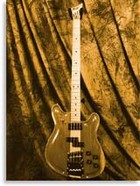
    Gene’s research led to his designing a completely new instrument, the first Fender prototype headless bass. The instrument consists of a maple neck-through body with mahogany wings. The neck has a 32″ scale with 23 frets and black position markers. The body is cut to a stylized Jazzmaster shape with a carved top similar to the LTD jazz guitar. The body-mounted tuner is a simple right-angle pull design with tuning knobs in the tailpiece. Individually adjustable bridge sections are used, as well as individually-adjustable mutes. The neck pickup is humbucking, while the bridge pickup is a P-Bass with a special cover. Two switches provide pickup control and phase reversal.

    When this instrument was field tested, it got very good results. But marketing thought it was too radical for its time, so it was never produced. Eventually, Fender gave the bass to Gene, and it is still in his possession.


    I’d like to thank Gene Fields for sharing his story with us.


    The 1975 Fender Headless Bass, prototype.

    This article originally appeared in VG‘s Feb. ’97 issue.

  • Wah-Wah Pedals

    An Evaluation of Effects and Pedals

    The idea for this article came about when I purchased a box of effects pedals from the owner of a music store which had closed in the late seventies. Most were new old stock Electro-Harmonix with a few other brands mixed in. I spent several hours deciding which I found useful and thought others might profit from the information. This is a totally subjective evaluation, and I’m sure my opinions wouldn’t be of value to a metal player or others of that ilk. I play and write blues, regae, R&B, and classic rock. I have searched diligently through the years for the Duane Allman, Dickey Betts type guitar sound. The violin type sustain of a Les Paul has always inspired me, and I’ve played a 1959 Les Paul flame top for most of my guitar playing career. After playing through at least 50 different amps the last two years I arrived at the ever popular 1956 Fender Bassman. Mine has reconed Jensen P-10R’s, is outfitted with a matched set of NOS Tungsol 5881’s, and after using all RCA 12AX7’s, I went to the original Bassman configuration of 2 12AY7’s so as not to overdrive the power tubes so much. This amp is a dual rectifier amp and sounds delicious at all volumes with all types of guitars. I go into detail here as this amp was my tone base for all testing.

    Another point I want to mention here is many acts I’ve heard and admired over the years were playing in large venues, football stadiums, large auditoriums, etc., allowing the guitar players to overdrive their amps with no worry about blowing the audience through the back wall. Those of us working in smaller venues, clubs etc., have a different problem to deal with. Achieving a singing sustain and fat tone in a small rehearsal space or a club is a different animal entirely. I usually don’t run my amp over three or four in these situations, and mic it when playing larger venues. My amp only puts out 40 watts or less and is sufficient for most playing situations.

    Since writing the above preamble several months ago some things have changed. First, I purchased a 1966 Fender Vibrolux reverb. It is equipped with Sovtek 5881’s and puts out about 35 watts. Although it doesn’t sound as good as my Bassman, it’s quite portable to take to jam sessions and when sitting in at a club. It, of course, has built-in reverb and is easy to carry and set up quickly. It also has Jensen speakers and, other than the reverb, doesn’t significantly alter the sound of the various effects tested when I A/B the effects between the two amps.

    The other thing is, with a little help from my friends, and a lot of looking on my part, this article has gone from covering some dozen effects to covering dozens of effects. My initial research has led me to fellow players saying, “Hey, if you like the MXR Distortion Plus, try the ProCo Rat,” etc. Presently I have three large drawers filled with various effects, seven Wah-Wah pedals, several very interesting articles dealing with the above, and apparently an endless chore! I’ve come to realize I couldn’t possibly review the multitude of effects gizmos gushing forth from the mid 60s to the onslaught of digital signal processing. I am going to cover as much ground as possible, and it is for that reason this article will be two or more parts.

    I conclude this introduction by saying I have switched back to all analog effects, and I feel I’m getting a much warmer and more musical tone from my guitar and amp by doing so. Granted there is a trade-off in convenience. Rack mounted gear is faster to hook up at the gig, and midi makes programming digital effects easy and versatile; ie. a different reverb for each effect, fifty different chorus types, etc. I use straight guitar with reverb for 85% of my playing, controlling overdrive with my guitar volume knob. As for the other 15%, I just want one excellent chorus sound, or one ideal Wah-Wah, not fifty mediocre digitally synthesized ones. I don’t want guitar tone like the guitar player I hear on every beer commercial!

    The Wah-Wah Pedal
    The preceding having been established, it is only fitting that part one of my article deals with the Wah Wah. In the early seventies my primary effects were a CryBaby Wah, a MXR Distortion Plus, and a MXR Phase 90 (both script logo models). Interesting to note here, my Phase 90 stopped working during a recording session at The Record Plant in Sausalito. I sent a roadie out to buy me a new one, which turned out to be a block logo model. The difference in timbre was so great I ended up omitting the effect on the cut we were working on. It wasn’t until a few years ago I found out about the difference between the script and block logo MXR products, but more on that in part two. The CryBaby was the most common Wah of its day and, as I recall, it was quite adequate, I’m sure I wouldn’t have kept using it if I found its quality inferior. It employed the infamous TDK 5130 inductor. I know that for a fact because I still own it and I checked. I made the Wah-Wah part one of my article because next to straight guitar tone Wah was the effect I used the most.

    History
    It is outside the scope of this article to deal too thoroughly with history as the author’s intent is to help fellow players find the most useful instrument (Wah) for their purposes.

    The first wah type sounds were obtained by pioneer electric guitarists working the tone knob, a technique still used today, especially by country players playing Teles. Circa the mid 1960s Vox came up with the first commercially successful unit. This first model was named the “Clyde McCoy” model after a trumpet player who asked Vox for a device to make a keyboard sound like a muted trumpet.

    The Clyde models are the most sought after by collectors with early models having his picture on the bottom and later models only a signature. They were manufactured in Italy and sold by Thomas Organ in the U.S. The sound caught on with great success and songs of the late sixties and seventies are permeated with wah-wah.

    The following has been quoted from an article in the May 1992 issue of Guitar Player entitled “Wah: The Pedal That Wouldn’t Die”, by Art Thompson. I highly recommend this article for more on the subject of wahs. However, I would like to take issue with a couple points mentioned concerning Vox wahs:

    “The introduction of the Vox Crybaby pedal around 1968 came about because the U.S. distributor, Thomas Organ, and the European distributor, JMI, both wanted to sell the Wah-Wah but neither wanted the other to have the same pedal. Vox solved this by slapping the Crybaby name on the same model for the American market. The story goes that when Vox needed a new name for the pedal, they asked one of their distributors to describe the wah’s sound. The response was ‘it sounds like a baby crying.’ Also at this time, Vox and Thomas Organ introduced a new model designated V846 that used a Japanese inductor made by TDK instead of the Italian made inductor. Most purists agree that this change degraded the sound of these pedals, but in the informal test we conducted, our favorite (because of its almost human vocal quality and vomiting sounds) was an excellent sounding V 846…

    “The next major change occurred when Vox came out with the King Wah, the first unit made completely in the United States. Vox also tried different variations on the wah theme, such as the bass wah and the fuzz wah. It should also be noted that by the late ’60s there were probably 40 or 50 different manufactures making wah-wah pedals on both sides of the Atlantic…..

    “Most pedal gurus consider the Clyde series to be rather thin and cheesy-sounding when compared to later models.”

    At this juncture I’d like to introduce Mr. Geoffrey Teese. I was introduced to Geoffrey by my close friend, George Cole, a professional player/teacher in the L.A. area. George told me that Geoffrey had modified his ’70s CryBaby to old Vox standards and it sounded remarkably better. I called Geoffrey and since then we have become friends via many telephone conversations. Geoffrey is the “authorized vintage Vox wah repairman”, and has done more research and has more information on vintage wahs than anyone I know! Geoffrey has been invaluable in the preparation of this part of my article, and I thank him.

    Geoffrey modified my ’70s CryBaby to “Clyde McCoy” standards and I agree with George, the mod made all the difference. I thought the CryBaby was pretty good until I heard the difference in timbre and tonal sweep after Geoffrey reworked it. I introduce Geoffrey here because I agree with what he had to say regarding the last part of the Guitar Player article quoted above.

    “The GP article says pedal gurus consider the Clydes to be ‘rather thin and cheesy-sounding when compared to later models.’ I disagree! The TDK 5103 square inductor had ‘almost human vocal quality and vomiting sounds.’ Again I disagree! The Vox/USA V846 changed much more than just the inductor. Everything but the very basic resistors were changed, making the V846/King-Vox Wah/Crybaby virtually an entirely new pedal (lumped together because they all shared circuitry, layout, and componentry). If Clydes are ‘thin and cheesy sounding’ then why are they commanding such a high price tag?”

    The issue here isn’t one of being right or wrong! The sound one likes is a very subjective animal. I personally agree with Geoffrey about the wah sound being much better before the TDK inductor. I also don’t have much use for a “vomiting sound” when I’m playing, but others may have. Another gray area is the naming of the Vox verses Crybaby name used for U.S. distribution. One pedal I tested was a Vox Crybaby made in Italy. This doesn’t fit in with the Thomas ‘Crybaby name theory’ mentioned above. Also, I’ve had trouble dating the exact years of issue of the Clyde McCoy. If the GP article is accurate, the Vox Wah was manufactured in 1966. The Vox V846 replaced the Clyde in April, 1967. This apparently leaves one short year for the picture and signature model Clydes to have been on the market. Thomas Organ signed distribution rights with Tom Jennings (Vox), in 1964. The original inductor used in these early pedals (the 80-5048-7 discussed later) was taken off microfilm as being created on 4/22/63. This makes the author wonder if the inception date of the wah might not be earlier than 1966?

    Inductors
    What an inductor is and does may be found in a basic electronics book. However, a layman’s definition is in order as the inductor and caps play such an instrumental role in the overall qualities of the wah. Mr. Teese supplied me with the following explanation: “An inductor is a type of coil that influences the amount of time it takes a signal to go from one point to another.”

    I have seen four variations of inductors in the pedals I’ve tried for this section on wahs. The first, in my Italian Vox V846, looks like a small version of the old aluminum film canisters and has ‘500’ ink stamped on the top. This is generally referred to as the “canister” type inductor. The second looks like a stack of three or four dimes covered with a dark reddish brown material. The original Jennings Musical Instrument (Vox) part number was 09-5905-0. Thomas Organ changed this part number to 80-5048-7 in order to conform to their numbering system. This is the inductor Geoffrey refers to as the “48”. The third is the infamous TDK 5103, a brown cube manufactured in Japan. It’s interesting to note here that pedals manufactured in Sepelvuda, Ca. used the TDK 5103 while pedals manufactured in the Midwest during this same time period retained the “48” style inductor.

    The last was a unique find. A month ago I bought a Wah Baby made in Italy. I called Geoffrey because I’d never seen an inductor like it. The inductor was mounted perpendicular to the circuit board and was bright red. I was describing it to Geoffrey when I grabbed my reading glasses to tell him what it said on the back. It said FASEL! Too hip! I was jazzed. All the inductors except the Fasel were mounted flush on the circuit board. Geoffrey contends that though they have different casings, these inductors are all the same. The only major difference is the TDK 5103.

    I want to mention that the tone of your individual wah may be adjusted to your personal taste by simply pulling back the rubber retaining loop, which applies pressure to the shaft, and rotating the pot to change where the shaft engages the pot. This will change the tone range emphasized by the pot

  • Bill Gruggett

    Still Buildin' em in Bakersfield

    The agrarian area of California that includes such cities as Bakersfield and Tulare has a special significance to country music lovers and guitar lovers alike. The musical mystique, of course, involves legendary players such as Merle Haggard and Buck Owens, among others, while most of the guitar brands made in the Golden State’s agricultural belt have been on the periphery of interest in classic American-made instruments, possibly because many of them were flashes-in-the-pan. Most guitar aficionados are aware of the Mosrite connection to Bakersfield, but other now-defunct brands, such as Hallmark, Standel, and others, seem relegated to an almost “ghost-like also-ran” status, and those brands were also built in Bakersfield or the surrounding area.

    Not only did Bill Gruggett work for Mosrite on more than one occasion, he also built Hallmark instruments during that brand’s brief existence, and he’s even built his own brand of instruments on more than one occasion (and such is the case today). Gruggett’s past self-named guitars included the unique “Stradette” from the late ’60s, and when he sat down with VG at a recent guitar show, he discussed his decades of work in an area (geographical and historical) that is still of interest to fretted instrument fanatics.

    Bill Gruggett was born in Tulare, California. His childhood had a great deal of itineration, Gruggett says. His father was a minister who specialized in starting new churches and helping those in need. Ultimately, his family returned to Tulare, where Gruggett graduated from high school. A few years later he moved to Bakersfield, and began working as an auto mechanic. Around the same time, he began picking up used guitars, mandolins, and violins at local yard sales and garage sales, to restore and sell.

    “The first instrument I fixed up was a little mandolin-banjo”, says Gruggett. “I painted it Candy Apple Red.”

    The auto mechanic soon began building his own guitars. Initial customers included fellow employees at his auto shop.

    “I began to accumulate tools, and built guitars in my garage at night, after work hours,” he said. “After two years at the auto shop, I quit, and concentrated on building guitars fulltime. My first guitars were sold to local musicians playing in clubs throughout the valley. I also put my instruments on consignment in music stores as far away as Fresno.”

    The time spent by Gruggett in developing his own guitars was considerable, and was a contributing factor to the dissolution of his first marriage. Gruggett’s aspirations went into a tailspin, but then he hooked up with another Bakersfield builder.

    “I knew Semie Moseley was working in a tin barn out in the country, on Panama Lane. He was working by himself, like I was, so I started working for him in 1962,” said Gruggett. “The first Ventures guitars were made there. The orders started coming in to the point that Semie called his brother, Andy, in Tennessee to help with the company; Andy was to be Vice-President. We hired help, and Semie also hired several men from prison who needed a job to gain parole. Eventually, the tin barn became too small, and we moved to a larger facility on P Street, in downtown Bakersfield.”

    Gruggett’s primary duty during the first year at the P Street factory was to paint all of the instruments, which involved long hours until he was able to train two associates. He states that he was ultimately in charge of the paint, wet sanding, neck dressing, and buffing sections, as well as assembly and checkout.

    “Later, we initiated a custom department that I was also in charge of,” he noted. “I worked for four years without a vacation.”

    Once Gruggett did take a well-earned 3-week paid vacation, however, trouble was in the cards when he returned.

    “Semie had bought out the Dobro company, and they had to hire Mr. Dopyera and a sidekick of his for one year,” Gruggett says. “So they made Mr. Dopyera the maintenance manager, and they gave his sidekick one of my departments, but he would come into the departments that I had left and try to boss my supervisors around. This wasn’t working out, so I began looking for another job.”

    According to Gruggett, another employee, Don Stanley (foreman of Mosrite’s woodworking department), had gone to work for a new company called Hallmark, in Arvin, California, in 1955. Joe Hall’s fledgling organization then approached Gruggett two months later, and he went to work for Hallmark as the company’s production manager. “We didn’t make a lot of guitars; I would estimate that we’d built approximately 40 before the money ran out,” he said. The short-lived Hallmark debacle motivated Bill Gruggett to begin making his own instruments once again.

    “The All New Stradette Model Guitar” was introduced by the Gruggett Manufacturing Company in 1967 (one circular from those days included the phrase “For the Mod Generation”). Gruggett Stradettes probably have a particular place in the pantheon of vintage guitars due to their unique style. The builder advises he was trying to come up with an instrument that incorporated a classical, violin-like shape with a modern, double-cutaway electric guitar shape. The hybrid aesthetics of Stradettes are probably their more endearing features, and while Mr. Gruggett said he originally set out to make only basses, the lineup ultimately included 6-string guitars, 12-string guitars, and doubleneck models.

    One doubleneck model was particularly unusual. The D-126’s 12-string neck had a shorter scale than the instrument’s 6-string neck. “I cut off the first two frets,” said Gruggett. “It sounded brighter.”

    Sharp-eyed guitar lovers may also note that some of the hardware on Stradette models may look familiar. According to Gruggett, a local metalworking company, Metaltec, had been supplying the Mosrite company with parts, such as bridges. And when Semie Moseley opted to change suppliers, Gruggett bought some of the remaining parts from the Bakersfield company (which is still in business, by the way). Moreover, the vibratos on some Stradettes were originally Standel parts. When that particular builder went out of business, Gruggett bought some of their parts at a bankruptcy auction. He replaced the snake-like Standel logo on the vibrato’s tailpieces with his own logo.

    Gruggett avers that he built his first 40 instruments in his garage, then moved to downtown Bakersfield and hired four employees. He says that approximately 300 guitars were partially built, but only around 120 instruments were completed in 1968. He also built some Epcore-brand guitars during this time, such instruments were styled like Gibson ES-335s.

    In 1969, Gruggett’s father became ill, and turned responsibility for his pipe and cable business over to his son. Bill Gruggett’s guitar business was put on hold, and he closed his shop. He ran his father’s business until the elder Gruggett passed away in 1974, after which he began doing repair work for Bakersfield-area music stores and musicians.

    In 1976, Semie Moseley returned to Bakersfield, and hired Gruggett to manage his shop.

    “We were building Ventures models for Hollywood Music of Hollywood, California,” said Gruggett. “And we also built the Brass Rail models.” Those particular Mosrites featured an exposed brass rail down the middle of the fretboard. This second association with Moseley only lasted six months.

    So Bill Gruggett returned to making his self-monikered instruments, including his own brass rail models. He also did repairs and restorations for area customers and stores.

    And Mr. Gruggett’s still at it. He’s built guitars with brass rails running through the entire neck and body, and he likes using highly-figured woods in his lutherie. Since he makes instruments one at a time, it’s fair to say that his work is almost always made-to-order, although some retailers such as Fuller’s Vintage Guitars, Houston, are displaying his wares. Gruggett states his instruments all have hand-carved tops and set necks; he’s also been using the same headstock style for quite some time.

    Another intriguing aesthetic amenity on Gruggett instruments are wood-covered pickups. Veneers are hand-sanded to the thickness of a sheet of paper, so plenty of signal gets through. One guitar with this feature had pickup covers and pickup rings made from gorgeous birdseye maple.

    So Bill Gruggett is still active, producing high-quality instruments on a custom-made basis. Some years ago, he remarried, and his wife Carolyne is an accountant. He describes her as “…a person who understands the ups and downs of a business, and who is supportive of my craft.”

    Obviously, Bill Gruggett has been through some ups and downs himself, but he’s been associated with some historically-important American guitar brands, and it’s probably appropriate to opine Bill Gruggett should be considered historically important in his own right.


    Bill Gruggett with one of his current insturments.

    This article originally appeared in VG‘s Feb. ’97 issue.

  • Gibson ES-357

    Gibson ES-357

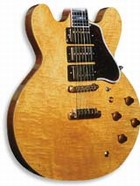
    In June of 1984 trucks came to take most of the machines out of Gibson’s historic Kalamazoo, Michigan factory and move them down to Nashville, Tennessee. The End of an Era. Shortly before, in May of ’84, the Gibson Custom Shop completed a batch of six instruments that had been co-designed by Los Angeles guitarist Mitch Holder in conjunction with Gibson R&D’s Tim Shaw and Bruce Bolen. These guitars were thin-line, semi-hollowbodies, made entirely of highly figured maple, with many deluxe, ES-355-style appointments, but with a number of interesting features that truly set them apart. They were two inches thick, not one-and-three-quarters. They had no F-holes. They had TP-6 fine-tuning tailpieces and graphite nuts. And they had three P-90 pickups with an easy-to-use switching system which allowed every possible combination available. Though never produced commercially, they were given a “model name”

  • Gibson EH-150

    Quintessential Pre-War Amp

    Introduction
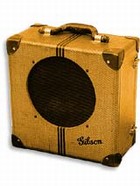
    Gibson’s E-150/EH-150 amplifiers have long been regarded as the quintessential pre-WWII model, one of the most influential and recognizable amps of all time. It wasn’t the first amp Gibson marketed for use with an electric guitar (see “Antique Amplifiers” in the September ’97 issue of VG for the first), and it wasn’t originally designed or even manufactured by the highly respected company. But it will forever be associated with the early days of Gibson’s long-running stellar electric line.

    Electric guitar pioneer and Gibson endorser Alvino Rey worked on the company’s behalf in Chicago in mid 1935, along with engineer John Kutilek of Lyon & Healy, trying to develop an electric Hawaiian guitar and amp set worthy of the Gibson name (VG January ’97). Rey had long been associated with the pre-Rickenbacher brand Electro Frying Pan and amps, which reportedly were role models for the experiments. While Gibson’s first real test run of aluminum-bodied Hawaiian models in late ’35 arguably showed little influence of the Chicago pickup experiments, the four-tube amps that accompanied the instruments had a definite leaning toward Alvino’s personal Electro amp.

    The first production wood-bodied Hawaiians of early ’36 also came with this simple circuit, but by the end of the year Gibson had an improved model it could call its own. And for the next 30-plus years, they would stay at the forefront of guitar amplifier design, a fact often overshadowed by Fender’s dominance in the vintage market. If nothing else, the beautiful tweed cabinets of the pre-WWII Gibsons set a new standard for design – no more plain black boxes!

    But more important than cosmetics, the late-’36 Gibson EH-150 stands out as the first amp to pursue the idea of tone manipulation as opposed to merely amplifying what the guitars sent their way. Rey is credited with designing the high-frequency roll-off tone control for guitars, which Gibson introduced to the world on the aluminum Hawaiians. The general idea was incorporated into the amp as a tone switch, to be used in conjunction with the tone pot on the guitars.

    More important than that grand revelation would have to be the inclusion of an extension speaker output and matching speaker/cabinet setup, which today may also not seem like such an earth-shattering event. However, the intended application of the 1/4″ jack was described in an early owners manual as follows: “Its use presents many new possibilities. The true Echo effect is obtained by placing the E-150 speaker and amplifier near the player and the Echo Speaker at an approximate 35-foot distance, preferably further from the audience and to either side. The slight soundwave lag time…creates a new and beautiful effect.”

    A second, more practical (for the time, at least) example followed.

    “When using a vocal microphone the additional loudspeaker is also desirable, permitting better and more complete coverage of the audience.”

    But while this use had been explored in PA system design for years, the “…beautiful effect” preceded all other “effects.” The idea of intentionally altering the acoustic sound of a guitar – embellishing it – and pursuing a more pleasurable sound cannot be ignored in historical contexts, for the future of Spanish guitar had little room for dry, flat tone. Remember, electric Hawaiian guitars, which inherently produced vibrato-drenched tone, outsold electric Spanish models by as much as 10 to 1 in the pre-effects days.

    This month we’ll look at four basic versions of the EH-150, which showcase a number of the technological improvements that transpired from the mid ’30s to the start of WWII. These will be referred to here as Styles 1 and 2, having the smaller “square-corner” box with 10″ speakers and Styles 3 and 4 with the “rounded-corner” box housing 12″ speakers (there were actually two slightly different sizes of each box). Closing out the offerings are a couple amps marked “EH-150,” that aren’t!

    Style 1 (1935-’36)
    Like all amps of the time, there was no control panel on the chassis of the first E-150s. The power cable, fuse holder (round, house-fuse style on earliest models), on/off switch, pilot light, and two inputs were all secured directly to the backside of the bottom-mounted, bent-metal chassis. A black crinkle paint covered all the exposed surfaces and, like many of the amps of the time, there were no volume or tone controls.

    Four tubes were laid out similar to Alvino’s Rickenbacher, to the left between the power transformer and the speaker came either a glass 80 or metal 5Z4 rectifier. Twin 6F6s for the power were mounted catty-corner to the right of the speaker with a shielded 6A6 preamp in the front right corner. This triode (actually twin triodes in parallel for Class A operation, as specified in the RCA tube manual) was fed directly by the parallel inputs and was all she wrote in the preamp tube gain department (amplification factor of approximately 35, compared to 100 for the modern 12AX7). The paralleled plates in turn directly fed the phase inverter, with no need for coupling caps.

    Like many amps of the era, phase inversion for the push/pull outputs was performed by a transformer of the center-tapped secondary type, which stepped up the voltage negligibly while providing equal but opposite signal to the power tubes.

    This device was mounted to the back wall of the chassis (opposite the inputs), as were the power supply filter caps (two large boxes). Between the front and back panels were the tube sockets, with only a few resistors and caps professionally connected using binding posts, a large grounding strip, and neatly tied wires. Whoever was building these – and it wasn’t the Gibson factory – knew proper assembly techniques (and could have taught Leo Fender a thing or two in his early days).

    Access to the interior is a breeze, with the chassis secured to the cabinet by a single large bolt from underneath protruding through the metal topside before being capped by a fancy brass nut. Alligator cloth/paper lined the insides of the tweed-covered cabinet as neatly as plaid would line a suitcase of the era, a very pleasing touch. A small label attached to the inside surface of the removable back cover (also lined) had the serial number pencilled in. This number also shows up inside the chassis and on the magnet cover of the speaker. Utah’s respected 10″ field coil model, previously used by Rickenbacher, was standard.

    Style 2 (1936-’37)
    This new and vastly improved version was included in Gibson’s Catalog X from very late 1936, along with the brand-spankin’ new ES-150 Electric Spanish Guitar. The company’s reputation apparently needed to be considered, since it took over a year from the release of the metal Hawaiians to the first serious promotion of the electric line. It’s obvious whoever was in charge cared about tonal quality and not merely making the instruments louder, as with the early model. Two independent channels were installed, one with a single microphone input and a second having a pair of instrument inputs. Each channel connected to a separate volume pot, adding much-needed control when using a vocal mic and a guitar or multiple instruments. Other new additions included the extension speaker output jack labeled “Echo Speaker” and the Bass/Normal Tone switch (see above).

    More power and gain came from two additional tubes and gain stages; a 6C5 triode driver (amplification factor of 20) prior to the phase inverting transformer and a 6N7 twin-triode preamp (amplification factor of 35) with one side for the instrument inputs and the other for the microphone channel, plus a high-mu (amplification factor of 100) 6F5 triode used in the first stage of the microphone channel, compensating for the low-output mics of the time. While considered low power by modern standards, the amp Gibson finally decided to promote is not drastically different from today’s amps, and reveals the primitive design of its predecessor in comparison. At $70, it was competitive with the better amps of the day.

    Style 3 (1937-’41)
    Another year, another new EH-150 amp – and only $5 more! The tweed case was enlarged and rounded on the left and right top edges, eliminating the need for the top four leather corner protectors (a transition model with the new circuit and the old cabinet has been reported, but these are either really rare or prototypical). Speaker size increased to a 12″ field-coil with the Gibson name on the magnet cover.

    A beefed up circuit employing seven tubes featured the relatively new 6L6 beam-power variety, in metal. The 5Z3 rectifier, 6C5 driver and 6F5 microphone channel preamp remained from the earlier model, but the twin triode 6N7 was replaced with two 6C5 triodes for the instrument and microphone channels.

    Power ratings were given for the first time, a respectable 15 watts.

    It appears this version ran for a number of years, as the picture and basic description from the late-’37 Catalog Y also showed up in catalogs Z from late ’38 and AA from late ’39, plus AA supplements dated October 1, 1940, and May 20, 1941 (shown with the slant pickup on the instrument replacing the Charlie Christian-type of the earlier catalogs). These “What’s New” flyers from ’40 and ’41 replaced the AA electric section, due to rapid changes in that segment of the line. The first supplement showed new or updated artist renderings for the EH-185, 150, and 100 Hawaiians, the EH-100 amp and the ES-150 and 100 Spanish Guitars. Number two had the second-style ES-300, the new EH-125 Hawaiian/amp set and up-to-date prices, so they appear accurate, although they did not show the change from brown alligator lining to light cream leatherette on the 150. Finally, Catalog BB included the last version of the 150 amp, referred to here as Style 4.

    Some examples from this era have two labels inside the cabinets – one for Geib, who made guitar and amp cases for Gibson, and a Western Electric licensing agreement granted to Electrical Research Products, Inc., who also made amps for Oahu, Harmony, etc.

    STYLE 4 (Ca.1941-’42)
    The final variation showed up in Catalog BB, dated 1942, with a rearranged control panel, having the tone switch replaced by a potentiometer, ranging from Treble at 0 to Bass at 9, with Normal halfway between. The picture was the once-again retouched version of the ’37 catalog’s shot. A major change in the circuit (that may have occurred earlier) was the tube phase inverter, with a twin-triode 6N7 replacing the transformer. Also new were the 5U4 rectifier and the three 6SQ7 high-mu triodes (amplification factor of 100), with two for the microphone channel and the third common to both channels.

    An interesting placement of tubes on the amp, which was not included in the retouched catalog shot, features the power tubes on either side of the rectifier tube, not standard anywhere else in the world of amps, but somewhat logical. Removal of the tubes to satisfy our curiosity revealed marked sockets from the factory, so this apparently wasn’t the result of repairman monkey business. Sadly, the Echo Speaker output was removed for the final 150, possibly to save money on the center-tapped output transformer previously used. By this time, the EH-150 and the previously supercharged EH-185 shared the same circuit design, right down to the schematic.

    EH-160 AC/DC
    Some sections of urban America still relied on direct current in the ’30s, and in rural areas DC generators were the only supply of electricity. Gibson tried to accommodate those unfortunate few electric guitarists from these districts (and foreign markets) by offering a “universal-type” power transformerless amp capable of running just about anywhere, sometimes referred to in catalogs as the EH-160.

    These were offered during the entire run of the 150, but the varieties are beyond the scope of this article. Mention should be made, however, of one that appears in The Tube Amp Book by Aspen Pitman. The 11-tube amp (page 47, Volume 3) is mistakenly noted as using a “…duet of 6L6s” when the four tubes in the back right corner should all be 25B6 power amplifier pentodes. There is a good chance this amp says EH-150 on the control panel (which matches the 150’s panel to a T), but a schematic for what appears to be this exact model, officially labeled EH-160, shows up in an old Gibson amplifier service book.

    On the far left, in front of a transformer -like device (probably the power supply choke) are four 25Z5 rectifiers. Across the front right are three metal-cased 6C5 triodes, with one driving the phase inverting transformer, a second for the microphone input and a third for the two instrument inputs. The idea of universal-type AC/DC amps had been used previously for radios and would be exploited on student models by numerous guitar companies after WWII. Usually, this type of amp’s heaters are run in series, with their total adding up to approximately 110 volts. Since Gibson wanted the amp to compare favorably to its standard model, they ran a series that included the four 25Z5 rectifiers and one of the 6C5s (106 volts total) in parallel with the four 25B6 power tubes and remaining 6C6s (112 volts – note; the first number in a tube’s designation relates the heater voltage, e.g. 5Y3 uses a five-volt supply, 6L6 uses six-volt, etc.). As to how much current the amp drew or the amount of power it could produce, we’ll have to wait until one turns up in working order.

    EH-150/185
    Another amp that gets confused with the 150 was the early version of the EH-185, Gibson’s high-end addition to the line, with removable chassis and flip-top ported cabinet. It seems many of these were fitted with control panels marked EH-150 (albeit often scratched out, as seen later on wooden Fender Pros with Model 26 panels). It’s possible Gibson planned on revising the 150 combo, but decided to leave it untouched, and instead used the ideas for an improved, all-new (and more expensive) model. So the $75 150 combo remained and the piggyback 185 with separate bass and treble controls – not to mention more power and an $87.50 price tag – got shipped with the “new” 150 panels. Were any of the combos fitted with the separate bass and treble controls? Annual catalogs and updates from ’39, ’40, ’41, and ’42 point against it, but anything’s possible. Who’s got one?

    Postscript
    While tone is subjective, many great players have had relationships with the Gibson EH-150, especially the 12″ model. The most famous and influential of these is the late, great Charlie Christian. While he is later pictured with the EH-185 and the short-lived deluxe maple cabinet EH-275, his early use of the 150 is well documented on classic recordings with the Benny Goodman Sextet.

    Even more important than these may be his after-hours jamming at Minton’s nightclub, in Harlem, where he was able to stretch and develop his ideas in a manner not possible with the Goodman band. Many feel the future of jazz guitar, and bebop in general, came out of these sessions.

    According to interviews in Peter Broadbent’s Charlie Christian: The Seminal Electric Guitarist, Minton’s manager, Teddy Hill, bought an EH-150 and a bar-pickup equipped ES-150 guitar (similar to the one from Christian’s early Goodman days) to keep at the club for his use (more on this later). Check out Charlie Christian – Live Sessions At Minton’s Playhouse on the Jazz Anthology label to hear why his playing and the sound of the ES-150 through an EH-150 amp continue to thrill and inspire listeners and players the world over, as they have since 1939. And while his playing surely could have transcended his equipment, the fact he used an EH-150 for a good portion of his career guarantees the model a place in the Vintage Guitar Amplifier Hall Of Fame.


    Special thanks to Experience Music Project, Peter Blecha, Roger Sadowsky, Ken Fallon and the gang at Sadowsky Guitars, Rod McDonald, Bill Victor, Thom and Kathy at Ross Music, Buck Sulcer, and Lynn Wheelwright.


    EH-150 guitar and Style 1 amp from first quarter of ’36.

    This article originally appeared in VG‘s Jul. ’99 issue.

  • Fresher Guitars

    Fresher Guitars

    Epic poetry is great, but all these long treatises on the massive guitar pedigrees of Kay and Aria have made me feel a bit like a Milton scholar, a fate not to be wished anyone. The Fall was bad enough. So, how about a little lyric poetry, something fresh for a change, some lighter fare at the bountiful buffet of guitar history. Let’s take a peek at Fresher Guitars from Japan.

    I don’t remember when I first heard of Fresher guitars, but somehow I knew they’d made guitars with built-in effects. Anything goofball like that is, as you know, right down The Different Strummer alley. So, when I saw a VG classified placed by Nils Freiberger from the Boston area offering one for a reasonable price, I figured it was time to hook up with one. As it turns out, Nils traveled for work and was coming down my way, so we hooked up on a chilly windy Winter day and over cheesesteaks in an old 19th Century cast-iron corner restaurant in South Philly, talked guitars and did the deal.

    Now that I had one, what was it? The knowledge quest had begun. There’s a chapter on Fresher in “History of Electric Guitars” (Player Corporation, Japan, ca. 1985), a book which is highly recommended if you can find a copy, but unless you read Japanese, this is not terribly enlightening. Fortunately, Hiroyuki Noguchi, editor of Rittor Music’s Guitar Magazine in Japan, was able to supply some outline information to help us fill in a few of the blanks.

    Fresher is hardly a household name in most American guitar collecting families, with good reason. Basically, these were primarily made for domestic use in Japan, although at least some were briefly exported at least to the United Kingdom. Despite the fact that examples occasionally show up, as of now there is no evidence that Fresher guitars were ever officially imported into the United States.

    The Fresher story begins back in 1973 when Fresher guitars were introduced by the Kyowa Company, Ltd., of Nagoya. Nagoya, you’ll recall, is one of the principal guitar-making regions in Japan. Kyowa was primarily a trading company, importing products and developing some musical instruments. The company is still in operation, importing Charvel/Jackson, Takamine and Dean Markley products, among others.

    Fresher guitars were built by the Matsumoto Musical Instrument Manufacturers’ Association, a consortium of suppliers in the Matsumoto region. This organization, by the way, did not include either Fujigen Gakki or Matsumoku, the area’s more famous manufacturers.

    Little is known of these early Fresher guitars, but Mr. Noguchi recalls them as being pretty much low end instruments when compared to other brands available at the time, including Greco, Tokai, Guyatone, Fernandes and Ibanez. Based on the evidence of slightly later designs and the vogue for copying at the time, it’s probably safe to assume these were mainly inspired by popular American designs.

    Illustrated in the “History of Electric Guitars” are three guitars which probably reflect this early line. The FL-331 was a white Les Paul Custom copy, with gold hardware, bound ebony ‘board, block inlays and a pair of gold-covered humbuckers. This appears to be a glued-neck guitar. About the only difference seems to be a slightly exaggerated center dip on the open-book headstock. The FN-281 was a copy of the Fender Competition Mustang done up in a blue finish with white stripes, maple fingerboard and black dots. The FN-384 was a black copy of a Rickenbacker 4001 bass, complete with triangle inlays.

    As the Seventies progressed, quality began to improve and designs to get more original. In 1977, Fresher introduced the onboard electronics for which it will, most likely, be best known in guitar history. Initially three “Built-In 5 Effects” models were a Strat copy, like the one I got from Nils, a Les Paul and a Firebird.

    At least two numbering schemes have been encountered for the same models of guitars, and there’s no way to tell if the number is a clue to sequence, or whether the numbering relates to different markets. Since these model numbers don’t appear on the guitars themselves, such a distinction is probably academic. We’ll leave that to the Milton scholars!

    The Strat was both the FS-1007 and the FSC-100. This was a copy of a late-’70s Fender Stratocaster with a white ash body, solid bolt-on maple neck, big Fender-style headstock, brass nut, maple fingerboard, black dot inlays, three single-coil pickups, an adjustable bridge/tailpiece assembly, a pickguard that looks like a Strat except for a sort of genie tail on the lower bout where the electronics controls were mounted. In lieu of a traditional fiveway select, the FS-1007 had two threeway minitoggles which controlled either the front and middle or back and middle pickups, both sharing the middle pickup, in a most curious arrangement! Each of these was then hooked up to separate volume and tone control, yielding four knobs rather than the usual three. Finish was natural oak.

    Of course, what’s more of interest here are the onboard effects. Because it is so curious, let me quote at length from the catalog which Mr. Noguchi kindly faxed to me. This is written in that wonderful English which I’ve come to recognize as typical Japanese translation. You may be amused by the errors in grammar and syntax if you’re not familiar with this style, but it reflects what happens to the intrinsic differences in two languages with quite disparate etiologies when they collide in the form of advertising hype!

    “‘FRESHER’ JUST CREATED NEW FANTASTIC ELECTRIC GUITAR. ‘FRESHER’ have developed just new fantastic electric guitar in which body 5 Effectors are enclosed compactly, so that players can freely creat [sic] their own fantastic effect sounds just by momentary arrangement of the switches and controllers without any troublesome setting like as pedal system effectors.

    “No only individual effect sound but alternative sound by mixing effect sounds can be made. Of course, the normal sounds can be enjoyed. Also, players can change the order of connector between AutoWah and Phase Shifter.

    “Now, players need not to carry effectors separately and to connect them with cords. So. Free from noise. Free from setting trouble. Economical costs rather than the total costs of electric guitar plus five effectors. Only ‘FRESHER’ satisfy the demand of Jazz Rock guitarists who are enthusiastic to have new sounds.”

    The five onboard effects included phase shifter, auto wah, sustainer, distortion and power booster. These were controlled, overall, by a bypass minitoggle allowing you to kick them in or out at will. Three additional minitoggles then controlled the five individual onboard effects. Each of these then hooked up to a separate potentiometer which basically served as a volume or speed control, depending on the effect. Simplest to operate was the sustain, which had its own toggle for off or on. The other two operated with a threeway toggle, both off in the middle. One controlled either auto wah or power boost, the other either phase shifter or distortion. In essence, you could have up to three of the five effects in combination at any one time. Finally, there was a little red battery power light.

    The Les Paul was called both the FL-1005 and the FLP-100. This was a pretty good reproduction of a Gibson Les Paul Custom, with a solid carved maple top over a mahogany body, a glued-in mahogany neck, Rotomatic tuners with tension controller, bound headstock and fingerboard (no split diamond on the head, by the way), block inlays, brass nut, twin humbuckers, threeway select, twin volume and tone controls, elevated pickguard, finetune bridge and stop tail. The FL-1005 came outfitted with Gibson strings! This was available in a natural oak or tobacco brown sunburst. Unlike a Les Paul, however, this had the Fresher Built-In 5 Effects.

    The Firebird was called the FF-1003 and the FFD-100. This handsome devil was a neck-through-body guitar made of all-mahogany. The headstock was carved bi-level and two-tone, just like a real Gibson. The rosewood fingerboard was bound with dots. It had a brass nut, combination bridge/stop-tail, two mini-humbuckers and a black pickguard which began like a Firebird but stretched all the way down the guitar to hold the electronics. On the lower horn were two toggles, a threeway select and the effects bypass switch. Otherwise, the effects were the same.

    OK, so how do they work? Well, based on the one I have, not bad, all things considered. As usual with onboard systems, the effects tend to be a bit “thin,” and switching is noisy, something that often happens as these guitars age. If you are an effects purist, you want a good pedal. But if you like those cheezy effects that can only be gotten with an onboard circuit board, these are pretty cool. And like the copy says, you don’t have to schlepp around a bunch of pedals and cords.

    Actually, the guitar I have differs slightly from the guitars shown in the Fresher catalogs I’ve seen. Mine is called a Fresher Straighter (which the others may be too). Unlike the previous guitars, which have the logo written in an angular script, mine has the logo in a Fender-style spaghetti script. The Straighter is wrapped along the lower edge of the headstock much like the word Stratocaster on a Fender. Stand back and squint your eyes and you’d swear it said “Fender Stratocaster” instead of “Fresher Straighter!” Mine also has a more traditional fiveway select and one volume and two tone controls, like a normal Strat. Mine also has a rosewood ‘board with pearl dot inlays. Otherwise, it’s the same. The strings on mine pass through the body and are secured with ferrules.

    Another version of the Fresher Straighter was made with a traditional Fender-style vibrato.

    It’s not clear how long these effects guitars were made, but probably not long. I’d be surprised if they made it to 1980.

    Textual evidence from the catalog copy suggests that Fresher may have still been making these guitars as non-effector reproductions at this time.

    Perhaps even more interesting than the Built-in 5 Effects guitars were the Fresher Preamp guitars introduced in around 1978. These were equal double cutaway solidbodies with neck-through-body construction clearly in the same mode as other guitars popular at the time, including the Ibanez Musician and Aria Pro II Rev-Sound, all inspired by the success and aesthetics of Alembic.

    Two Fresher Preamp guitars were offered, the FX-309G and the FX-509. Both had wide shallow cutaways, almost perpendicular to the two-octave neck, with sharp little points on the horns. The neck was a five-ply maple-walnut laminate ending in a dramatically tapered three-and-three headstock, almost like a Paul Reed Smith, with a large concave scoop out of the top, the upper edge extending beyond the lower. The nut was brass. The fingerboard was bound and possibly made of an ebonized maple, if the copy is to be believed (or understood), inlaid with large oval position markers. Two twelve-pole humbuckers were mounted on metal surrounds. The stud-mounted bridge/tailpiece assembly was finetunable and had those little set-screws in the back to let you adjust them further. A brass sustain block was mounted in the body under the bridge. Hardware was gold. The FX-309G had one rotary pickup selector on the upper horn, while the FX-509 added a second rotary selector on the lower horn, yielding “18 settings.” These had white ash bodies which could be finished in natural oak or a two-tone light and dark color combination.

    Here’s what the copy said about the electronics. “The ultimate for Tone Variation. Fresher Preamp guitars offer the greatest variety of tone variations available today.

    “Using an On-Board Equalizer Preamp system, the player can control a wide range of Treble, Middle, and Bass sensitivities independently. And there rich tone variations can be controlled with out high frequency loss.”

    Basically the controls were four knobs set along a metal Tele-like strip on the lower bout and included a master volume, treble, middle and bass tone controls. The preamp was operated by two 9-volt batteries.

    Both the Built-in 5 Effects and Preamp guitars were offered in the United Kingdom in 1978 carrying the Kimbara brand name. The Effect line included the Kimbara 181/V Les Paul copy and the Kimbara 183/Y Strat with vibrato. This latter had the maple ‘board and the headstock simply read “Kimbara” with no faux-Stratocaster “Straighter” to confuse the issue. The Kimbara 183/B was basically a dark natural finished version of the FX-509.

    At least seven other guitars were offered in the Fresher line in around 1978 or so, several of which are quite curious, as well. These were essentially “copies,” but some took liberties with their inspirations.

    The EX-670 was a pretty faithful copy of a Gibson Explorer, with a glued-in neck and appointments essentially the same as the original. The SL-380 was a copy of a Gibson Thunderbird bass. The FS-556N was basically a Strat copy with a natural ash body, with Fender-style head, maple ‘board, traditional vibrato and pickguard with three single-coil pickups. What was different was the neck, which stretched all the way through the body with a heelless neck joint.

    Also offered was the BM-270 which was a copy of Brian May’s famous potato-shaped guitar. This had three pickups and was a dead ringer for the original. There was no date on this catalog, so I’ve assumed a late Seventies date. Even if it’s slightly later, this copy of May’s guitar appears to predate May’s arrangement with Guild.

    Also curious was the FX-840, which was a pretty good copy of the Ibanez Artist model. This had the twin small double cutaway horns, twin humbuckers, and a glued-in neck with a bound fingerboard with trapezoid inlays. The only difference was a three-and-three headstock with a flared crown.

    Two other strange hybrid guitars were offered. The FW-810 was an offset double cutaway with a body very similar to the Ibanez Studio series, which also dated from 1978. This had a pair of humbuckers attached to a six-position rotary select on the upper horn. This had a tapered headstock with an asymmetrical concave scoop out of the top, basically the same as on the Pre-Amp guitar, and not unlike the Ibanez Artist headstock. The FY-820 was an odd bass which had an exaggerated ash Fender P-Bass shape with a single split-coil pickup, a goofy batwing pickguard under the strings, maple fingerboard, and a neck that ended in a Firebird/Thunderbird headstock!

    In the early Eighties Fresher introduced another wonderful guitars which it advertised as being designed for the year 2001, the FX-700. This was a very angular Explorer with sharp points at each angle. It was done up in black with natty red binding, including on the fingerboard, which also had red dots. This had a locking vibrato system that looked like a Kahler and a pair of humbuckers with exposed staple pole pieces, threeway, volume and tone.

    At least two other Strat variations were available in the early Eighties as well, the FS-380S and FS-380H, the former with single-coils, the latter with a pair of humbuckers. This had a pickguard, and the humbuckers were covered in black plastic, with no poles visible. Hardware was black, with a traditional vibrato.

    At least one bass from this later era was offered, the FSP-850. This looked remarkably like a Riverhead Jupiter, with a rounded crown on the two-and-two head, a slim, offset double cutaway body with an extended round upper horn and an outwardly flared thinner lower horn. This had two single-coil pickups, threeway and two volumes and two tones.

    Clearly, these were not the only guitars offered by Fresher toward the end, but these are the only ones I’ve seen, and those were in photographs only.

    The Kyowa Company stopped producing Fresher guitars in 1985, and thus ends our brief saga. If you know more about this obscure Japanese brand, I’d welcome the information. But, at least now you know something the next time you encounter a Fresher Straighter with Built-In 5 Effects! Thanks to Nils Freiberger and Michael Lee Allen for giving us the opportunity to explore as much as we have.


    Ca. 1978 Fresher Straighter Strat copy with the Built-In 5 Effects.

    This article originally appeared in VG‘s Sep. ’95 issue.
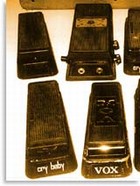
  • Fender Prototypes

    Gone... And Forgotten

    Philip Kubicki has been active in the music industry for over 30 years. He began building acoustic guitars at age 15. At 19, he was one of the first employees to be hired by Roger Rossmeisl, of Fender Musical Instrument’s research and development department for acoustic guitars. Nine years later, he moved to Santa Barbara, California, and established his own company, Philip Kubicki Technology, which builds acoustic guitars, custom electric guitars, bodies and necks, and mini-guitars. Phil currently manufactures the Factor Bass, designed in 1985, and recently introduced the Key Factor 4 and 5-string basses.

    This is the first of many stories Kubicki will share with VG readers in the coming months. Look for other Kubicki articles in the May, September and November issues in 1997.

    Reflecting back through my years in the guitar industry, much of my time has been spent in product development, prototyping, and the making of specialty guitars. In recent years, quite a bit has been written about the prototypes of instruments that made it to the marketplace. But what about the ones that didn’t, and the people who made them?

    Because of the developmental nature of invention, a series of prototypes is usually built. Beginning with the first model, refinements are made, then it is abandoned to build a new model incorporating the changes. Each of these prototypes becomes a betterment of the one before, until everything that was learned, solved and designed is integrated into the final prototype. The better the engineering and marketing synergy, the fewer the prototypes and the shorter the developmental time. If a patent is to be pursued, the patent process must be initiated before the product can be shown publicly. Then, it is test marketed for salability.

    Prototypes are rare indeed. Very few escape the possession of the parent company. Many are retained by the owner, founder, inventor, company or the immediate family for historical or personal reasons. A few are given to people who have been loyal and valuable to a company, as a memento of a time that was. Many have been destroyed, their true value not realized at the time they were built. The next time you see a real prototype, think of the moment in time when its creator was optimistic for its success, and when it was the only one of its kind in existence.

    A famous prototype is the very first Telecaster, which has been written about extensively and seen at guitar shows around the country. This guitar’s importance lies in the fact that there was a time when it was unique, the one and only Tele on the planet. From a guitarmaking standpoint, I view it as the most valuable of all Teles in existence. Others have been made famous by musicians and events, but this one represents the hands-on product of Leo Fender and George Fullerton’s work. It is also important that a prototype can be authenticated, as George Fullerton has done.

    The rarest prototypes are those abandoned after failing test marketing. Their value at the time seemed nil because they never made it into production. They have been put away and forgotten. Fender’s Marauder, Mod and Rocker, Songwriter, and Headless bass are just some examples of their abandoned prototypes.

    Since I am in the business of making headless basses, I’ll start with the story of the Fender headless bass, which was developed by Gene Fields in 1975. I got to know Gene during my years in the R&D department.

    Gene was with Fender research and development for 23 years! Some of his designs include the P.S. 210K keyless pedal guitar, the Starcaster thinline hollowbody guitar, and the second generation Marauder guitar. He also worked with Leo Fender on the Mustang bass, the Musicmaster bass, the Bronco and others. His last six years with Fender were in the string division. There, he was responsible for the introduction of automatic string winding machinery into the production line, the development of several sets of guitar and bass strings, and was involved with machining and testing of strings.

    In 1984, he joined Sierra in Portland, Oregon, designing guitars and basses before moving to M.C.I. Intertech as general manager of the pedal steel guitar division. Two years later, the company was purchased by the Fred Gretsch company, and rather than relocate again, Gene formed GFI Musical Products in Arlington, Texas, building high-quality pedal steel guitars.

    A few years ago, I went to the Arlington Fall Nationals guitar show and bumped into Gene. We had not seen each other for 20 years, so we grabbed a cup of coffee and sat down for a talk. As I told Gene about my company and our “Headless” and Key Factor bass guitars, he said he had something interesting to show me. I was amazed when he produced a Fender headless bass prototype. I was surprised because I never knew a project like that was ever developed at Fender. I asked Gene to explain how this instrument came to be. Here is his story.

    Historically, the first electric basses were developed as a smaller, lighter, more portable alternative to the upright bass. These early instruments were fitted with strings made with a nylon filament running along the steel core, inside the winding, to purposely eliminate some of the sustain in order to mimic the upright bass sound.

    As the years went by and music changed, bass players wanted a brighter sound. String manufacturers responded with roundwound and flatwound strings with as many as three layers of wrap. This produced a new problem. The bright sound created by these new strings, accentuated the “dead spot” found on some basses, on the G string at the fifth or sixth fret.

    Gene was asked to research the cause of this problem and eliminate it if possible. He tried many things, including double truss rods, all-maple bodies, uncarved necks to make them stiffer, as well as a multitude of different strings. Finally, he made a solid aluminum neck.

    All this research resulted in making the dead spot move to new areas of the neck. The Aluminum neck moved the dead spot up to the seventh fret. This was the clue Gene was looking for, it told him the dead spot was a result of the resonant frequency of the neck. At this point, Gene attached a 11/2-pound C clamp to the head of a stock P-Bass neck as ballast, to dampen neck vibration. This had the effect of moving the dead spot down in frequency and almost disappearing.

    Unfortunately, as most key-headed bass guitars are head-heavy to begin with, adding weight to the head was out of the question. An opposite approach was to lighten the head of the neck. Gene took another stock P-Bass neck and removed all strings but the first one. This moved the dead spot up in frequency but did not eliminate it. Then Gene installed the first string in the fourth string position, removed the other three keys and began sawing off the head 1″ at a time. He found that each time additional weight was removed from the head of the neck, the dead spot would move up in frequency. Then, Gene removed the last key, cut all but 1″ of the head off and drilled a hole for the ball end of the string. A clamp was used on the body to tune the string. The dead spot moved to about the 14th fret, to the point of no longer being a problem.

    Gene’s research led to his designing a completely new instrument, the first Fender prototype headless bass. The instrument consists of a maple neck-through body with mahogany wings. The neck has a 32″ scale with 23 frets and black position markers. The body is cut to a stylized Jazzmaster shape with a carved top similar to the LTD jazz guitar. The body-mounted tuner is a simple right-angle pull design with tuning knobs in the tailpiece. Individually adjustable bridge sections are used, as well as individually-adjustable mutes. The neck pickup is humbucking, while the bridge pickup is a P-Bass with a special cover. Two switches provide pickup control and phase reversal.

    When this instrument was field tested, it got very good results. But marketing thought it was too radical for its time, so it was never produced. Eventually, Fender gave the bass to Gene, and it is still in his possession.


    I’d like to thank Gene Fields for sharing his story with us.


    The 1975 Fender Headless Bass, prototype.

    This article originally appeared in VG‘s Feb. ’97 issue.

  • Fender Aluminum

    Aluminums Unwrapped

    Part of the guitar collector’s creed (an unwritten, unofficial entity, to be sure) includes axioms such as “Beauty is in the eye of the beholder,” or “The right to pursue whatever makes you happy…” Basically, there are no rules, and the hobby lends itself to an amazing array of personal tendencies within one very defined element. Some chase ‘Bursts, others pre-war Martins, D’Angelico’s, etc.

    For some, happiness is an aluminum-bodied Fender. Fender made the aluminum-bodied Harley Davidson Stratocaster in 1993 and later its metal brother, the Freddy Tavares Aloha Stratocaster. Both instruments featured engraved, chrome-plated aluminum bodies.

    But in 1994, Fender’s Arizona factory produced a small number of aluminum American Standard Stratocasters and a much smaller number of aluminum American Standard Telecasters in three unique anodized finishes – purple marble, blue marble and red, silver and blue flag – which gave the guitars an indescribably unique appearance to match the singular sound produced by their hollow bodies. They are unlike anything Fender produced before or since.

    In addition to the aluminum American Standards, Fender made three other unusual aluminum-bodied Stratocasters in its California custom shop. The first has a shiny, chromed body, like the Harley, with a black Custom Shop pickguard and black headstock. A near mirror image is the jet black aluminum Strat, with its black body, chrome pickguard and black headstock. Only six were made. The third is green, with chaotic black lines and gold catsup bottle swirls.

    Joe Schneider, a collector in Hollywood, Florida, is the only person known to have compiled the complete nine-guitar set, in a labor of love that spanned several years and included a detailed nationwide search.

    Schneider’s first aluminum was the purple Strat, which he bought from ABE Music, in Miami.

    “The owner had it put aside for two years, intending to keep it for himself,” he said.

    The dealer told Schneider that in addition to being made in limited numbers, many of the aluminums had small flaws (dents caused by the molded interior of their cases), and when many dealers returned them to Fender, the guitars were deemed irreparable and thus were replaced under warranty.

    After acquiring his first aluminum, Schneider immediately contacted Fender customer service to get the full story on the metal rarity. Fender customer service representative Bob Wilex told Schneider that although exact production figures were unavailable, Fender manufactured approximately 400 aluminum Stratocasters and 100 aluminum Telecasters. Wilex also explained the history of the three finishes and said Fender has no plans to make more aluminums.

    Schneider was later told (by non-Fender sources) that Fender was no longer purchasing aluminum bodies from the manufacturer. And in fact, dealers were selling unfinished aluminum bodies at guitar shows.

    After his conversation with Wilex, Schneider set about tracking down one aluminum American Standard in each finish.

    “I started by calling local music stores. One Fort Lauderdale store had a flag [finish] Stratocaster that was on layaway for a year,” he said. “It had added some features I didn’t see on the others – a 40th anniversary Stratocaster pin on the headstock and an engraved 40th anniversary neck plate.”

    Schneider then started calling music stores around the country. Many of the dealers he spoke to didn’t even know Fender made aluminum guitars, and several who received aluminums sent them back to Fender because of defects. Still others had recently sold their entire stock.

    Scouring the country, Schneider eventually found all the aluminums, except the purple Telecaster. Through a major sleuthing effort, he learned about a former Virginia music store employee who had one.

    “When I finally tracked him down,” Schneider said. “He told me ‘I know what I got and I ain’t selling.’”

    Finally, Schneider placed a want ad in VG, and he quickly received a message on his answering machine from someone in Rochester, New York, who had a purple Tele.

    “I thought my friends were playing a trick on me,” he said. “But sure enough, when I called, the voice on the recorder was real, and the set was completed.”

    When Ron Bicknell, manager of the Hallandale (Florida) Guitar Center, heard about the collection, he asked Schneider to put it on display. Guitar Center circulated a press release nationwide, and the collection was exhibited at the store from February 1 through April 30 of this year. It generated worldwide attention, and people from around the country, as well as collectors in England, Japan, Germany and Singapore, contacted Schneider about the aluminums.

    “One caller told me he drove through 16 states in search of an aluminum Telecaster,” Schneider said. “And he didn’t find one.”

    Many callers sought advice, others talked about their one-of-a-kind aluminum Stratocasters, ordered from the Fender Custom Shop.

    Schneider is often asked how the aluminums sound.

    “Through an amplifier, they sound just as good as any other American Standard Stratocaster or Telecaster. Without an amp, they have a nice, resonant, acoustic quality. The playability is also similar to their wooden counterparts, except aluminums are comfortably lighter.

    “The necks on the Custom Shop Strats are highly-figured maple,” he added. “The jet black and chrome Strats have ebony fingerboards and play well with a slide. The aluminum American Standards have maple necks, with and without rosewood fingerboards.”

    The Fender aluminums are a rare anomaly that likely will never be reproduced, but they will certainly continue to pique the interest of guitar enthusiasts well into the future.


    Serial Numbers
    Blue Stratocaster #N536963
    Blue Telecaster #N504254
    Purple Stratocaster #N557485
    Purple Telecaster #N4952912
    Flag Stratocaster #N4184772
    Flag Telecaster #N502623
    Chrome Stratocaster #CN400991
    Green Stratocaster #CN30364
    Jet Black Stratocaster #3 of 6


    The Stars and Stripes (a.k.a Flag) Tele and Strat.

    This article originally appeared in VG‘s Jul. ’97 issue.