Month: June 2001

  • Sean Watkins – Let It Fall

    Let It Fall

    Sean Watkins is one third of the young Grammy-nominated supergroup Nickel Creek. Along with his sister Sara and mando phenom Chris Thile, they’ve lit up the festival circuit with fresh musical energy. Let it Fall is Sean’s first solo album, and it showcases his superb chops and mature musical sensibilities.

    All but one of the selections here are instrumentals, the exception being the title cut, which features Glen Phillips on lead vocals, backed by Sean and Sara. It may even get some airplay on AAA/Americana radio stations because it is so moving and melodic. On the rest of the album, Watkins’ musical styles span from moody acoustic folk, to celtic, bluegrass, and jazz-inflected “newgrass.” At the end of the disc, if you’re very patient, you’ll discover a bonus track of Django-like jazz.

    Other musicians include Jerry Douglas on dobro, Stuart Duncan and Luke Bulla on fiddle, Dennis Caplinger on banjo, Todd Phillips, Kevin Hennessy, and Bob Magnuson on bass, and Duncan Moore on drums. Watkins produced the CD, which was recorded at four different studios. David Glasser, Airshow Mastering, roped the disc together and gave it a spacious and natural soundstage. This fine CD shows that musical sophistication is certainly not a function of chronological age.


    This review originally appeared in VG‘s June ’01 issue.

  • Reverend Slingshot

    Modern Sound with a Cool Vintage Vibe

    Many Vintage Guitar readers are probably familiar with Reverend guitars, designed and built by Joe Naylor in Michigan (VG, May ’99). Naylor created Naylor Amplifiers, but later left the company to started this new venture. As someone knowledgeable about tone and what players want to hear in a guitar and amp combination, Naylor set out to develop a distinguishing instrument that would be more versatile and offer more than the typical Strat or Les Paul.

    The Reverend Slingshot we received for review has an eye-catching appearance with a cool retro vibe. The body on our sample has a flat black finish trimmed with a spiffy silvermist pickguard and a chrome-plated armrest. The first thing we noticed about the guitar was its super light weight. The Slingshot’s body is semi-hollow and has a mahogany center block with a steel sustain bar that runs through it, for added sustain. The top and back are made of a wood-based phenolic material, and sides are molded. With its hollowed-out chambers and solid center block, the body rings loudly and resonates nicely when played acoustically. It’s loud enough for practicing without using an amp.

    The neck is made of solid maple with a rosewood fingerboard and dot inlays. It has a 251/2″ scale, 22 jumbo (I mean jumbo) frets, and bolts onto the body. The neck is straight, the frets are level, and the fret ends are smooth. The neck is comfortable and easy to play, and the added fret height (over a typical Strat neck or Les Paul fret) is super for bending and fluid finger vibrato. The neck’s shape is thin from side to side, with a C-shaped profile around the back and a smooth satin finish. It’s much fatter than a typical Strat neck and the frets are gargantuan in comparison. The headstock’s design mimics the shape of the pickguard, and complements it well. There’s no pitch on the headstock, like on a Fender, so two string trees keep the first four strings seated and crossing the nut at proper breaking angles.

    The Slingshot’s hardware is plain, simple, and straightforward – no bells and whistles here, just basic, effective equipment. The tuners are six-per-side with enclosed gears that hold the strings firmly in tune. At the other end, a through-body, fixed six-saddle bridge secures the strings, like a Tele, for maximum sustain. The intonation was accurate and the action was set just high enough to give the strings a bit of height to resonate.

    The Slingshot is loaded with two white-covered Reverend P-90 pickups with a three-way pickup selector, master volume, and tone controls. Now let’s plug in and take it for a spin.

    For a decent cross section of sounds for rhythm and lead with clean and dirty settings, we tested the Slingshot through a trusty late-’60s 100-watt Marshall Super Lead plexi with two 4 X 12 basketweave cabinets, and a ’77 silverface Fender Twin Reverb combo. The Slingshot combines the best tonal characteristics of several popular instruments and creates its own unique personality. It unites the spank and punch of a Tele, the beef and bite of a Les Paul Special, all mixed with the sparkle and airy qualities of a Danelectro. This versatile combination works favorably with clean and distorted amp sounds. Chords cut through and you can distinguish the ringing of each string. Single notes pack plenty of power and punch, too. The Slingshot really cuts through for playing leads.

    To sum it up, the Slingshot’s tight, fat tone lends itself well to blues, rock, country, and just about any electric musical style. If you’re investigating the market and looking for a new instrument, check out the Slingshot and any other Reverend model. They look great and sound even better.


    Reverend Slingshot
    Type Of Instrument: Semi-hollowbody electric guitar
    Features: Semi-hollow body with phenolic top and back, molded sides; bolt-on maple neck with 22 jumbo frets and 25-1/2″ scale; two Reverend P-90 pickups with 3-way selector, master volume and tone controls; fixed bridge; 6-per-side enclosed tuners
    Price: $879 w/Reverend gig bag
    Contact: Reverend Musical Instruments, 23109 Gratiot Avenue, Room #2, Eastpointe, MI 48021, ph. (810) 775-1025, www.reverendmusical.com.


    This review originally appeared in VG‘s Nov. ’99 issue.

  • David Clayton and Todd K. Smith – Free: Heavy Load

    David Clayton and Todd K. Smith

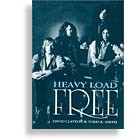
    This epic chronicles the story of the seminal British blues/rock band Free. Leaving no stone unturned, and with the help of more than 400 photos, authors David Clayton and Todd K. Smith have painstakingly detailed the rise and fall of the band from its early pub gig days in late-’60s London through the massive chart success of “All Right Now,” to the varied fortunes of vocalist Paul Rodgers, drummer Simon Kirke, bassist Andy Fraser, and guitarist Paul Kossoff (VG, May ’00).

    Obviously a labor of love, Clayton and Smith have transformed the magic of Free’s music and the chemistry of the band into print through conversation with the surviving members and others, including Al Kooper, Chris Blackwell, Andy Johns, Ritchie Blackmore, and more. Given the perspective associated with the passage of time, the writers are able to give Free its place in rock history as a significant and important musical force.

    While never enjoying the huge commercial success of their contemporaries in Led Zeppelin, Free’s early live performances were legendary and often shattered attendance records set by The Rolling Stones and The Who in their native U.K. Heavy Load reads like a comprehensive who’s who of late-’60s/early-’70s rock bands, particularly those British.

    The story within is of the genius and tragedy of Paul Kossoff, whose early playing earned him legions of fans, including Eric Clapton. But sadly, the drug use present in his life since late childhood eventually destroyed his body and contributed to his untimely death in March of ’76, at age 25.

    Of particular interest to guitar aficionados are the descriptions and superb photographs of Kossoff’s instruments (most are late-’50s Gibson Les Pauls) and amplifiers we now consider vintage and collectible.

    In a time of cookie-cutter approach to musical biographies on TV music channels, Heavy Load paints Kossoff, Kirke, Fraser, and Rodgers as vibrant-yet-human musicians, not Spinal Tap-ish caricatures. The quality of the writing and the drama of the story ensures it will appeal to fans and non-fans alike.

    At $58 ($35 for the book, $23 for shipping from England) Heavy Load is not cheap, but it’s arguably one of the best books ever written about a rock band, and it’s the definitive Free book. For more, contact Todd Smith at The Cutting Edge, (215) 657-8651, tkscutedge@aol.com.


    Kirke, Bundrick on Heavy Load
    VG recently had a chance to talk to former Free drummer Simon Kirke and keyboardist John “Rabbit” Bundrick about the new book, Heavy Load, the story of Free. After the breakup of Free, Kirke went on to fortune and fame with Bad Company, and Bundrick has played with a host of big names including Bob Marley, Johnny Nash, Mick Jagger, and Snuffy Walden. Since 1979, he has been keyboardist with The Who.

    Vintage Guitar: What went through your minds when you heard a book on Free was in the works?

    Simon Kirke: My first thought was, “About bloody time!” It’s been so long since Free was around, but I suppose time has added to the mystique somewhat. The story is such a classic one of humble beginnings and the triumphs and tragedies that befell us. I think it makes for compulsive reading. It also gave everyone involved a chance to tell their tale.

    John Bundrick: My first thought was, “Oh boy, they’re not gonna let Free die. Free is still alive and well in the souls of the fans.” Naturally, when I heard that (Free historian) David Clayton was heading it up, I knew it would be good. Dave is very thorough. It’s always a real treat to see photos in books like this, and Dave filled the book up, bringing back all those lovely memories. Very nice touch!

    Thoughts on accuracy, completeness of the story, and overall writing?

    Simon: I was impressed. David really loves the band, and it shows. He and Todd Smith spent years putting it together. I was also very moved by the stories. Most of the events took place over 30 years ago and I had forgotten them. The oral history aspect of the book worked well, gave it a conversational feel…

    Bundrick: I thought it was a very professional job. So good, in fact, I’m gonna give my copy to Pete Townshend. The cover design is excellent, showing the real Free at its best. Overall, the accuracy was spot-on, however, any time you deal with a pot of memories, somewhere along the way, somebody remembers an event a little bit differently, but in all, Dave and Todd juggled it beautifully. The story will never really be complete, because all of us except Koss are alive and still very active – in reality, as offshoots of the original Free lineup.

    What do you remember most about your time with Free?

    Simon: The high points include performing at the first Isle Of Wight festival, Wilson Pickett’s version of “Fire & Water” – Paul Rodgers was on cloud nine for weeks after! Also, receiving our one and only gold disc for “All Right Now,” shows at Sunderland and Newcastle during our heyday – scenes you would not believe. And, touring with Traffic and the Muscle Shoals rhythm section in ’73, Pete Townshend coming up to our van and saying how much he liked “All Right Now.” Ditto Elton John.

    Bundrick: The main vibe I remember was one of honest, completely unbending, hard, hard, work with the four guys who brought me into the fold without any prejudgement. I can recall the smell of Basing Street Studios, the family-type vibe from Island Records’ Chris Blackwell and all their staff, and all the other bands on Island. We were like farm animals in Blackwell’s Barn! Just slopping it out, trying this and trying that.

    Touring with Free was always a treat. I felt like I was in the big time, playing with the big boys. These guys really knew their stuff, so I was with the right crowd, you can be sure. Whenever Paul would sing, you knew you were in the right place – onstage with him. Simon and I always got on, and are still good friends today. As detailed in the book, Simon was the peacemaker. He stepped in the middle of trouble several times, but nobody was gonna mess with him, so any trouble soon got dispersed.

    Overall, the experience of recording in the studio and doing the wonderful tours was an experience I have never matched.

    Since the breakup of the band, do you think Free has been given its proper place in rock history? What should its legacy be?

    Simon: Free should be in the Rock and Roll Hall of Fame, quite honestly. We influenced a lot of bands and although we didn’t sell as many records in the States as in England, there’s still a lot of respect for us. Whether or not we will remains to be seen.

    Our legacy was a blues-based, soulful music played with passion and feel. We lived and died for that band.

    Bundrick: I don’t think Free has been given its proper place in rock history! I’m sure it’s due to the fact it didn’t survive long enough to conquer the American market. They hit on it, but never kicked it to death. So they didn’t have the endurance of, say, The Who or The Stones. Free could have been just as big, in my eyes. With a singer like Paul Rodgers onboard, it’s pretty hard for the boat to sink! In fact, I think Paul should have his own place in the Rock and Roll Hall of Fame.

    Free’s legacy is as the band that started it all in the ’70s! The godfathers of white soul music! They influenced a slew of bands like Foreigner, Kansas, Humble Pie, and all of the singers who mimic Paul. His phrasing is very original, and when you hear a singer using his style, you easily pick up on it.

    What would you like the readers of VG to know about Free – little-known facts, anecdotes, etc.?

    Simon: We schlepped Eric Clapton’s totem pole up and down the West Coast leg of the U.S. Blind Faith tour in our bus. He has it in his garden in Surrey. Also, the guitar he swapped with Koss on that tour (’59 Les Paul Standard) was just auctioned for $100,000 for charity.

    Bundrick: I’d like people to know that Paul Rodgers and I don’t hate each other. It’s a myth generated from one bad encounter in ’72. He’s the finest rock singer on the planet, bar none!

    What have you done in the years since Free?

    Bundrick: Paul and Simon went on to Bad Company, who recently reformed for a reunion tour. Paul is with them off and on, plus he does his amazing solo work. I went on to join The Who. Also, we must not forget Tetsu Yamauchi, the bassist who took over from Andy in Free. Tetsu was an admirable replacement, and he now lives in his home country of Japan. Richard Digby Smith, our resident engineer at Island, was my mentor and helped me wade through all these different English-type muses, and explained what was going on.

    So, really, the story of Free goes on!

    Simon: Since the Bad Company reunion tour, I’ve been on a couple more All-Starr tours with Ringo. I write songs and do sessions, and at the moment I’m involved with film scoring and supervision. I live in New York City with my wife and four children.

    For more on Bundrick, see www.johnbundrick.freeserve.co.uk.


    East Coast guitarist/songwriter Tom Guerra is working on the followup to his debut CD, Mambo Sons, on The Orchard Records.

    This review and interview originally appeared in VG‘s June ’01 issue.

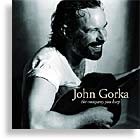
  • John Gorka – The Company You Keep

    The Company You Keep

    John Gorka is the energizer bunny of singer/songwriters. He just keeps going and going. Each new release not only equals the quality of his last, but exceeds it. The Company You Keep is John’s eighth album. It features not only superb songwriting, but sterling performances.

    While some songwriters create great melodies, Gorka’s forté is his lyrics. The clever wordplay on “Hank Williams Senior Moment” and “Around the House” makes you think while you’re tapping your feet. His songs can also be evocatively beautiful. “When You Walk In” has a haunting quality reminiscent of the best work of Mark Cohn or Jessie Winchester.

    Joining John is Micheal Manring on bass, Peter Ostoushko on fiddle, Den Magraw, Patty Larkin, and John Jennings on guitar, and Lucy Kaplansky, Ani DiFranco, and Mary Chapin Carpenter on vocals.

    Production credits are shared by Gorka, Andy Stochansky, and Robb Genadek. The sound is warm and intimate, yet texturally intricate. This is a CD that will quickly become a cherished possession.


    This review originally appeared in VG‘s June ’01 issue.

  • Charly Baty

    Feelin' Good All Over

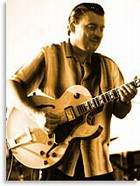
    You really have to love a guy who smiles as much as Charly Baty does as he snakes his way across the stage, spurring his jump blues band, Little Charly and the Nightcats, through wild stylistic changes.

    Pulling jazz lines out of a Gibson ES-295 in the middle of one tune, then doing out-of-phase Texas blues licks with a Strat in quick succession, only hints at the versatility of this well-rounded guitarist.

    “Yeah, I enjoy all kinds of guitar music,” Baty said. “Although I really spend most of my off time listening to jazz. I’ve played those old blues records so many times I literally have thousands of them memorized. And now, I guess, not only do I enjoy some of the old great jazz artists, but they definitely have inspired and influenced my playing.”

    Baty got his first instrument (a department store guitar) when he was 12, along with the ever-familiar Mel Bay book.

    “Actually, I really just couldn’t get very far with it, you know. I fooled around for awhile, and then I was attracted to harmonica – blues harp – and I pretty much stuck with that during my teens.”

    At age 19, he moved to Berkeley, California, and went to work on a degree in mathematics. Originally from Birmingham, Alabama, he’d spent most of his childhood in California, and about the time he started on his B.A., he ran into the recordings of Charlie Christian.

    “Well, that stuff really turned me around. To this day, I love Charlie’s music, and I started wanting to learn chords and constructed parts and this led me back into the guitar. I was listening to a lot of the blues groups out there and gigging where I could, and in the fairly early ’70s I ran into Rick Estrin (ace harpist who had submitted his dues living in Chicago and working the Southside blues joints), and we started playing together, and it’s been about 20 years now.”

    Little Charly and the Nightcats is a great live band – it has something for everybody. For all you gone cats who like to just stand there and gawk at superlative guitar mastery, Baty is your man. Always right at the edge and sometimes straight over the top, he wrangles more voicings and turnarounds out of the standard I-IV-V changes than most musicians get out of any repertoire, and his tone simply smokes with a dead-on righteous attack, whether he’s creaming thick chords down a cascading wall of distortion or backing off the volume and caressing sweet little harmonics out of the upper register. And the band is great example of Zoot suits done by the book, with the neat pleat and complete seat of lost era-styling that makes Estrin look positively wily fronting the quartet of fashionable gents. Together, they’ve scored several W.C. Handy awards on the strength of their playing and Estrin’s catchy, memorable lyrics.

    Baty says that usually, equipment picks and players from the past are the most useful to him, and he prefers practicing at home on an old Epiphone Triumph.

    “Yeah, it’s a nice blond one. Very fine condition, and I’ve been careful not to mar it or put any extra holes in it, so I fitted it out with one of those pickups built into the pickguard (a Joe Pass model), although I usually play it unamplified, anyway. I also have a nice Super 400 that sounds just great and I gotta tell ya’, I really love the necks on those big old archtops. In fact, I had John English at the Fender Custom Shop make me up a one-of-a-kind Tele, or at least it’s a Telecaster of sorts.

    You know, it’s a thinline, hollow, with a quilted maple top, just gorgeous. But then it’s fitted with soap-bars, and it has the neck diameter of a Gibson ES-350. You could call it my signature model; it has ‘Charly’ inlaid on the fingerboard.”

    For the sake of practicality, Baty has a number of new guitars and a few reissue Strats.

    “Yeah. I mean [professional musicians] essentially all feel the same way. You hate to go on the road and take your favorite pre-CBS with you and have it stolen or damaged while you’re doing a gig 10,000 miles from home. I have a seafoam green Strat, and another one, a ’57, that was pretty obviously owned by a lefty. I mean, it’s a right-handed guitar, but you can tell quite clearly from the fret wear, the pick marks down across the body, and the entire way that the finish has been rubbed off in spots, that it was worked pretty good by a lefty for a long time. So it plays differently, to my mind. But I love that guitar, so I’d hate to lose it, and I prefer taking a few nice newer ones with me, which are replaceable.

    “Same thing with amps, although you don’t worry as much about nicks and scratches with those,” he adds, saying again how he prefers the older stuff. “Yes, I have a few Fender Supers, and a couple of Vibroverbs, a few have a 15″ [speaker], and a couple are set up with two 12s, and I have a brown Vibrosonic with a 15.”

    And speaking of weird gigs far from home.

    “Well, we were booked in Australia, and we played a job way out in the outback, place was called Garra Dunga,” Baty recalls. “So, you know, we pile into this van, and I’m telling you, we’re going farther and farther into all these miles of sugar cane fields, just a deep-rutted dirt road, bouncing around with the cane so high you couldn’t see but 10 feet in front of you, taking forever, and it’s like 100 degrees out there.

    “So we finally get to this warehouse set up in the middle of nowhere, and this is Garra Dunga, just a big, empty shell fixed up for the band, and we’re playing in the middle of this joint and they have a bonfire going inside and it is just sweltering and gnats and mosquitoes are divebombing us during our set and you can’t go outside because there’s crocodiles wandering around out there and it’s already way more than nuts.

    “Then, some girl belts another girl over the head with a beer bottle and the fighting starts! We’re just sweating bullets, trying to play through this melee, and this was one strange booking! My guitar was so soaked from sweat and humidity and whatever all else in there that it swelled and took weeks to dry out! So who wants to bring a rare collectible to those situations?”

    Again, it’s important to keep in mind just how powerful Charly’s playing is, and the way it affects listeners. That’s where the variety really kicks in, and helps the band go over in a wide range of venues. In the last year, I’ve seen Little Charly and The Nightcats bring the entire audience to its feet at Buddy Guy’s Legends, (which still has a serious blues cutting gunslinger feel to it), along with the same results at Fitzgerald’s and Shades, two popular Chicago suburb night spots known for more eclectic entertainment, and also on a sold-to-capacity blues cruise in the Caribbean.

    And, it’s always the same, it happens in the middle of one of Charly’s Surf-guitar-from-Mars-meets-Flamenco-master-bebop-artist solos! In terms of theory, arrangement and composition, Baty goes way beyond the average blues guitarist who knows a few jazz chords.

    “I’d say my main sources of inspiration are Charlie Christian and Charlie Parker. It’s all there. I always tell young players, ‘Learn lots of changes, get your fundamentals and your theory down, get as much playing experience as you can, and keep listening to that good old music.’

    “And it’s not that there aren’t great artists today – there are! But the music, especially the blues, that came out of Chicago and elsewhere during the early ’50s and a while after, I mean it was exciting and you can still hear that. Those guys were on to something new, reworking acoustic Delta blues with electric guitars and amps, they were hot. You know, listen to Robert Jr. Lockwood if you want to understand how to back a harp player, check out Jimmy Rogers. Now obviously, if you were to back Jazz Gillum, you’d play differently than if you were working behind Little Walter, but there is so much to learn and to hear from those early players.

    “By the way,” Charly reminds us, “I have a little list of guitars I’m still looking for. I’d love a nice late-’30s L-5 Premier, and I also have my heart set on finding an old ES-250. I’ve worked up a little jazz number on our latest release, the CD is called Straight Up, and the tune is entitled Gerontology. What’s cool is that it’s getting a lot of play on jazz radio stations and jazz programs, and Bruce Iglauer (head of Alligator Records) has given me the green flag to crank out a really unusual release for his label. It’s gonna be a straight-ahead jazz recording, so watch for that one!”

    The Nightcats’ disks are all a lot of fun and full of hot chops, but like a few other exceptionally dynamic guitarists, Baty might best be heard in a live situation. He definitely feeds off of audience reaction and is very sensitive to the response he gets and shifts gears accordingly. Therefore, songs change length and solos vary, which is typical and all the more reason to put Charly Baty on your calendar of must-sees! It’s great to watch a musician just loving his guitar every second he’s playing it; it makes you feel good all over.


    Charly Baty cuts loose at the Bayfront Blues Festival, Duluth, Minnesota, August, 1996. Photo: Ward Meeker.

    This article originally appeared in VG‘s Jun. ’97 issue.

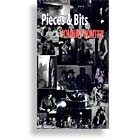
  • Johnny Winter – Pieces and Bits

    Pieces and Bits

    The long-awaited authorized video from blues/rock guitar icon Johnny Winter has finally arrived. Compiled in part by Winter’s manager, Teddy Slatus, who asked fans to send video clips, the set includes TV clips and kicks off with never-before-seen still photos by Johnny’s wife, Susan.

    The video is enhanced by commentary from Johnny recorded at different stages in his life, which accompanies rare and personal photos of him with family and friends. He speaks about hearing blues for the first time, and how it affected him. And he’s candid in talking about some of his life experiences, including getting his first tattoo.

    Written commentary offers more history, and the concert footage isn’t in chronological order. Much of it isn’t even dated, but there are a lot of fun things to watch, including (but not limited to) performances of “Rock and Roll Hootchie Coo,” “Stranger,” “Sweet Papa John,” and “Mannish Boy.”

    Another segment is dedicated to Winter’s father, and there’s also film from ca. ’69 that teams Johnny and brother, Edgar, on “Tell The Truth.” Other noteworthy musicians who make appearances include Dr. John, Tommy Shannon, Uncle John Turner, B.B. King, Bob Dylan, Steve Cropper, and G.E. Smith. And of course, Winter’s singing and guitar work shine throughout.


    This review originally appeared in VG‘s June ’01 issue.
  • Acoustic Black Widow

    Black Widow Guitars

    In the late ’60s, when Domino guitars were fading away, tube amplifiers were out of vogue. Old technology, man! Cool bands played through solidstate amps that delivered lots of clean power with none of that awful tube distortion. Cool bands played through Standels and tuck-and-rolled Kustoms. Entire bands were run through a single 350-watt Mosrite monster.

    Coming out of the late-’60s affection for transistors was the Acoustic Control Corporation, which specialized in what were, for the times, pretty advanced solidstate amps. However, in ’72, Acoustic introduced its one and only guitar and bass design, the Acoustic Black Widow, which represented a fascinating foray into the world of guitar manufacturing.

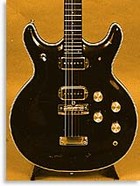
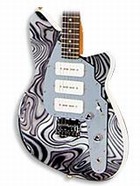
    The Acoustic Black Widows were particularly interesting because they really went in the face of trends of the times. Black Widows were likely designed in the U.S., but the majority were built in Japan (though Semie Moseley said he built the final 200). The Black Widow shown here is Japanese, and I have personally held a Black Widow guitar with slightly different features and a feel that is unmistakably Mosrite. What made these so curious was that, while most American importers and manufacturers were rushing headlong toward the copy syndrome, the Acoustic Black Widows were unique, designed with certain technological objectives in mind.

    Guitars and basses were equal double-cutaway solidbodies looking like an enlarged Les Paul Junior. Cutaway horns were flared, the wide lower bout was oval-shaped. Bodies were black-lacquered maple, with a German carve around the edges. The black-finished maple neck was bolted on, with a wide, triple-bound center-peaked headstock that was kind of a cross between a Kay and a Gibson. The logo was all lower case. The neck had a zero fret followed by two octaves of frets in a rosewood fingerboard on the guitar, 20 frets on the bass. Position markers were mini-dots. Strings passed over a fine-tune bridge to a large tailblock placed further back, designed to increase sustain. These were not instruments for the timid. The guitar had a whopping 27″ scale, while the bass logged in at 31.” The guitar had two humbuckers with chrome sides and a black plastic insert, with 12 poles, a three-way select, and two volume and two tone controls. The bass had one humbucker with eight poles in the center position, with volume and tone. Jack was front-mounted, and they came with a plush-lined hardshell case. The guitar was equipped with Grover Rotomatic tuners, while the bass came with Grover bass tuners. By ’74, the bass tuners had been changed to Schallers. Knobs were brushed aluminum. The most striking feature of the Black Widows was a red leather pad on the back of the guitar, attached with snap-on fasteners, stitched with a “black widow” pattern.

    Toward the end of the run, the Black Widow guitar got an endorsement from jazz fusion great Larry Coryell, the only big name player to align himself with these guitars.

    The Black Widows exhibit a surprising quality for their time, far in advance of comparable Japanese guitars. The pickups were fairly high-output for the time, hovering around seven ohms resistance. While they look unprepossessing, when you pick one up you feel in the presence of a solid guitar worthy of respect. The guitar and bass were still offered in the ’74 Acoustic catalog, but disappeared by ’75 as the copy era finally triumphed. Acoustic would continue to make amplifiers, but would never return to the guitar business. Acoustic Black Widows were not produced in enormous quantities, so they are relatively rare, but they turn up with some regularity if you keep your eyes open, mostly because few people pay attention to them. Expect to pay much more for a Moseley version, if the seller knows what he’s got. Most folks don’t know what they are, and they shouldn’t cost you a fortune, even though they represent an interesting punctuation point in American guitar history.


    Ca. 1973 Japanese Acoustic Black Widow Guitar.

    This article originally appeared in VG‘s July ’98 issue.

  • Acoustic Black Widow

    Black Widow Guitars

    In the late ’60s, when Domino guitars were fading away, tube amplifiers were out of vogue. Old technology, man! Cool bands played through solidstate amps that delivered lots of clean power with none of that awful tube distortion. Cool bands played through Standels and tuck-and-rolled Kustoms. Entire bands were run through a single 350-watt Mosrite monster.

    Coming out of the late-’60s affection for transistors was the Acoustic Control Corporation, which specialized in what were, for the times, pretty advanced solidstate amps. However, in ’72, Acoustic introduced its one and only guitar and bass design, the Acoustic Black Widow, which represented a fascinating foray into the world of guitar manufacturing.

    The Acoustic Black Widows were particularly interesting because they really went in the face of trends of the times. Black Widows were likely designed in the U.S., but the majority were built in Japan (though Semie Moseley said he built the final 200). The Black Widow shown here is Japanese, and I have personally held a Black Widow guitar with slightly different features and a feel that is unmistakably Mosrite. What made these so curious was that, while most American importers and manufacturers were rushing headlong toward the copy syndrome, the Acoustic Black Widows were unique, designed with certain technological objectives in mind.

    Guitars and basses were equal double-cutaway solidbodies looking like an enlarged Les Paul Junior. Cutaway horns were flared, the wide lower bout was oval-shaped. Bodies were black-lacquered maple, with a German carve around the edges. The black-finished maple neck was bolted on, with a wide, triple-bound center-peaked headstock that was kind of a cross between a Kay and a Gibson. The logo was all lower case. The neck had a zero fret followed by two octaves of frets in a rosewood fingerboard on the guitar, 20 frets on the bass. Position markers were mini-dots. Strings passed over a fine-tune bridge to a large tailblock placed further back, designed to increase sustain. These were not instruments for the timid. The guitar had a whopping 27″ scale, while the bass logged in at 31.” The guitar had two humbuckers with chrome sides and a black plastic insert, with 12 poles, a three-way select, and two volume and two tone controls. The bass had one humbucker with eight poles in the center position, with volume and tone. Jack was front-mounted, and they came with a plush-lined hardshell case. The guitar was equipped with Grover Rotomatic tuners, while the bass came with Grover bass tuners. By ’74, the bass tuners had been changed to Schallers. Knobs were brushed aluminum. The most striking feature of the Black Widows was a red leather pad on the back of the guitar, attached with snap-on fasteners, stitched with a “black widow” pattern.

    Toward the end of the run, the Black Widow guitar got an endorsement from jazz fusion great Larry Coryell, the only big name player to align himself with these guitars.

    The Black Widows exhibit a surprising quality for their time, far in advance of comparable Japanese guitars. The pickups were fairly high-output for the time, hovering around seven ohms resistance. While they look unprepossessing, when you pick one up you feel in the presence of a solid guitar worthy of respect. The guitar and bass were still offered in the ’74 Acoustic catalog, but disappeared by ’75 as the copy era finally triumphed. Acoustic would continue to make amplifiers, but would never return to the guitar business. Acoustic Black Widows were not produced in enormous quantities, so they are relatively rare, but they turn up with some regularity if you keep your eyes open, mostly because few people pay attention to them. Expect to pay much more for a Moseley version, if the seller knows what he’s got. Most folks don’t know what they are, and they shouldn’t cost you a fortune, even though they represent an interesting punctuation point in American guitar history.


    Ca. 1973 Japanese Acoustic Black Widow Guitar.

    This article originally appeared in VG‘s July ’98 issue.

  • Johnny Winter – Deluxe Edition

    Deluxe Edition

    When you think about it, Johnny Winter has had quite a career. And here, from Alligator Records, just to let you know it continues strong, is a set of cuts from his stint with Alligator. There’s raucous blues, blistering rock and roll, and even some nice acoustic blues with Johnny shining on dobro.

    There are a couple of things about Johnny that shine through when you hear him. One is his total immersion in the blues. He knows them inside out, and feels them. That feeling always comes through in his rough and ready vocals. And his playing is almost an encyclopedia of blues and blues/rock licks. Check out the rockin’ “Lights Out.” Yikes! Johnny cooks. Same thing with “Route 90.” Johnny’s nasty sound, killer single-line playing, and dazzling double-stops bounce out of your speakers and make it impossible not to dance around your room (or in my case, the car, which can be very embarrassing). Johnny’s prowess on slide shines through too on cuts like “Mojo Boogie” and “Murdering Blues.” He’s definitely one of the masters.

    Another thing I’ve always liked about Johnny is his choice of material. He always seems to pick great songs. It’s tough to top tunes like “Third Degree,” “Don’t take Advantage of Me,” and the very funny “Master Mechanic.”

    This CD is a great representation of Winter’s career for the past 15 to 20 years. If you’re a fan, you’ll love it. If you’re just being introduced, it’s a good place to start.


    This review originally appeared in VG‘s June ’01 issue.
  • Rick Nelson – Legacy

    Legacy

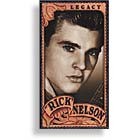
    Rick Nelson was blessed in many ways, but some of those blessings also could be a curse. I’m talking about his great looks and his luck of having a national showcase in television on the “Ozzie and Harriet Show.” Those two things, unfortunatly, made some folks doubt his musical prowess. With this wonderful four-CD set, Capital tries to set the record straight.

    Everything you’d expect is here. In fact, there’s 100 cuts, 54 of which hit the charts. Plus there’s a lot of unreleased tracks, live stuff, and alternate versions of a few songs. There’s a 48-page booklet that contains some great essays and more information than you can shake a stick at on the tracks that are contained on the CDs. Even the sleeves in each individual CD have info on what Rick recorded and when during different phases of his career.

    Let’s talk about the music. There’s no denying the young Nelson fell under the influence of Sun Records and Elvis. Disc one has great cuts like “Be Bop Baby,” “If You Can’t Rock Me,” and so many rockin’ cuts it’s hard to pick just one to single them out. And talk about guitar playing. By the middle of the CD, James Burton has been installed as Rick’s lead guitarist. And he carves out a huge history of rock and roll on too many cuts to mention. What’s cool is that Burton gets his own page in the liner notes booklet – a very nice appreciation, written by Bob Hyde. By the way, Burton isn’t the only guitarist of note to record with Nelson. How about the likes of Joe Maphis, Barney Kessel, and in later days, the late Bobby Neal, who died in the plane crash that claimed Nelson.

    Back to the music. There are a few cuts where it’s obvious daddy Ozzie picked the tune. But none of them are awful. Just boring. It’s when Rick tears it up that things get going again. By disc three, when his interests turn to country and country rock, things get really interesting. He’s doing stuff like “Louisiana Man” several years before the Byrds hit the country trail, and many years before the Eagles. He was trailblazer. His cover of Dylan’s “She Belongs To Me” was one of my favorite songs as a 12-year-old. Disc three also has his masterpiece from the later years, and one that summed up his philosophy – “Garden Party.” By the time we hit disc four, Rick can’t buy a hit, but the disc has some of his best stuff. Blazing country rock, killer ballads, and rockabilly heaven highlight the effort.

    His vocals were always on the money, his band was tight as could be, and you could tell he still loved the music. His death in that New Year’s Eve plane crash in 1985 took away one of the true pioneers of rock. And by the way, no, drug use in the plane did not contribute to the crash, the NTSB made that official years ago, but for some reason that rumor just hangs on.

    Anyway, check this one out. It’s finally a great package from one of the pioneers of rock who continued to grow long after his fans stopped progressing.


    This review originally appeared in VG‘s May ’01 issue.